
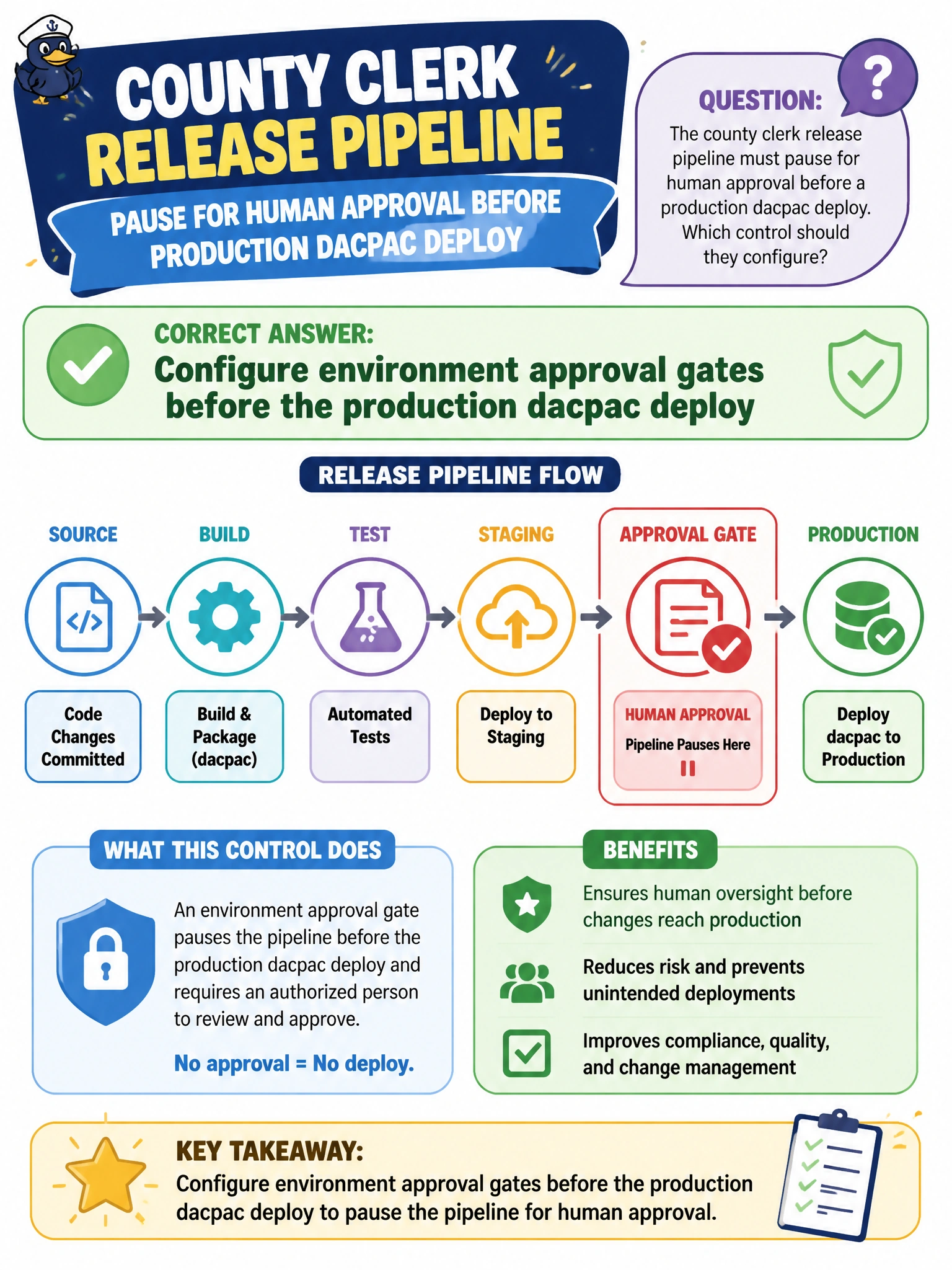
The county clerk release pipeline must pause for human approval before a production dacpac deploy. Which control should they configure?
Select an answer to reveal the explanation.
Short Explanation
Environment approval gates are the clerk’s ‘two keys to open the vault’ step—pipeline builds the dacpac, a human still turns the final key for prod.
Full Explanation
The county clerk release pipeline must pause for human approval before a production dacpac deploy by configuring environment approval gates on the production environment. In GitHub Environments, Azure DevOps environments, or similar, required reviewers must approve before the deploy job runs—implementing separation of duties so a successful build does not automatically push clerk schema changes to production. Auto-deploying to production on every commit to any feature branch eliminates stability and review and can publish unfinished clerk work. Granting the build agent sysadmin and skipping release checks widens blast radius and removes safeguards. Publishing dacpacs to production from developers’ laptops after hours bypasses the pipeline’s audit trail and approval controls entirely. Exam caveat: environment gates protect deploy jobs; they do not replace PR review or CI tests. Approvers should be distinct from the requester when policies require it. Ensure the gate applies specifically to the production environment, not only to staging, and that bypass privileges are tightly limited for true emergencies with after-action import to source control. Operational check: define a production environment with required approvers; point the dacpac deploy job at that environment; run a release and confirm it waits for approval; approve as an authorized clerk IT owner and verify deploy proceeds; deny a test release and confirm production was not changed.