
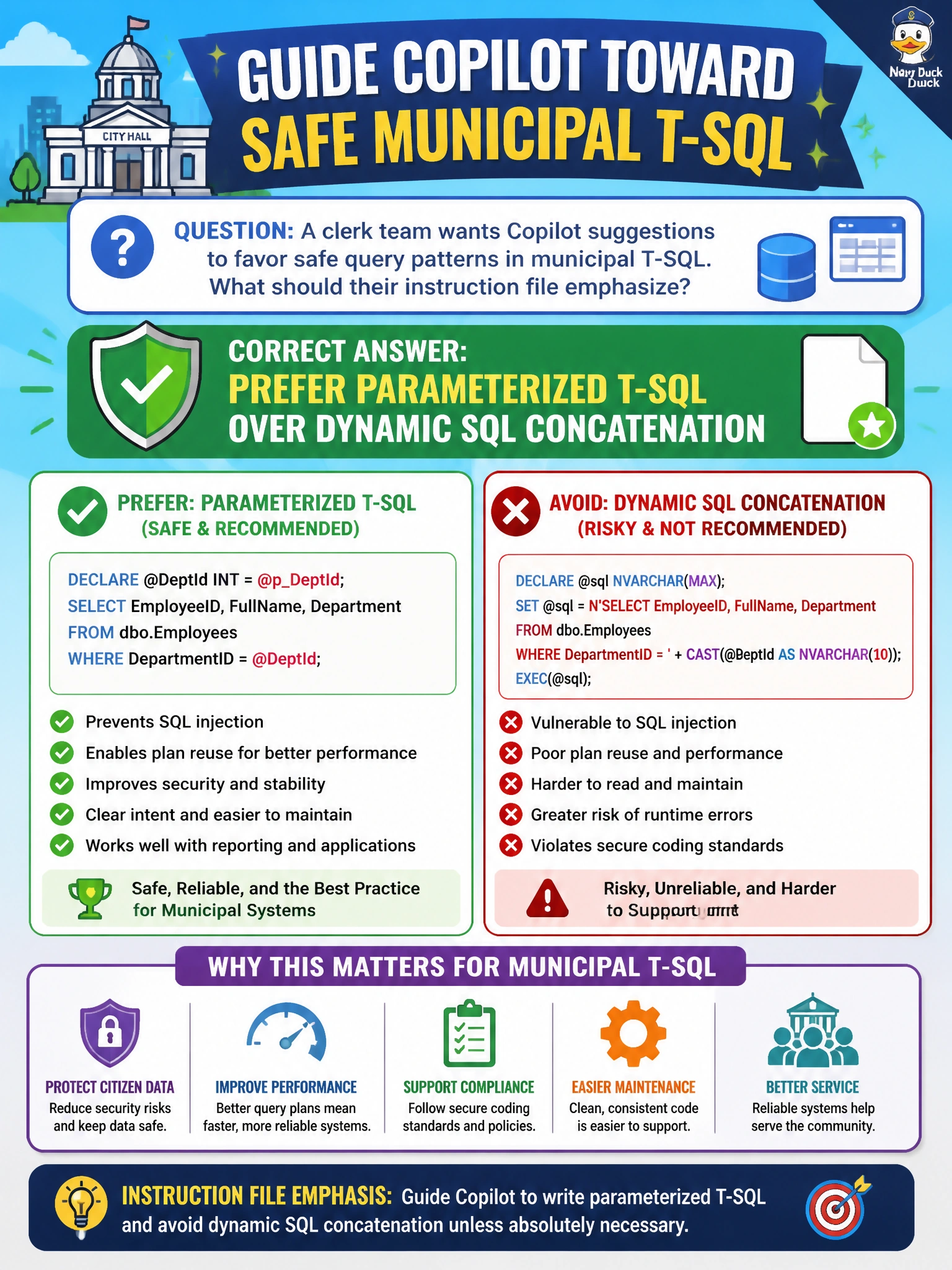
A clerk team wants Copilot suggestions to favor safe query patterns in municipal T-SQL. What should their instruction file emphasize?
Select an answer to reveal the explanation.
Short Explanation
Parameterized SQL is like using a locked form instead of scribbling raw text into a warrant template—instruction files should tell Copilot to prefer that safer pattern.
Full Explanation
Preferring parameterized T-SQL over dynamic SQL concatenation is what the clerk team’s Copilot instruction file should emphasize so suggestions favor safe query patterns in municipal T-SQL. Parameterization reduces SQL injection risk from concatenated user or clerk input and is a core secure-coding norm instruction files can encode for civic apps.
Embedding SQL authentication passwords in every procedure fails by concept because it spreads secrets into code and suggestions. Disabling TRY/CATCH in all clerk procedures fails because it removes structured error handling needed for resilient municipal ops. Preferring SELECT * into production tables from anonymous internet sources fails because it introduces untrusted data and overly broad projections into production—antithetical to secure civic practice.
Exam caveat: Secure Copilot instructions promote parameterization, least privilege, and safe data sources—not password embedding, disabled error handling, or anonymous internet loads into production.
Operational check: Add the parameterization preference to the instruction file, request Copilot help on a clerk filter query, confirm suggestions use parameters rather than string concatenation, and reject PRs that reintroduce dynamic SQL built from unchecked input.