
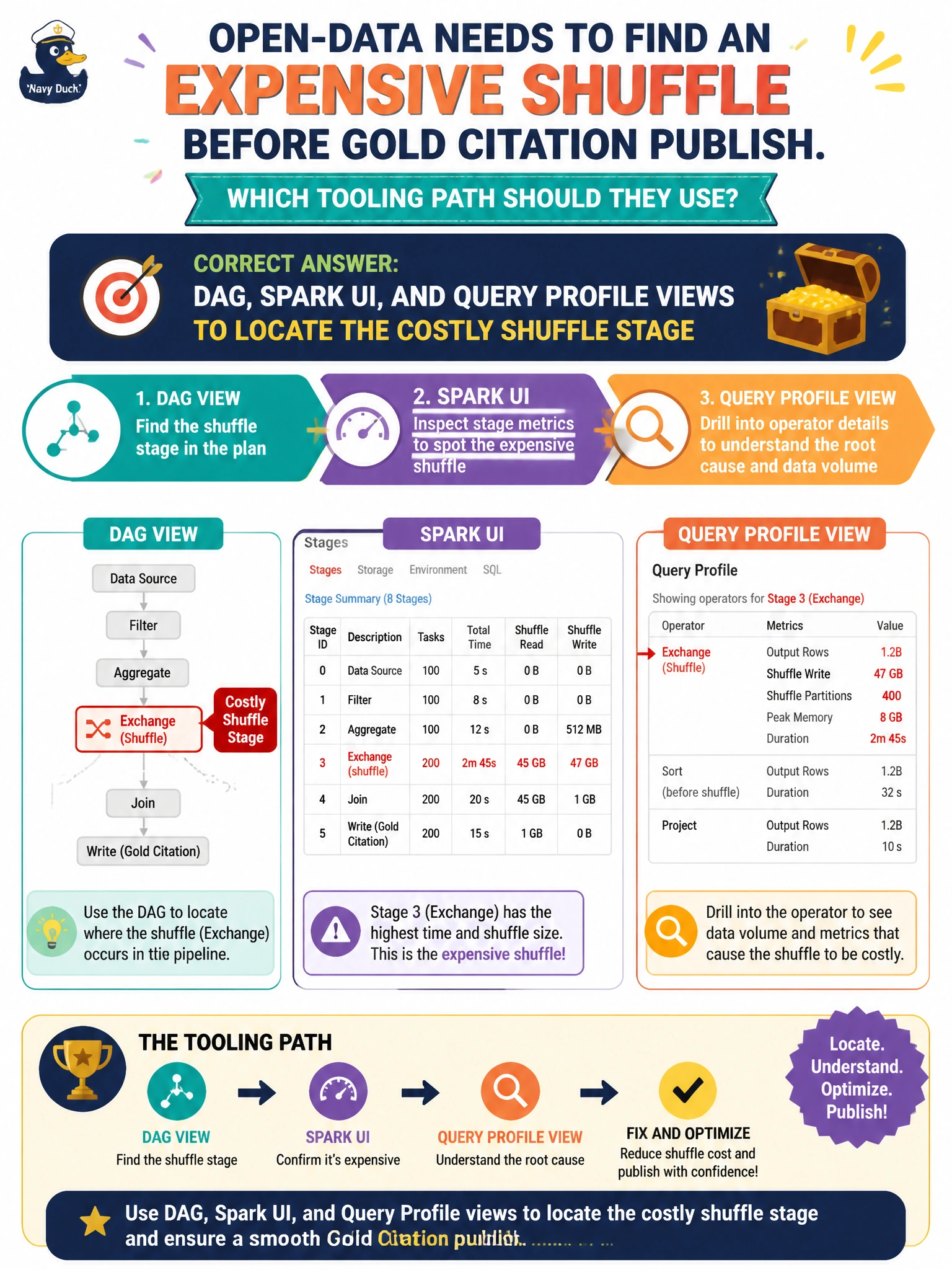
Open-data needs to find an expensive shuffle before gold citation publish. Which tooling path should they use?
Select an answer to reveal the explanation.
Short Explanation
To catch the expensive shuffle before citations go gold, open the DAG/Spark UI/query-profile map. You'll see cluster logs and driver stdout won't pinpoint the shuffle stage since they show cluster output, not shuffle sizes. Table history and lineage graphs won't either since they show versions and sharing, not shuffle bytes.
Full Explanation
Open-data teams hunting an expensive shuffle before gold citation publish should use DAG, Spark UI, and query profile views to locate the costly shuffle stage. Those tools expose stage boundaries, shuffle read/write sizes, and physical-plan operators so engineers can see which join or aggregation dominates publish cost for municipal citation datasets. Relying only on cluster event logs and driver stdout to locate the costly shuffle stage fails because cluster lifecycle output reveals nothing about stage-level shuffle read/write or physical-plan operators. Table history and time travel queries to locate the costly shuffle stage fail because version audit trails do not identify which operator shuffles or whether broadcast versus sort-merge choices are appropriate. Unity Catalog lineage graphs and sharing logs to locate the costly shuffle stage fail because lineage and sharing telemetry show dataset dependencies and consumption, not execution plans or shuffle bytes transferred between executors. Exam caveat: DP-750 performance investigation centers on DAG, Spark UI, and query profile—not cluster event logs and driver stdout, table history and time travel, or lineage graphs and sharing logs to locate the shuffle stage. Operational check: open the citation publish job’s DAG and Spark UI, use the query profile to pinpoint the shuffle-heavy stage, then apply a targeted fix (broadcast, partition redesign, or filter pushdown) and re-profile before gold publish.
Prefer to study offline? Printable PDF study book + test engine ($7.50, unofficial). These questions stay free here.