
Finance sees Spark UI spill-to-disk during year-end payment reconciliations. What does that signal, and what should they address?
Select an answer to reveal the explanation.
Short Explanation
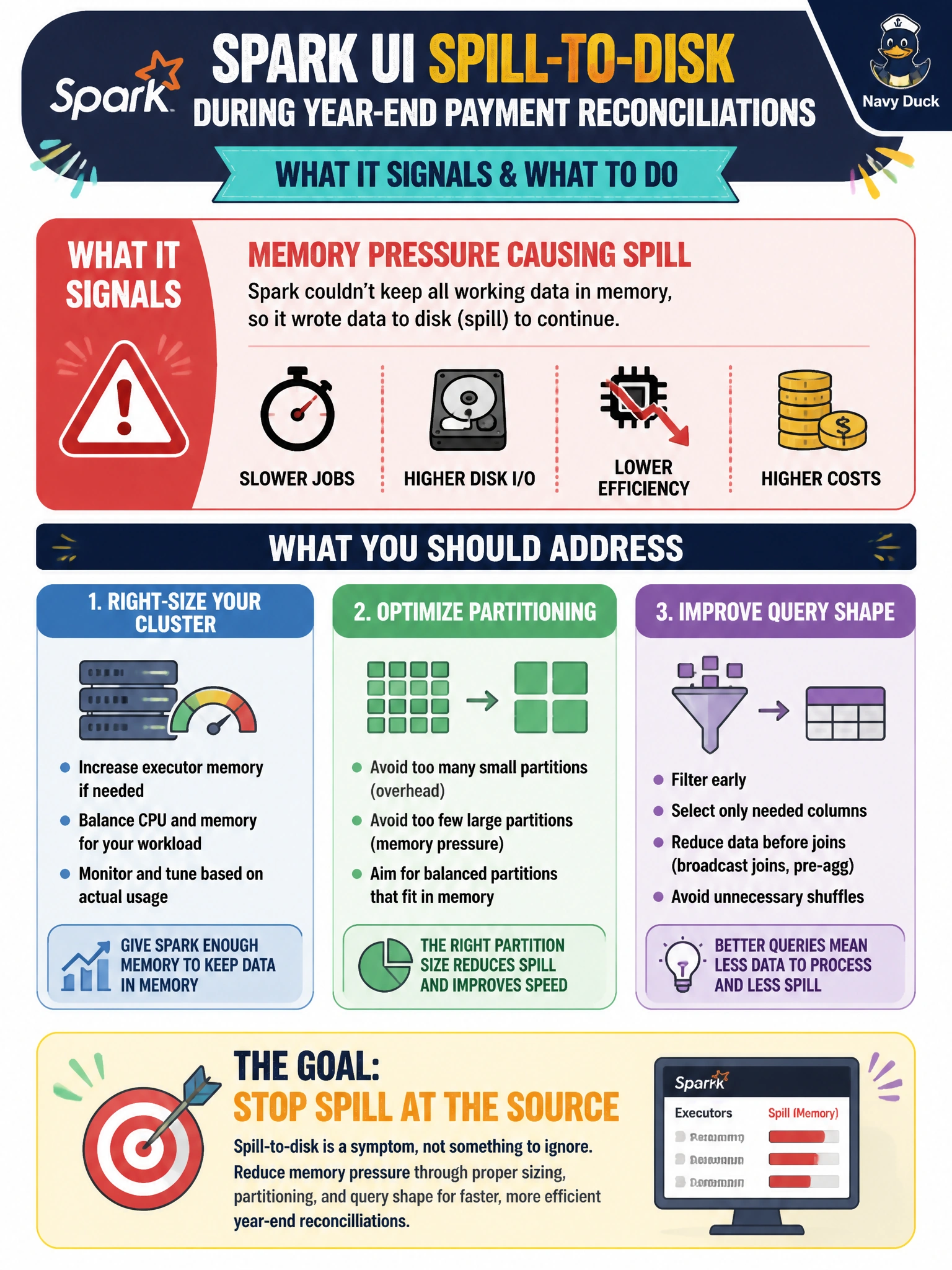
Spill-to-disk means you've run out of RAM and Spark is writing to disk. Fix the memory pressure, and don't expect OPTIMIZE with Z-ORDER on payment date to make the spill go away.
Full Explanation
When Finance sees Spark UI spill-to-disk during year-end payment reconciliations, that signal means memory pressure forced Spark to write shuffle or execution data to disk; teams should reduce memory pressure through sizing, partitioning, or query-shape changes rather than ignoring spill. Spill often lengthens civic reconciliation SLAs because disk I/O is far slower than in-memory processing and can cascade into longer stages. Attributing spill to large payment joins and aggregations and treating OPTIMIZE with Z-ORDER on payment date as the remedy fails because file compaction helps scan performance but does not reduce executor memory pressure or stop shuffle/execution spill during reconciliation. Assuming the problem is executor overhead from year-end volume and that raising driver memory while collecting reconciliation data to the driver for Python processing will help fails because executor spill is not fixed by driver memory, and pulling data to the driver can overwhelm the driver and bypass distributed processing. Blaming repeated disk reads from cache misses on payment tables and prescribing Delta cache pinning plus large broadcasts of fact tables fails because caching improves read speed but does not relieve the memory pressure that causes spill, and large broadcasts can add to executor memory strain. Exam caveat: DP-750 expects candidates to read spill as a memory-pressure symptom and remediate compute or query design accordingly. Operational check: quantify spill in Spark UI for the reconciliation job, increase memory or reduce per-task working set via partitions or query changes, and confirm spill volume and duration drop on the next year-end run.
Prefer to study offline? Printable PDF study book + test engine ($7.50, unofficial). These questions stay free here.