
Parks needs always-on incremental reservation facts plus a rare annual archive purge. How should pipeline styles be chosen?
Select an answer to reveal the explanation.
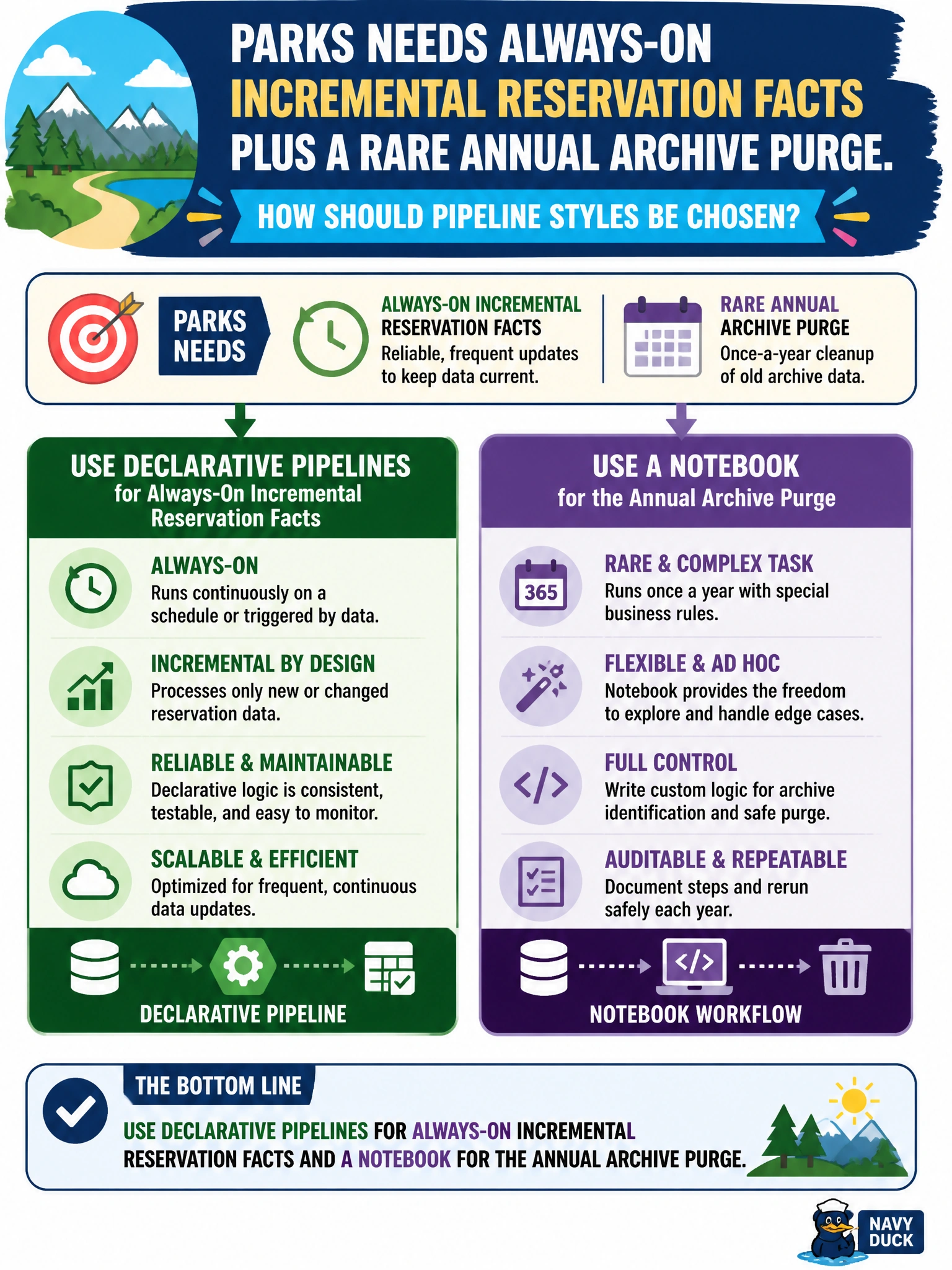
Short Explanation
Reservations drip all year through the declarative hose; the annual archive purge is a once-a-year notebook mop—different tools, same building.
Full Explanation
Recurring incremental civic facts fit declarative pipelines; rare annual tasks often fit notebooks or one-off jobs. Parks reservation facts that drip continuously should use declarative incremental design with expectations, while a rare annual archive purge can be a controlled notebook or scheduled job outside the always-on stream. Choosing styles by cadence and risk keeps the continuous path simple and puts destructive annual work behind explicit review.
Forcing the annual purge into the same always-on declarative stream as every reservation micro-batch fails by concept: a rare destructive operation does not belong on the critical incremental path and raises accidental-purge risk. Running only notebooks for continuous incremental facts with no declarative incremental design leaves always-on loads on the more brittle tool. Skipping both styles and purging production tables from a laptop SQL client ad hoc abandons auditability, scheduling, and peer review.
Exam caveat: even notebook purges should run as governed jobs with dry-run counts, backups/time travel checks, and change tickets—not as interactive deletes on production. Operational check: confirm reservation micro-batches flow through the declarative pipeline daily; execute the annual purge notebook/job in a lower environment with row-count dry runs; verify time travel or backups before production purge; keep purge out of the incremental pipeline graph.
Prefer to study offline? Printable PDF study book + test engine ($7.50, unofficial). These questions stay free here.