
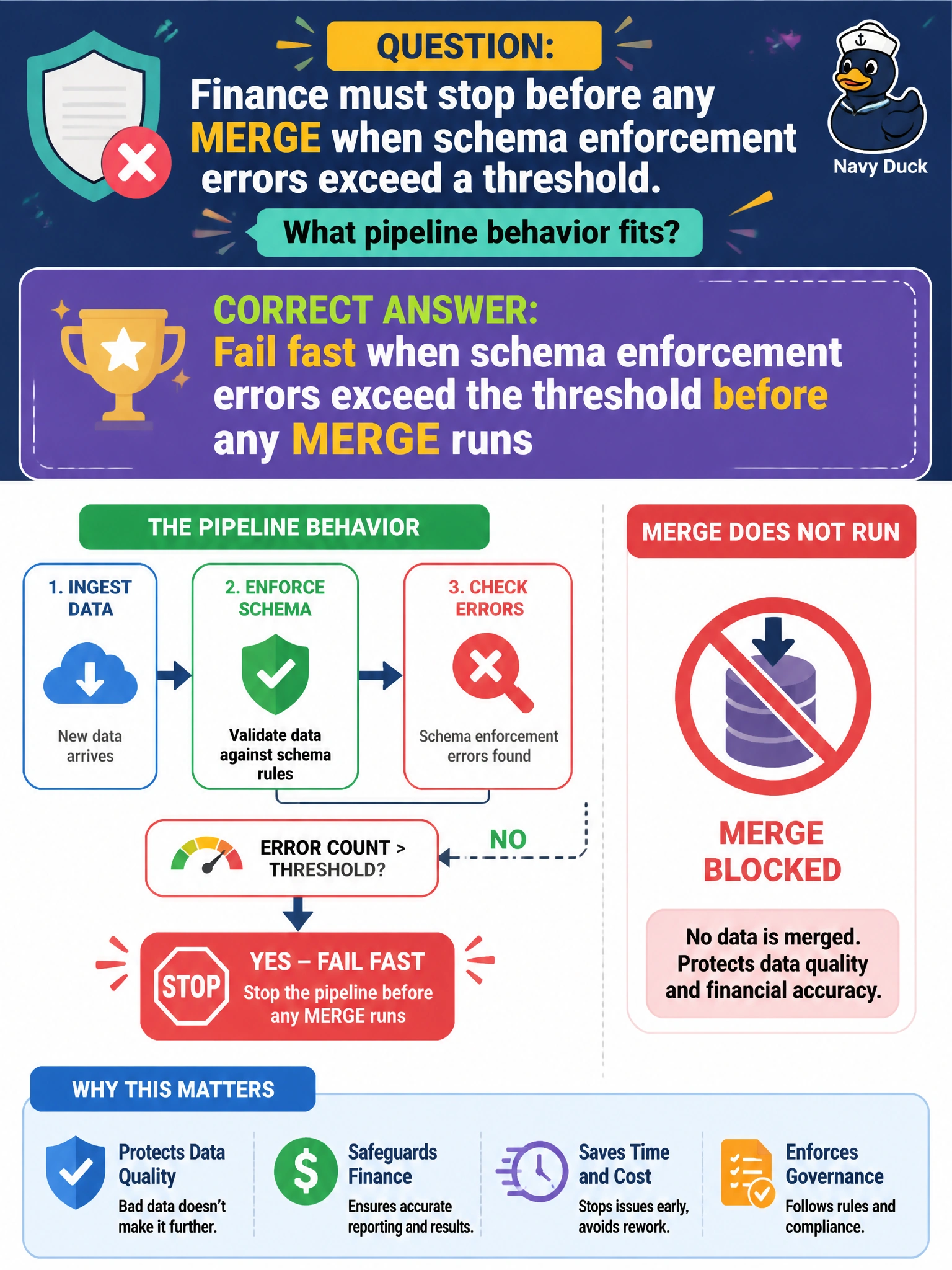
Finance must stop before any MERGE when schema enforcement errors exceed a threshold. What pipeline behavior fits?
Select an answer to reveal the explanation.
Short Explanation
If the ledger stamp pad is the wrong shape, you stop before you stamp a hundred checks—fail fast before MERGE. You've got to check enforcement errors before anything runs, so you won't be fooled by inference warnings or freshness delays, and you won't wait until you're mid-MERGE to stop.
Full Explanation
Fail-fast design protects unsafe municipal loads by stopping when schema enforcement errors exceed a threshold before MERGE. Finance pipelines that MERGE into governed tables should halt when schema violations cross policy limits so incorrect shapes never land in gold ledgers. Checking enforcement error counts before MERGE—and failing the run—keeps auditors and operators from reconciling a partially merged bad schema after the fact.
Failing fast when schema inference warnings exceed the threshold before any MERGE runs fails by signal: inference warnings flag uncertain auto-detected types, not hard enforcement violations, so it can stop for guesses while letting true schema violations pass unchecked. Failing fast when schema enforcement errors exceed the threshold during MERGE execution fails by timing: it starts MERGE before stopping, so bad-schema rows can already be partially merged into gold ledgers instead of halting before any MERGE runs. Failing fast when data freshness delays exceed the threshold before any MERGE runs fails by signal: freshness delays measure lateness, not schema shape, so it can block timely batches for being late while allowing schema-violating rows to proceed to MERGE.
Exam caveat: thresholding allows rare anomalies versus hard fail-on-first-error; set thresholds with finance risk owners, not only with pipeline authors. Operational check: introduce schema-violating rows above the threshold in staging, confirm the pipeline fails before MERGE, verify gold ledgers are unchanged, then run a clean batch and confirm MERGE proceeds with enforcement metrics within policy limits.
Prefer to study offline? Printable PDF study book + test engine ($7.50, unofficial). These questions stay free here.