
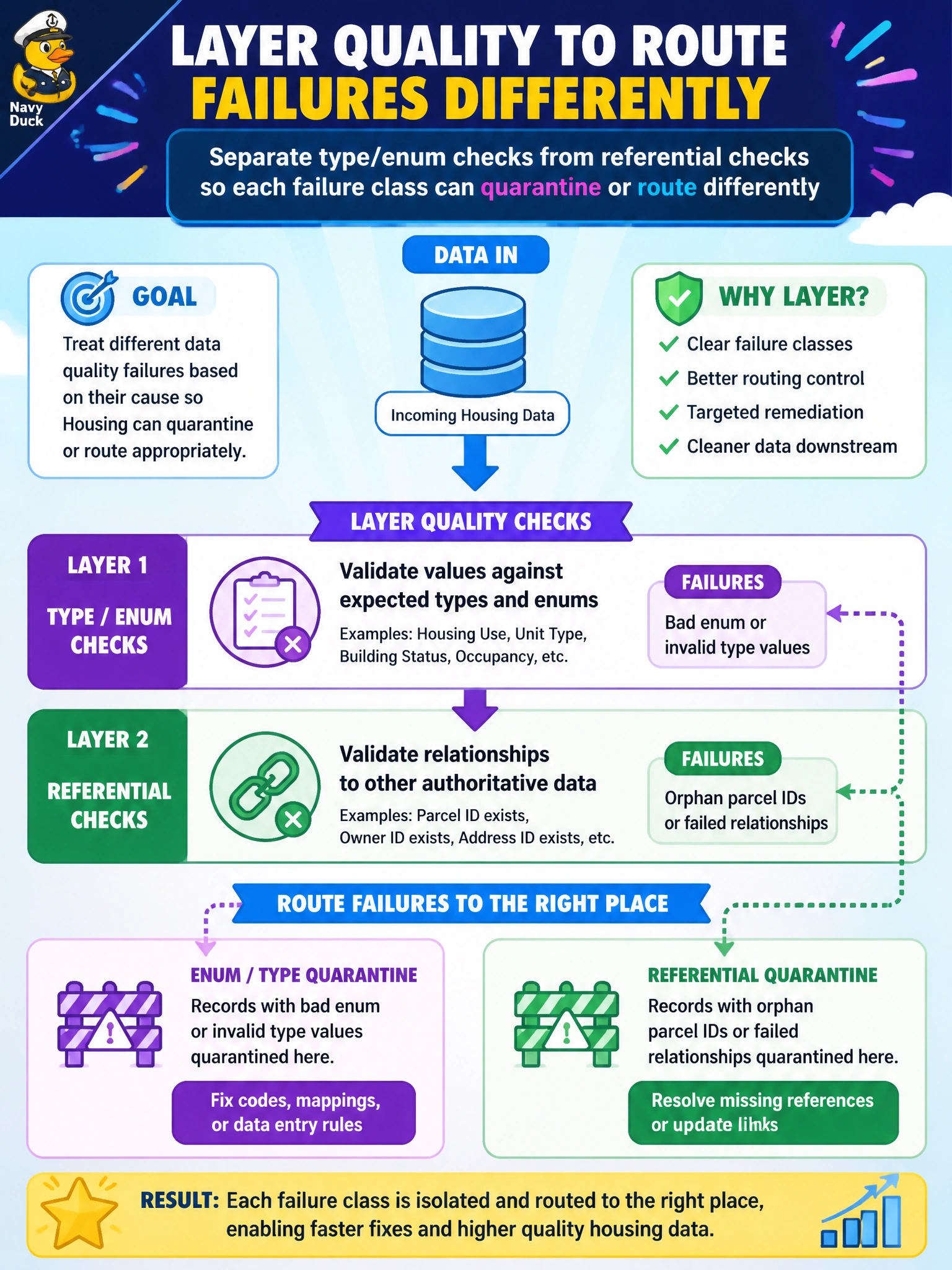
Housing wants bad enum values quarantined differently from orphan parcel IDs that fail referential checks. How should quality be layered?
Select an answer to reveal the explanation.
Short Explanation
Enums and orphan parcels are different kinds of bad mail—sort the wrong stamp into one bin and the unknown address into another. You'll let bad enums slip through if you just check for nulls and defaults, since a filled-in but illegal code looks fine to that check.
Full Explanation
Layering quality constraint types improves operability for municipal housing pipelines. Bad enum values (wrong status codes, illegal occupancy classes) are type/domain failures; orphan parcel IDs that fail referential checks are relationship failures. Separating enum/type checks from referential checks lets each failure class quarantine or route differently—for example, enum defects to a coding remediation queue and orphan parcels to a GIS/assessor match queue—rather than separating null/default checks from referential checks so each failure class can quarantine or route differently, which leaves populated but illegal enum values uncaught because they pass completeness checks.
Separating null/default checks from referential checks so each failure class can quarantine or route differently misses the requested failure class: it tests for completeness instead of domain validity, so wrong status codes or illegal occupancy classes slip through and never reach a distinct enum quarantine route. Separating type/enum checks from aggregation checks so each failure class can quarantine or route differently fails by check type: aggregation checks validate rollups not relationships, so orphan parcel IDs never trigger a referential quarantine and leak into housing metrics. Separating type/enum checks from referential checks so each failure class can cleanse or standardize differently fails by action: illegal enums and orphan parcels cannot be standardized into validity, they must be quarantined or routed to coding versus GIS remediation queues, otherwise cleansing overwrites evidence instead of isolating it.
Exam caveat: referential checks need a trusted reference set (parcel master); if that master is stale, orphans may be false positives—pair referential expectations with reference freshness monitoring. Operational check: inject an illegal enum with a valid parcel and a valid enum with an orphan parcel, confirm they land in distinct quarantine/routes, verify clean rows reach silver/gold, and review separate expectation metrics for type versus referential classes in the housing pipeline UI.
Prefer to study offline? Printable PDF study book + test engine ($7.50, unofficial). These questions stay free here.