
Transit reliability gold needs mean delay by route after removing test bus IDs. Which transform sequence fits?
Select an answer to reveal the explanation.
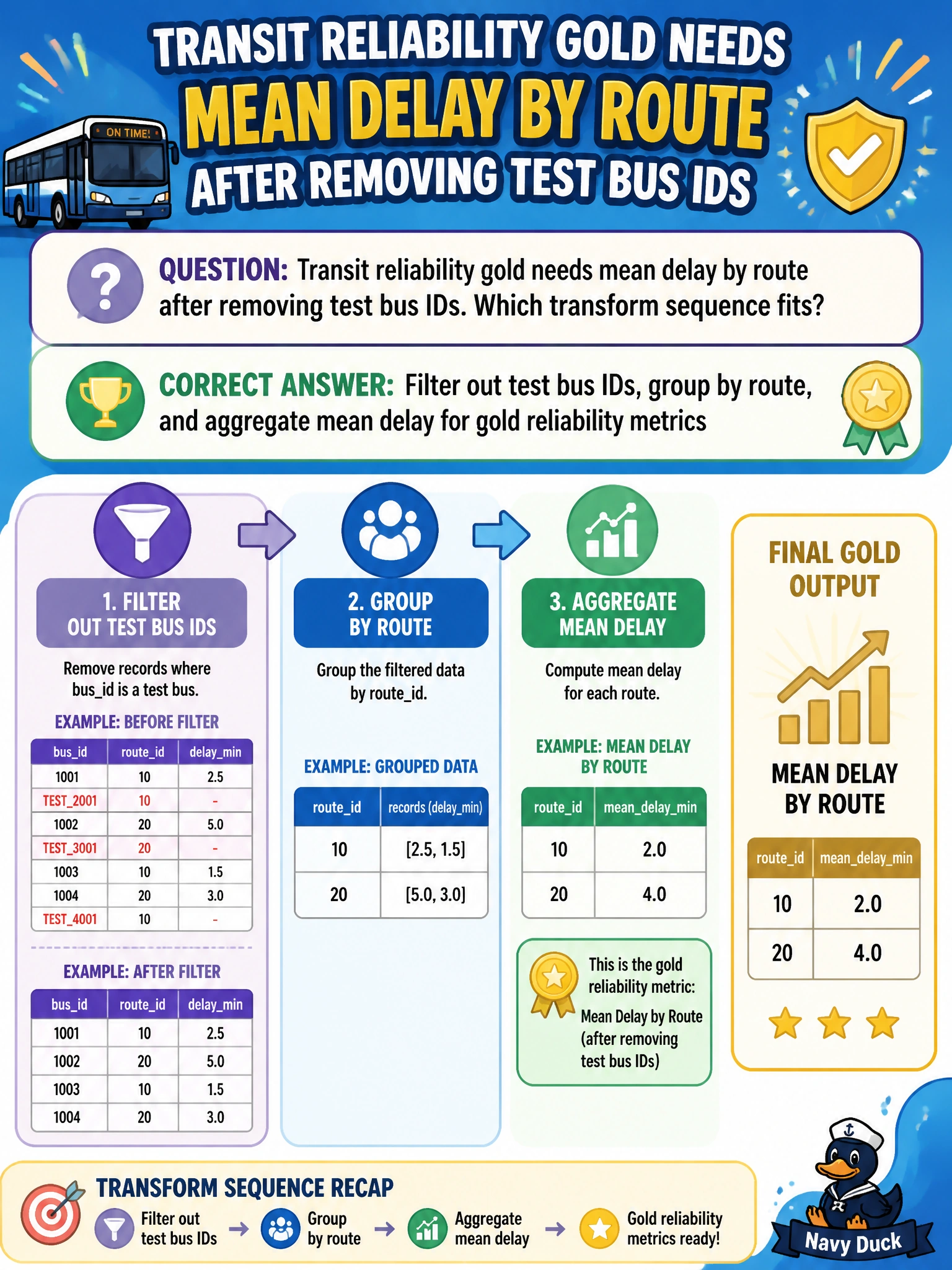
Short Explanation
Reliability gold is filter the fake buses, group by route, then average the delays—same as tossing practice laps before league stats.
Full Explanation
Transit reliability gold that needs mean delay by route should filter out test bus IDs first, then group by route and aggregate mean delay. Removing non-production vehicles prevents synthetic delays from skewing on-time performance. Grouping at route grain matches how transit agencies publish reliability, and mean delay is a standard KPI once the population is clean.
Aggregating route means before removing test bus IDs fails by concept: test buses still skew the averages before removal, and filtering afterward cannot undo that contamination. Grouping by service day instead of route abandons the required route grain, yielding day-level averages rather than mean delay by route. Grouping by route and bus produces a separate average per bus rather than a single route-level mean, so it fails to deliver mean delay by route.
Exam caveat: Transform order matters—filter bad actors, then group, then aggregate. Exam distractors often reorder filter and aggregate, group at the wrong grain, or split by bus instead of route.
Operational check: Label known test vehicle_ids, run the filter-group-mean pipeline, and confirm those IDs contribute zero rows to gold. Compare route-level mean delay to a hand-calculated sample for one route. Prove that filtering late, grouping by day, or splitting by bus diverges from operations' accepted reliability report.
Prefer to study offline? Printable PDF study book + test engine ($7.50, unofficial). These questions stay free here.