
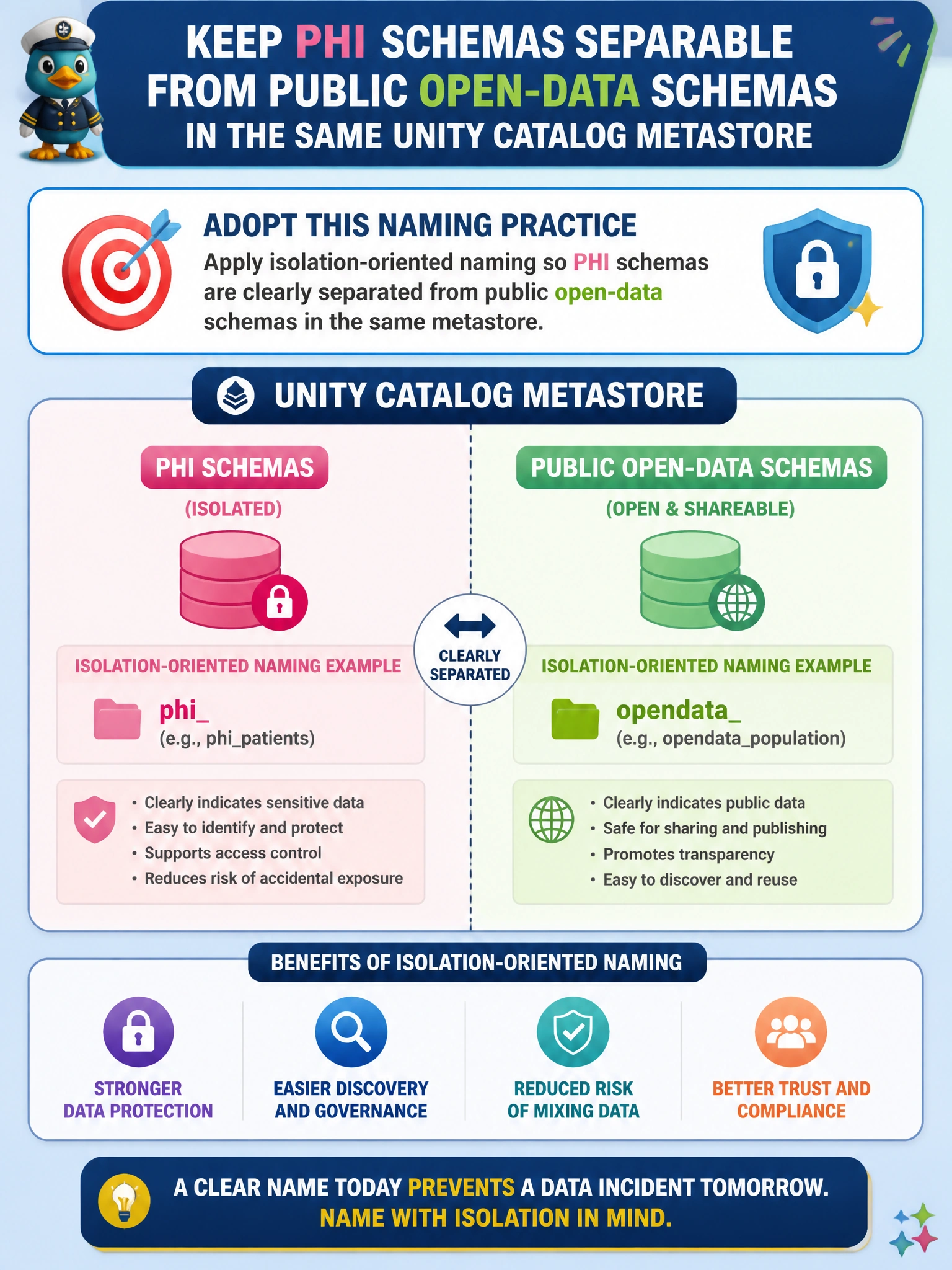
A health department must keep PHI schemas separable from public open-data schemas inside the same Unity Catalog metastore. What naming practice should they adopt?
Select an answer to reveal the explanation.
Short Explanation
Naming is the door sign on the clinic wing versus the lobby brochure rack—PHI schemas and open-data schemas must not share confusing labels. Clear isolation naming keeps sensitive civic data from blending into the public stack.
Full Explanation
Inside one Unity Catalog metastore, the health department should use isolation-oriented naming so PHI schemas are unmistakably separated from public open-data schemas. Clear names (and often separate catalogs or schema prefixes) act as door signs: clinic PHI wings versus the lobby brochure rack of open data. That reduces accidental grants, mistaken Genie/discovery hits, and human error when stewards assign privileges across mixed municipal workloads sharing a metastore.
Mixing PHI and open-data tables in identically named schemas and relying on tribal knowledge is an operational failure waiting to happen. Publishing PHI clinic tables to an anonymous open-data portal is a compliance violation, not a discovery strategy. Parking everything under a schema named temp without owners or descriptions erases stewardship and isolation signals.
Exam caveat: naming alone is not access control—pair isolation naming with UC privileges, possibly separate catalogs, and column controls for residual PII. Metastore sharing does not imply data sharing; securable boundaries and grants still apply. Operational check: inventory health schemas, rename or relocate so PHI versus open-data intent is obvious, attach owners/comments, verify open-data identities lack SELECT on PHI schemas, and spot-check that portal jobs only touch the public-named schemas.
Prefer to study offline? Printable PDF study book + test engine ($7.50, unofficial). These questions stay free here.