
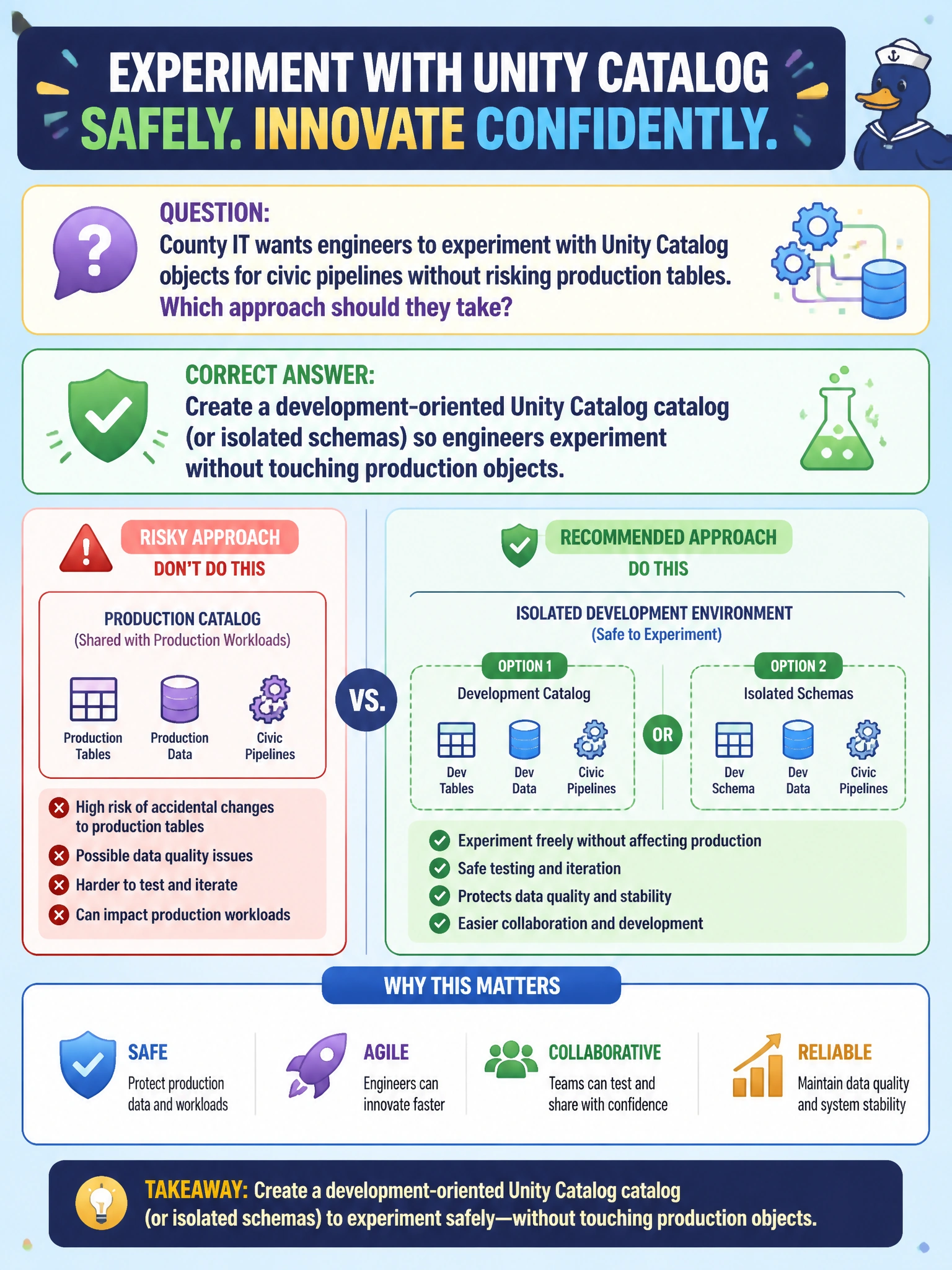
County IT wants engineers to experiment with Unity Catalog objects for civic pipelines without risking production tables. Which approach should they take?
Select an answer to reveal the explanation.
Short Explanation
A dev catalog is the city's sandboxed workshop next to the live museum—engineers can try new shelves without rearranging the public exhibits. Production MODIFY for everyone is how exhibits get broken.
Full Explanation
Engineers experimenting with civic pipelines need an isolated Unity Catalog catalog (or clearly isolated non-production schemas) so trials cannot alter production tables. A development-oriented catalog is the sandboxed workshop beside the live museum: CREATE/DROP and schema experiments stay off production gold and bronze that feed public services. County IT should point non-prod workspaces or jobs at that catalog and promote objects through controlled pipelines rather than live edits on production securables.
Granting every engineer unrestricted MODIFY on production gold invites accidental corruption of citizen-facing metrics. Disabling Unity Catalog in non-prod and falling back to classic Hive trains the wrong habits and creates a governance gap. Copying production PII into personal DBFS folders with public read ACLs creates a serious privacy and compliance incident under the guise of experimentation.
Exam caveat: isolation can be catalog-level or schema-level; the key is separate securables and grants, not merely a different notebook folder. Dev catalogs may still contain synthetic or masked data—avoid uncontrolled clones of production PII. Operational check: create a dev catalog, grant engineers privileges only there, confirm production gold rejects their MODIFY, run a trial pipeline in dev, and document the promotion path into production schemas.
Prefer to study offline? Printable PDF study book + test engine ($7.50, unofficial). These questions stay free here.