
A city lakehouse must keep permit silver tables from colliding across stages. How should Unity Catalog objects be named?
Select an answer to reveal the explanation.
Short Explanation
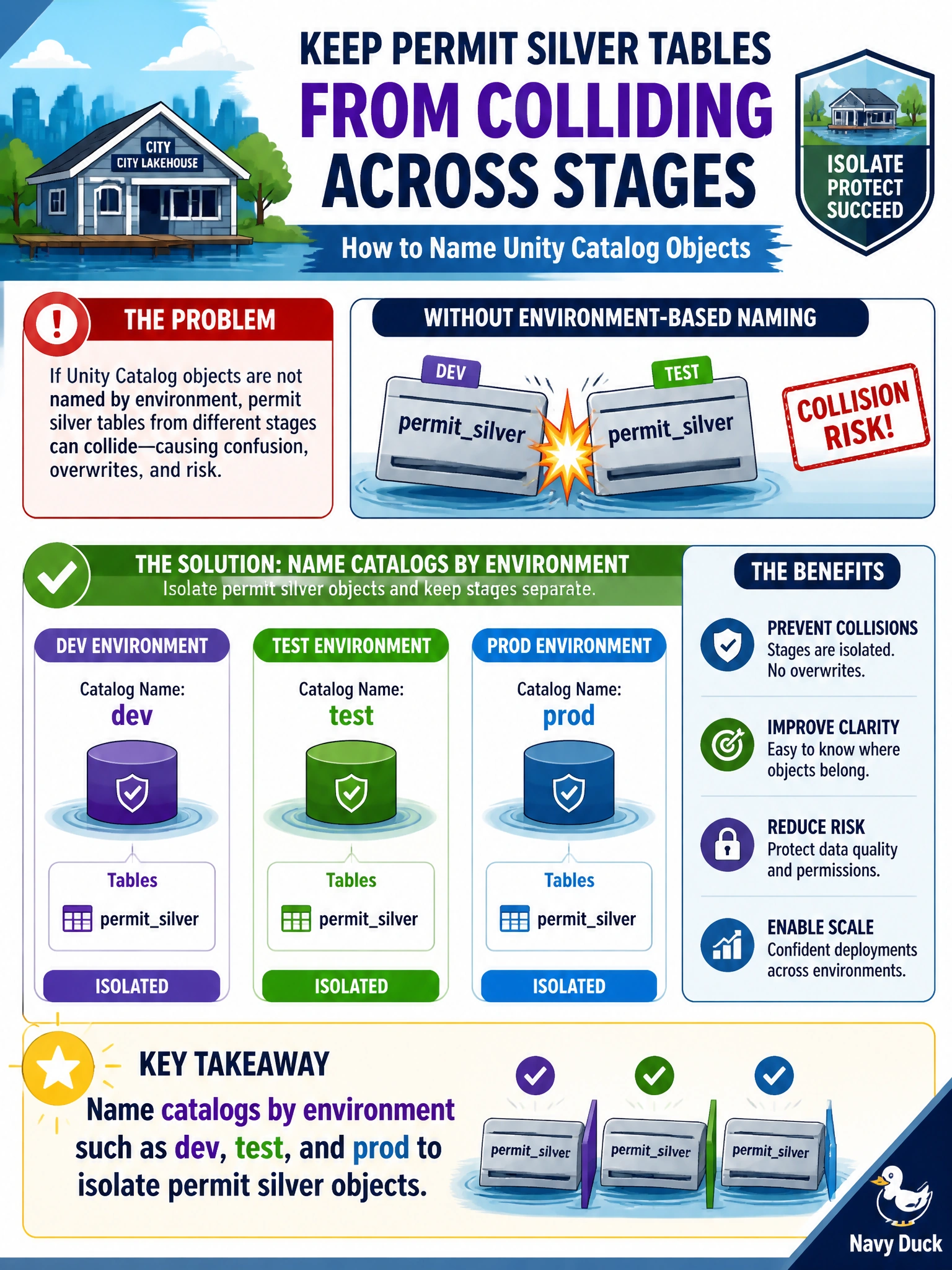
Environment-named catalogs are labeled shelves—dev, test, prod—so permit silver tables don’t crash into each other. You'll still mix stages if you sort by project or push the environment down to schemas or tables, since dev and prod permits would share the same namespace and you're one slip away from touching production.
Full Explanation
A city lakehouse keeping permit silver tables from colliding across stages should name Unity Catalog catalogs by environment—such as dev, test, and prod—to isolate permit silver objects. Environment-scoped catalogs provide clear top-level boundaries so identical schema/table names can exist safely per stage without overwriting production civic datasets during development promotions.
Naming schemas by environment such as dev, test, and prod to isolate permit silver objects keeps all stages inside one shared catalog, so broad catalog-level grants still span dev and prod and a single mistaken catalog reference can expose production civic datasets. Naming catalogs by project such as permits, zoning, and safety isolates civic domains rather than stages, so dev, test, and prod permit silver tables would still share the same permits catalog namespace and collide during promotion. Naming tables by environment such as dev, test, and prod to isolate permit silver objects leaves every stage in the same schema namespace and relies on suffix discipline—one missed suffix is all it takes for a dev query to land on a table meant for prod.
Exam caveat: UC three-level namespace is catalog.schema.table—environment usually belongs at catalog (or sometimes schema) consistently; the exam favors environment catalogs when stems emphasize isolating stages. Medallion layers (bronze/silver/gold) are orthogonal—you can still have prod.silver.permits separate from dev.silver.permits. Do not confuse catalogs with metastores (typically one metastore per region/account boundary).
Operational check: create dev/test/prod catalogs (or city naming equivalents), place permit silver tables under matching schemas, grant stage-appropriate principals, and block prod writes from developer service principals via UC privileges.
Prefer to study offline? Printable PDF study book + test engine ($7.50, unofficial). These questions stay free here.