
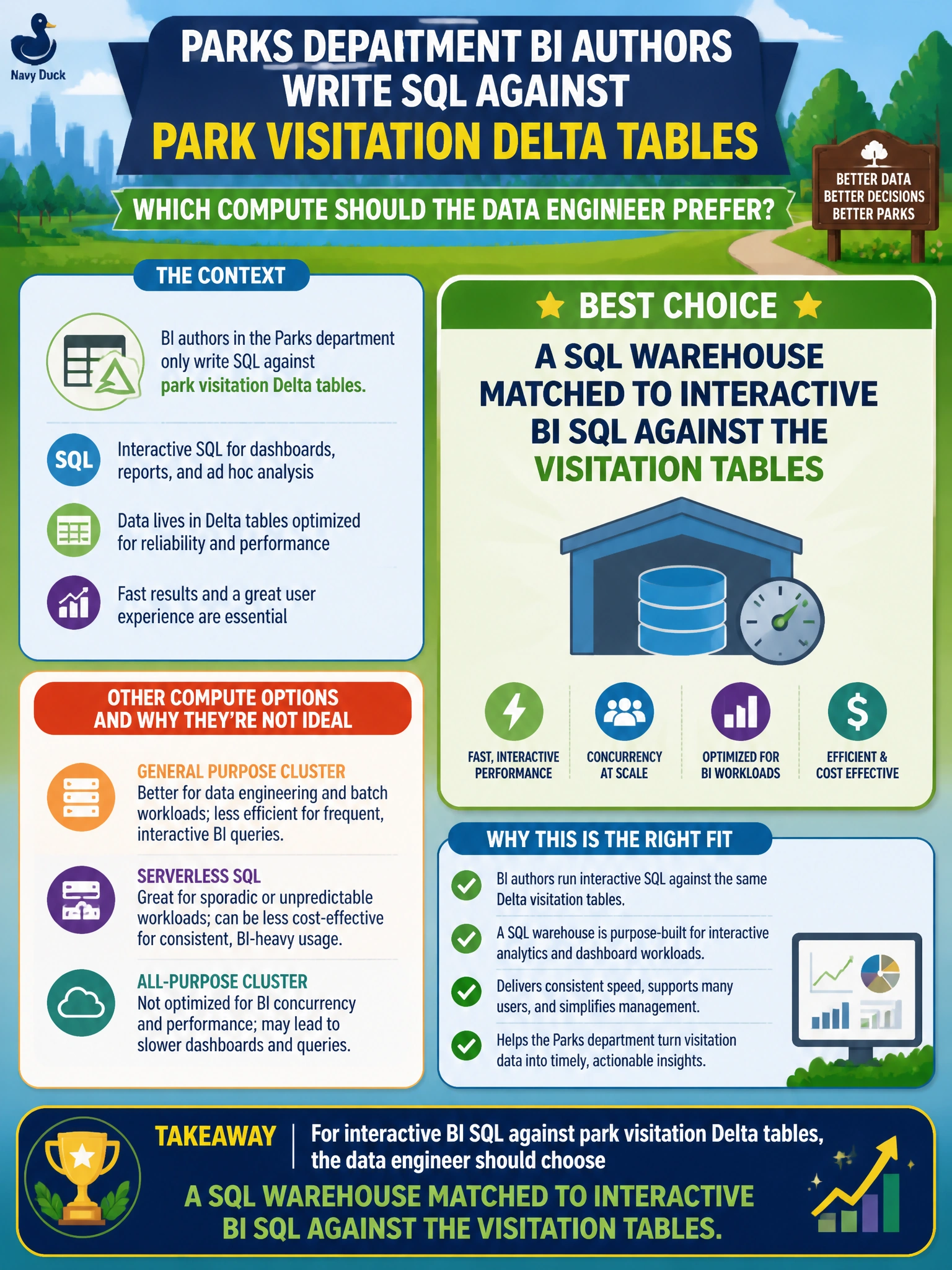
Parks department BI authors only write SQL against park visitation Delta tables. Which compute should the data engineer prefer?
Select an answer to reveal the explanation.
Short Explanation
If you’re serving only BI authors living in SQL, give them a SQL warehouse—the reading room built for that traffic—not an all-purpose cluster tuned for interactive BI SQL, a jobs cluster scheduled for automated BI SQL, or a serverless notebook compute tuned for interactive BI SQL, since you’ll miss the warehouse’s managed concurrency and always-on endpoint. Match compute to how parks visitation gets queried.
Full Explanation
When parks department BI authors only write SQL against park visitation Delta tables, the data engineer should prefer a SQL warehouse matched to interactive BI SQL against those visitation tables. Warehouses are built for dashboard and ad-hoc SQL concurrency, governance, and operational simplicity—aligning compute type to how civic BI authors actually work instead of over-provisioning general Spark or ML clusters.
An all-purpose cluster tuned for interactive BI SQL against the visitation tables can run SQL, but it is general-purpose Spark that needs manual sizing and management and lacks a warehouse's optimized concurrency and operational simplicity for dashboard BI. A jobs cluster scheduled for automated BI SQL against the visitation tables is ephemeral batch compute that spins up for a job and then terminates, so it provides no persistent endpoint for concurrent ad-hoc BI queries. A serverless notebook compute tuned for interactive BI SQL against the visitation tables is built for single-user notebook sessions, not for governed, concurrent dashboard serving through a BI endpoint.
Exam caveat: match compute to serving pattern—SQL warehouse for interactive BI SQL; all-purpose clusters tuned for interactive BI SQL, serverless notebook compute tuned for interactive BI SQL, and jobs clusters scheduled for automated BI SQL are not preferred for interactive BI SQL against the visitation tables even when labeled for it, because only the warehouse provides a persistent, concurrent, governed BI endpoint. A jobs cluster scheduled for automated BI SQL against the visitation tables fits scheduled automated refreshes, not interactive ad-hoc exploration by BI authors, and scheduled queries can still run on warehouses when needed. Photon on warehouses is a common follow-on performance choice but is not required to answer this stem.
Operational check: provision a parks SQL warehouse, grant BI authors warehouse + SELECT on visitation tables/views, connect the BI tool to the warehouse endpoint, and confirm query history shows warehouse execution rather than an all-purpose cluster tuned for interactive BI SQL against the visitation tables.
Prefer to study offline? Printable PDF study book + test engine ($7.50, unofficial). These questions stay free here.