
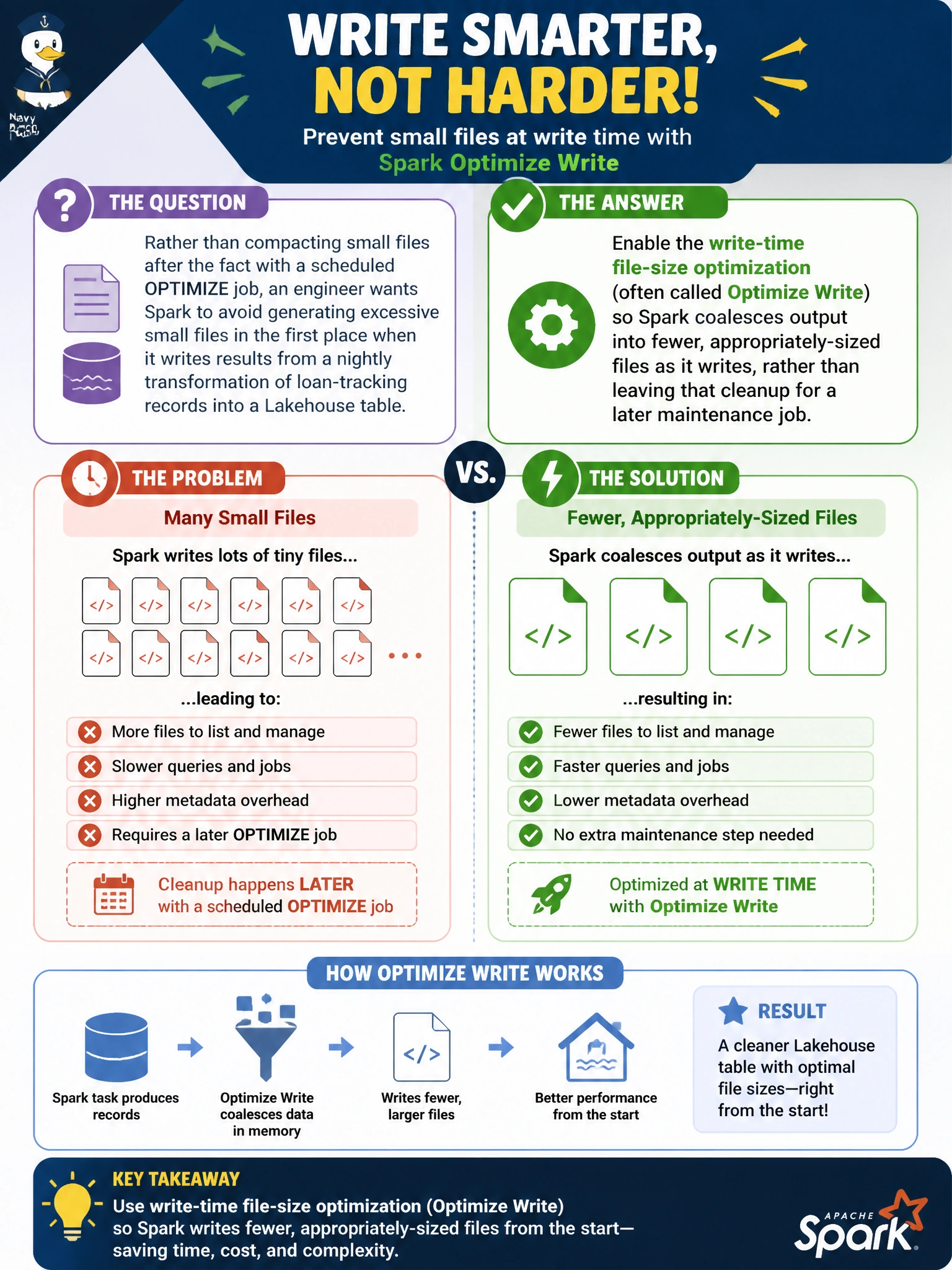
Rather than compacting small files after the fact with a scheduled OPTIMIZE job, an engineer wants Spark to avoid generating excessive small files in the first place when it writes results from a nightly transformation of loan-tracking records into a Lakehouse table. Which approach addresses the problem at write time rather than after the fact?
Select an answer to reveal the explanation.
Short Explanation
There's a difference between tidying up after a mess and simply not making the mess in the first place. A scheduled OPTIMIZE job is the tidying-up approach — it fixes small files after they've already piled up. Turning on write-time file-size optimization is the not-making-a-mess approach: Spark coalesces its output into sensibly-sized files as it writes, so there's less fragmentation to clean up later.
Full Explanation
Spark's default write behavior can produce one output file per task, and with enough parallel tasks writing relatively small amounts of data each, that naturally creates many small files even before any post-hoc maintenance is considered; the write-time optimization commonly referred to as Optimize Write addresses this at the source by coalescing data into fewer, more appropriately-sized files as part of the write operation itself, reducing how much fragmentation accumulates and how much a later OPTIMIZE job has to clean up. Disabling V-Order is unrelated and backwards — V-Order is a read-optimization encoding applied to written files, not a cause of file-count fragmentation, so turning it off wouldn't reduce small files and would remove a downstream read benefit for no gain. Reducing the Spark pool's node count would reduce write parallelism, which might incidentally produce fewer files, but at the direct cost of slower overall job execution — it solves the described problem by creating a worse one, rather than addressing file sizing intelligently. Running VACUUM immediately after every write addresses cleanup of old, unreferenced files after compaction, not the small-file generation from the write itself, and VACUUM doesn't compact files at all — that's what OPTIMIZE does. A caveat: write-time optimization and periodic OPTIMIZE aren't mutually exclusive — write-time settings reduce how bad fragmentation gets, but very high-frequency streaming writes can still benefit from occasional scheduled compaction on top. A concrete check: compare the number and average size of files produced by the nightly write job before and after enabling the write-time optimization setting.