
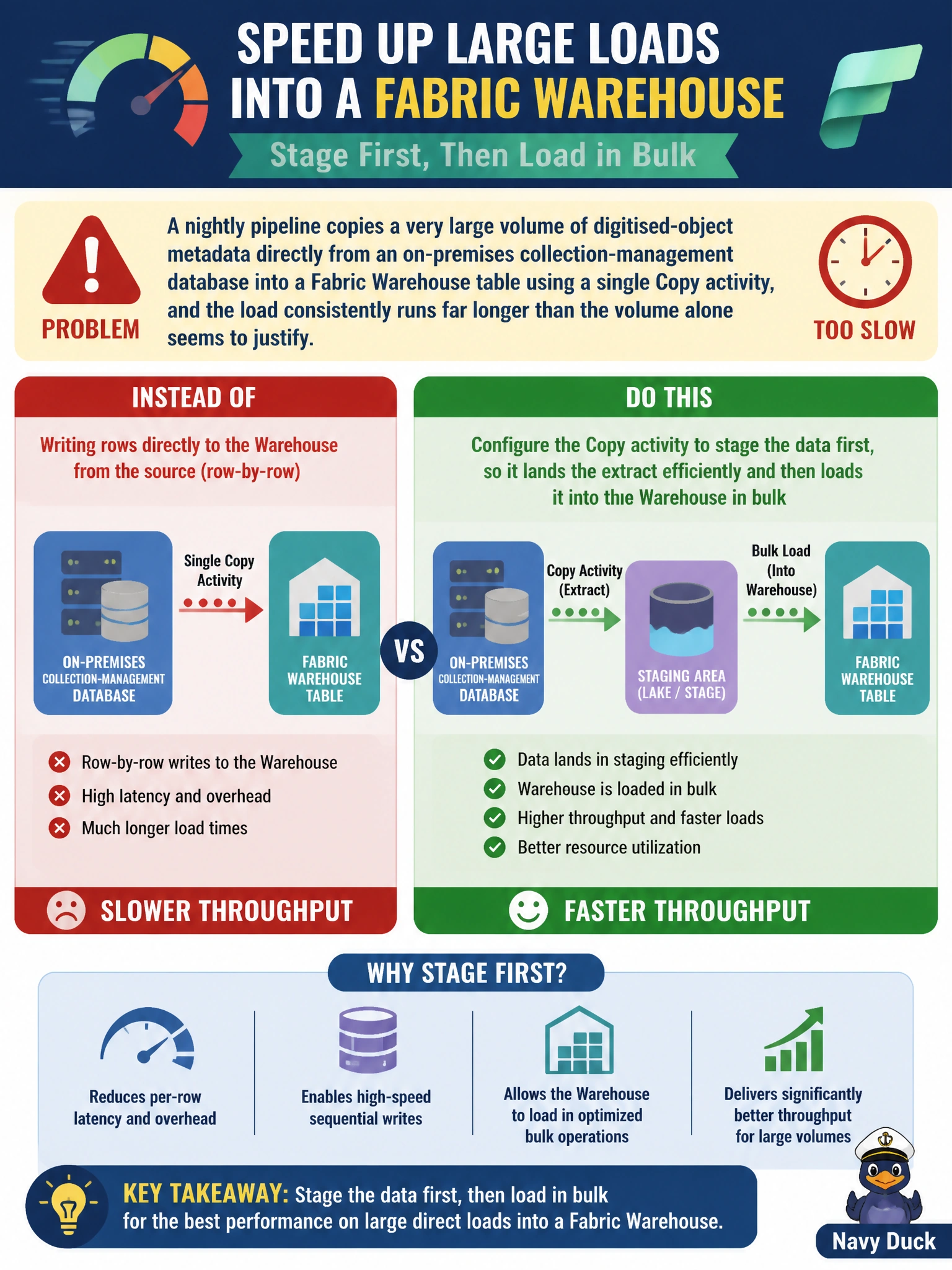
A nightly pipeline copies a very large volume of digitised-object metadata directly from an on-premises collection-management database into a Fabric Warehouse table using a single Copy activity, and the load consistently runs far longer than the volume alone seems to justify. What change is most likely to improve throughput for this kind of large direct load into a Warehouse?
Select an answer to reveal the explanation.
Short Explanation
Trying to pour a huge volume straight from a slow tap into a container designed for bulk delivery is going to bottleneck at the tap, no matter how big the container is. Staging the data first — landing it efficiently in an intermediate location, then loading it into the Warehouse in bulk — separates those two jobs so each one runs at its own best speed. It's the standard move for a large load that's crawling despite the volume not being unusual.
Full Explanation
A large data movement straight from a source system into a Warehouse can bottleneck on the row-by-row or batch characteristics of the direct source-to-sink path, especially when the source is a system like an on-premises database that isn't optimized for bulk analytical loading; configuring the Copy activity to use a staged approach lands the extract efficiently first and then performs the Warehouse load as an efficient bulk operation from that staged data, which is the standard technique for improving throughput on large loads into a Warehouse. Switching to a Lakehouse shortcut over the source database changes the architecture to query-on-read rather than materializing a copy at all — shortcuts still involve reading data from the source at query time, and swapping to one doesn't solve the stated problem of copying data efficiently, nor is it a drop-in substitute for a Warehouse table used elsewhere in reporting. Adding a Wait activity before the copy delays the whole pipeline without addressing the actual throughput bottleneck in the load path itself. A sensitivity label is a data-governance classification and has no effect on job scheduling priority within a capacity. A caveat: staging adds an intermediate storage location and step to manage, so it's worth reserving for loads large enough that the throughput gain outweighs the added complexity, rather than applying it to every small copy by default. A concrete check: compare the Copy activity's throughput (rows or MB per second) and total duration before and after enabling staged copy for the same source volume.