
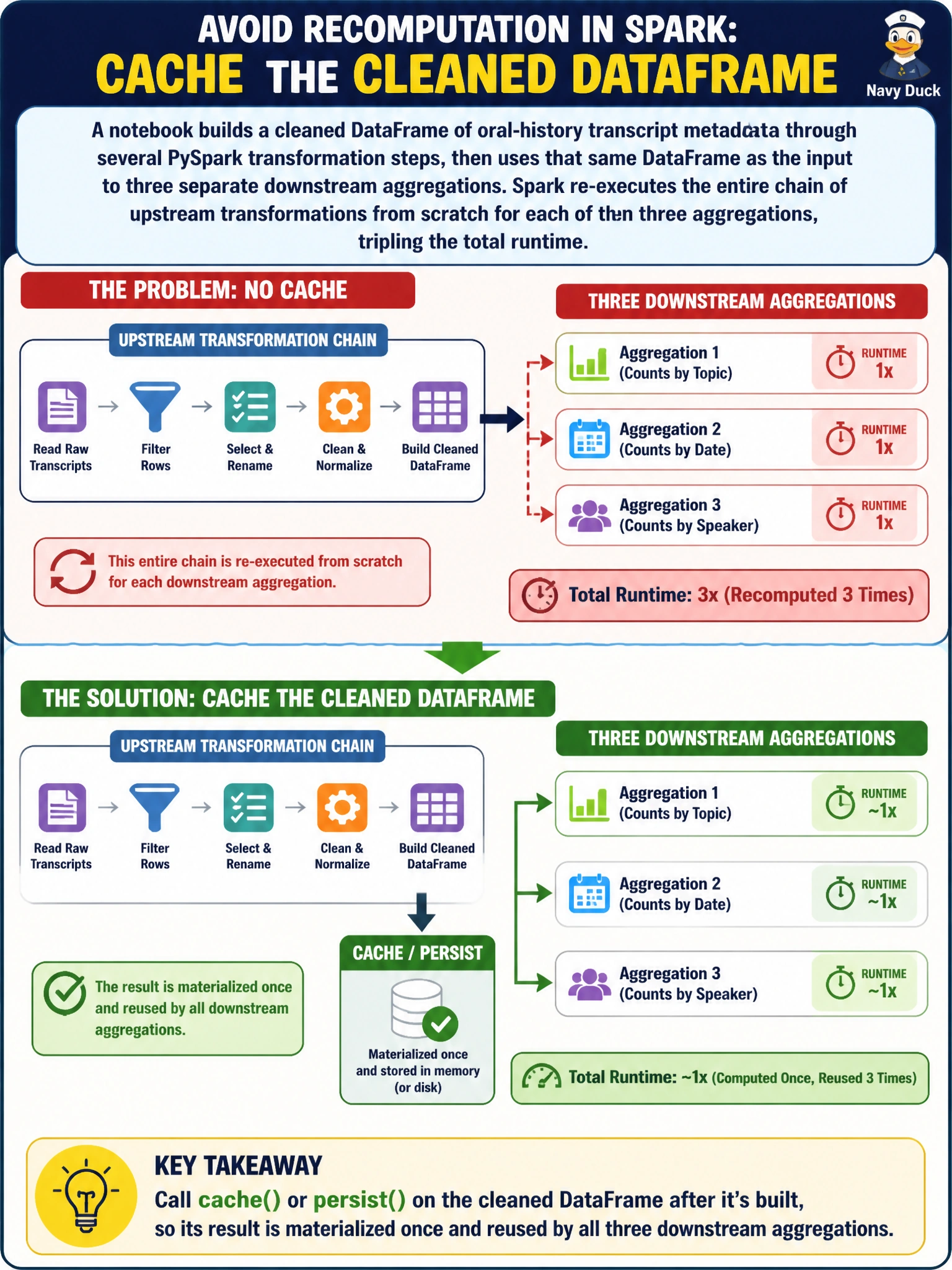
A notebook builds a cleaned DataFrame of oral-history transcript metadata through several PySpark transformation steps, then uses that same DataFrame as the input to three separate downstream aggregations. Spark re-executes the entire chain of upstream transformations from scratch for each of the three aggregations, tripling the total runtime. What change would most directly avoid that repeated recomputation?
Select an answer to reveal the explanation.
Short Explanation
Spark is lazy by nature — it doesn't actually build a DataFrame until something forces it to, and by default it forgets the result right after, so asking for it three times means doing the work three times. Calling cache() tells Spark to keep that materialized result around after the first time, so the next two aggregations just reuse it instead of recomputing the whole chain. It's the difference between re-cooking a dish from scratch every time versus cooking once and serving three plates.
Full Explanation
Spark's transformations are lazily evaluated and, by default, not persisted between actions, so each action that touches the cleaned DataFrame triggers Spark to re-run the entire upstream transformation chain that produced it — explaining why three downstream aggregations against the same DataFrame roughly triples total runtime. Calling cache() (or persist() with an explicit storage level) after the cleaning steps materializes that DataFrame's result the first time it's computed and keeps it available in memory or on disk for subsequent actions, so the second and third aggregations reuse the cached result instead of recomputing the cleaning chain. Rewriting the aggregations in T-SQL against a Warehouse would require the cleaned data to already exist as a Warehouse table, which changes the architecture and doesn't address the actual cause — repeated recomputation of a lazily-evaluated DataFrame — and introduces a separate engine and data-movement step. Increasing source-file partition count can help parallelism for a given read, but it doesn't stop the upstream chain from being recomputed three separate times; the recomputation, not the read parallelism, is the bottleneck. V-Order optimizes how files are physically written for faster downstream reads by other engines; it doesn't change Spark's in-session evaluation model or prevent recomputation of an in-memory transformation chain. A caveat: caching consumes cluster memory or disk, so a DataFrame that's genuinely too large to fit should be persisted at a storage level that spills to disk rather than cached purely in memory, and cached DataFrames no longer needed should be unpersisted to free resources. A concrete check: compare the job's Spark UI stage timeline and total duration before and after adding the cache() call.