
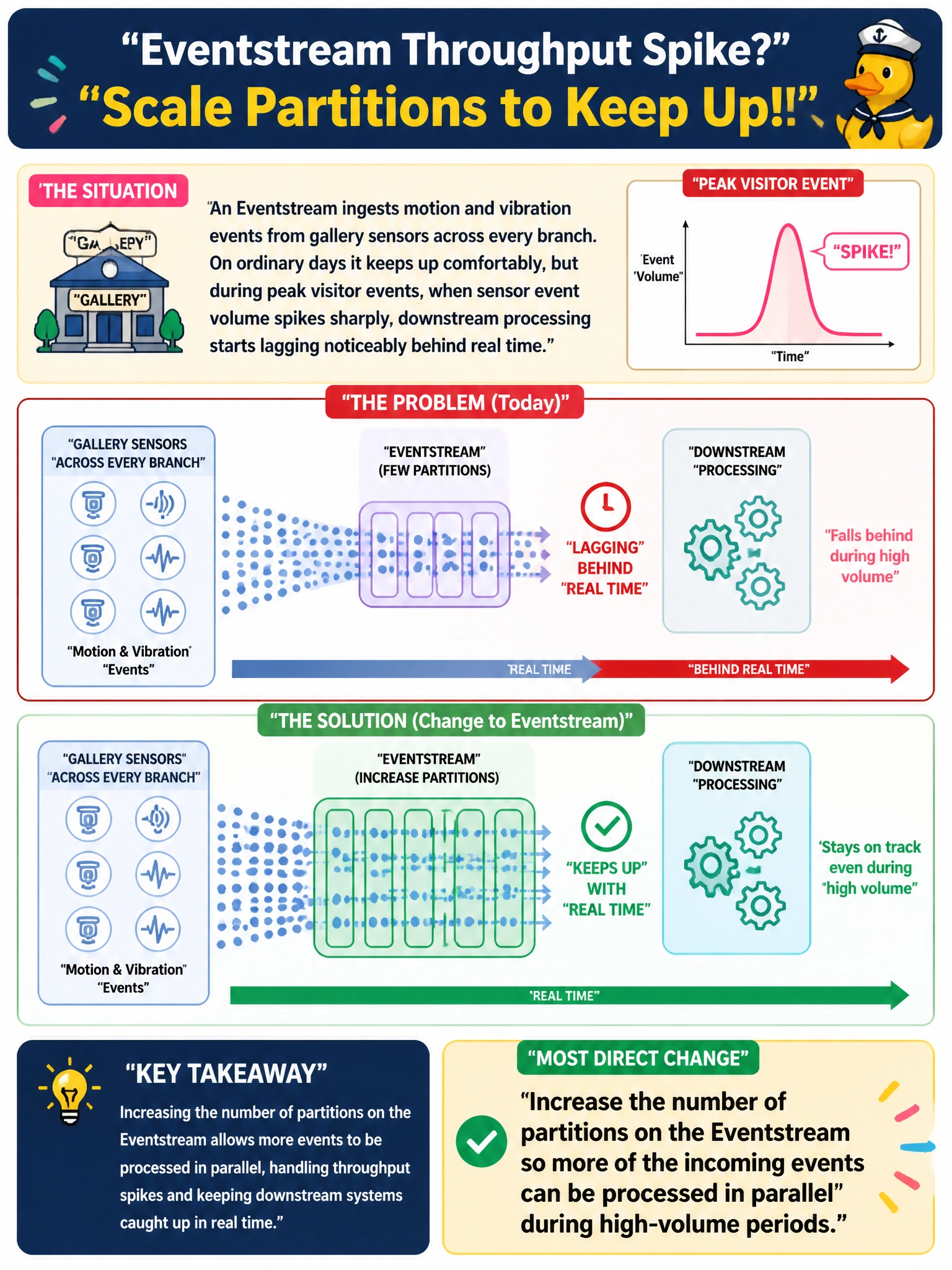
An Eventstream ingests motion and vibration events from gallery sensors across every branch. On ordinary days it keeps up comfortably, but during peak visitor events, when sensor event volume spikes sharply, downstream processing starts lagging noticeably behind real time. What change to the Eventstream is most directly aimed at handling this kind of throughput spike?
Select an answer to reveal the explanation.
Short Explanation
A single checkout lane can only serve customers so fast, no matter how efficient it is — the way to handle a rush is to open more lanes. Partitions work the same way for an Eventstream: more partitions mean more parallel lanes for events to flow through and be processed concurrently. When volume spikes past what the current partition count can keep up with, adding partitions is the direct lever for more throughput.
Full Explanation
An Eventstream's partition count sets the ceiling on how much of the incoming event volume can be consumed and processed in parallel; when event volume during peak periods exceeds what the current partition count can move through concurrently, downstream processing falls behind even though the stream itself keeps accepting events, which matches the described lag appearing specifically during volume spikes rather than during ordinary throughput. Increasing partitions raises that parallel-processing ceiling, directly targeting a throughput bottleneck. Switching the destination from Eventhouse to Lakehouse changes where data lands, not how much of it the Eventstream can move through concurrently, and neither destination is universally faster than the other — the right choice depends on the downstream query pattern, not raw ingest speed. A sensitivity label is a data-governance classification with no bearing on processing order or throughput. A deployment pipeline manages promoting Fabric items between workspaces for lifecycle purposes; it has nothing to do with a stream's runtime throughput capacity. A caveat: adding partitions only helps if the events can actually be distributed across them in a way that spreads load evenly — a partitioning key that funnels most events into one partition would limit the benefit. A concrete check: monitor consumer lag per partition before and after the change to confirm the backlog shrinks during a comparable peak-volume period.