
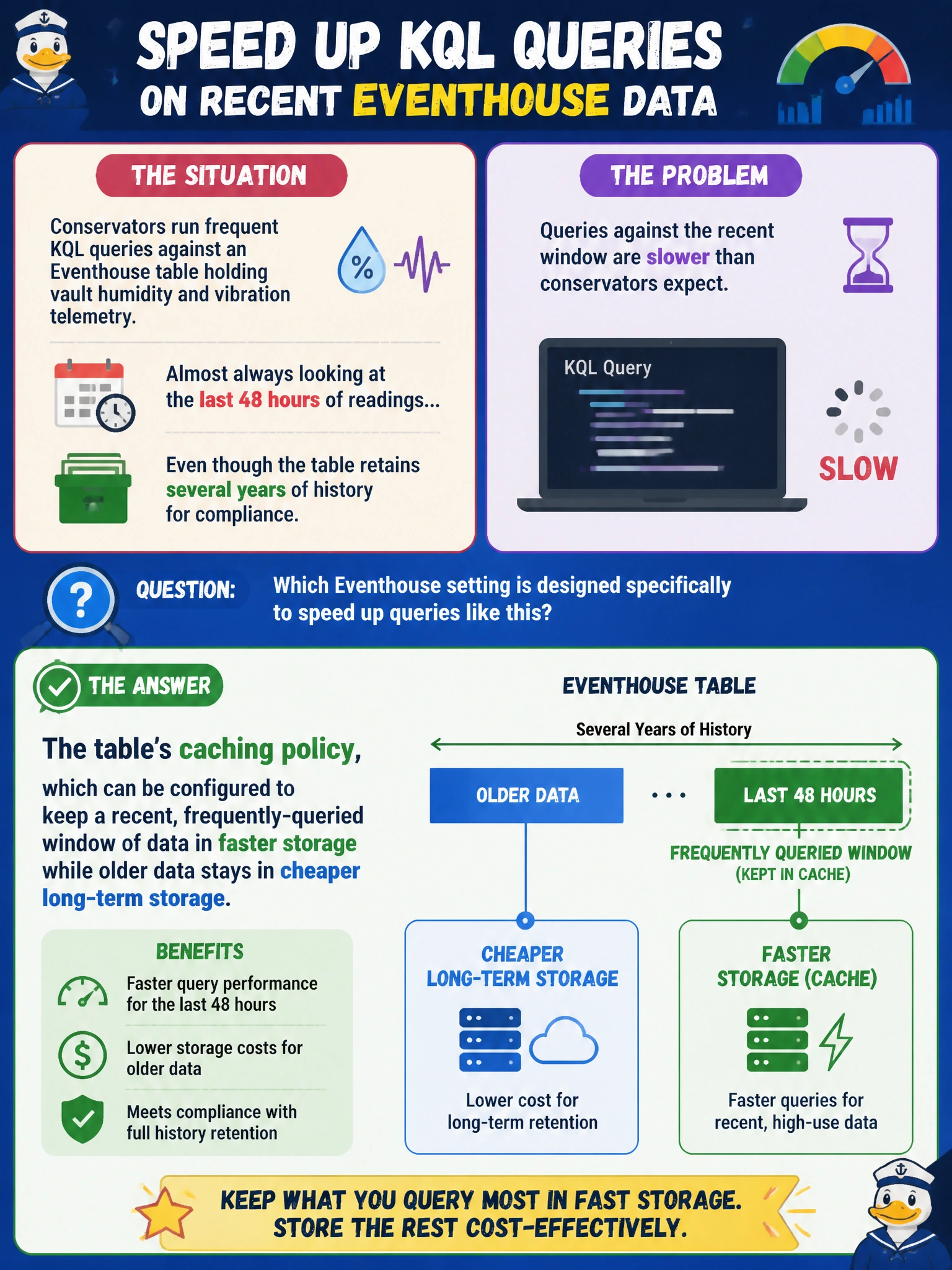
Conservators run frequent KQL queries against an Eventhouse table holding vault humidity and vibration telemetry, almost always looking at the last 48 hours of readings, even though the table retains several years of history for compliance. Queries against the recent window are slower than conservators expect. Which Eventhouse setting is designed specifically to speed up queries like this?
Select an answer to reveal the explanation.
Short Explanation
Think about keeping this week's files on your desk and last year's in the archive down the hall — you don't want to walk back there for something from this morning. An Eventhouse caching policy keeps a configurable recent window in fast storage while older data stays in cheap long-term storage. Since these queries hit the last 48 hours, tuning that hot window to match is the fix.
Full Explanation
An Eventhouse table's caching policy controls how much recent data is kept in a fast cache tier versus how much lives in the underlying long-term storage; queries that fall within the cached window are served largely from that fast tier, while queries reaching further back have to pull from storage, which is slower. Since the described query pattern is almost always the last 48 hours, setting the caching policy's hot-cache period to cover that window (rather than leaving it at a default that may not match this workload) directly targets the reported slowness without discarding any of the multi-year retention the compliance requirement needs — caching policy and retention policy are independent settings in an Eventhouse. Apache Airflow workspace settings configure a separate orchestration surface for Airflow-based jobs; they have no relationship to how an Eventhouse table caches its own data. Endorsement is a discoverability and trust signal for report authors browsing items in a workspace; it doesn't influence query execution or caching at all. A sensitivity label classifies data for governance and can trigger protections like masking, but it doesn't change where data physically lives or how fast it's read. A caveat: widening the cache window too far increases the cache's storage footprint and cost, so it should be sized to the real query pattern rather than maximized by default. A concrete check: compare query latency for a 48-hour-range query before and after adjusting the caching policy's hot period.