
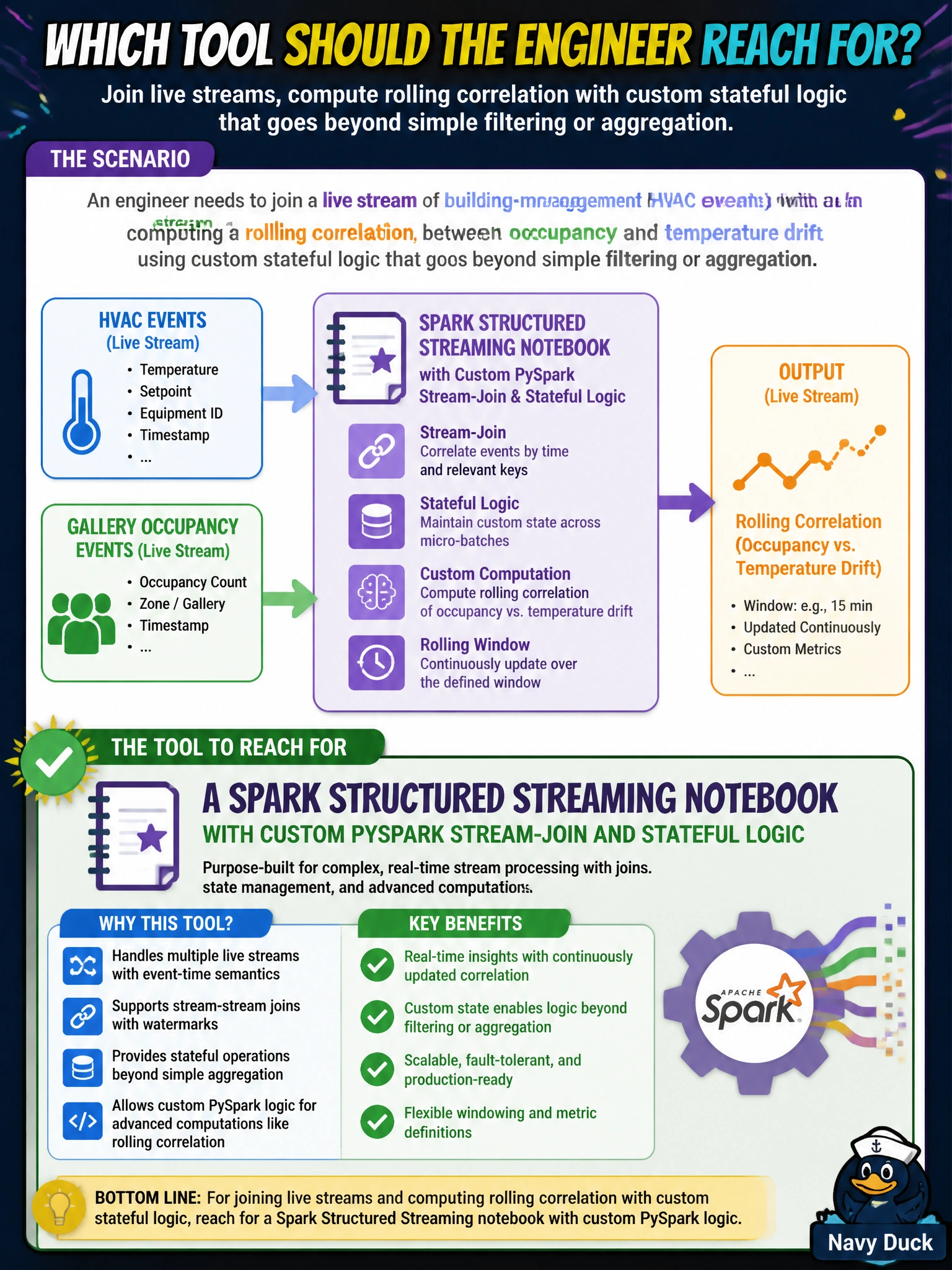
An engineer needs to join a live stream of building-management HVAC events with a live stream of gallery-occupancy events, computing a rolling correlation between occupancy and temperature drift using custom stateful logic that goes beyond simple filtering or aggregation. Which tool should the engineer reach for?
Select an answer to reveal the explanation.
Short Explanation
Simple filtering and counting stay on the no-code canvas, but a custom rolling correlation between two live streams is genuinely custom logic. That's the point where you reach for Spark structured streaming and write the join and stateful computation in PySpark.
Full Explanation
Spark structured streaming supports stream-to-stream joins and arbitrary stateful transformations expressed in PySpark, including custom logic like a rolling correlation calculation that has no equivalent built-in operator on a simpler canvas. Because the requirement here goes beyond filtering, renaming, or straightforward aggregation into genuinely custom stateful computation across two live streams, a Spark notebook is the tool designed to express that.
The Eventstream canvas's built-in operations — Filter, Manage fields, Group by — cover common shaping and windowed aggregation needs, but they do not expose a mechanism for joining two independent live streams together and running a custom statistical computation like correlation; that exceeds the no-code operator set. A T-SQL view over Warehouse tables only queries data that has already landed at rest; it has no access to two continuously arriving live streams and cannot compute a rolling, streaming correlation. A Dataflow Gen2 with a scheduled refresh is a batch tool that pulls data periodically rather than reacting to events continuously, which is fundamentally mismatched with a rolling, live correlation requirement.
A caveat: choosing Spark here trades the simplicity of the no-code canvas for the operational overhead of managing a running notebook job, including checkpointing and cluster sizing. Operationally, validate the join logic first on a bounded static sample of both event types before promoting the notebook to run continuously against the live streams.