
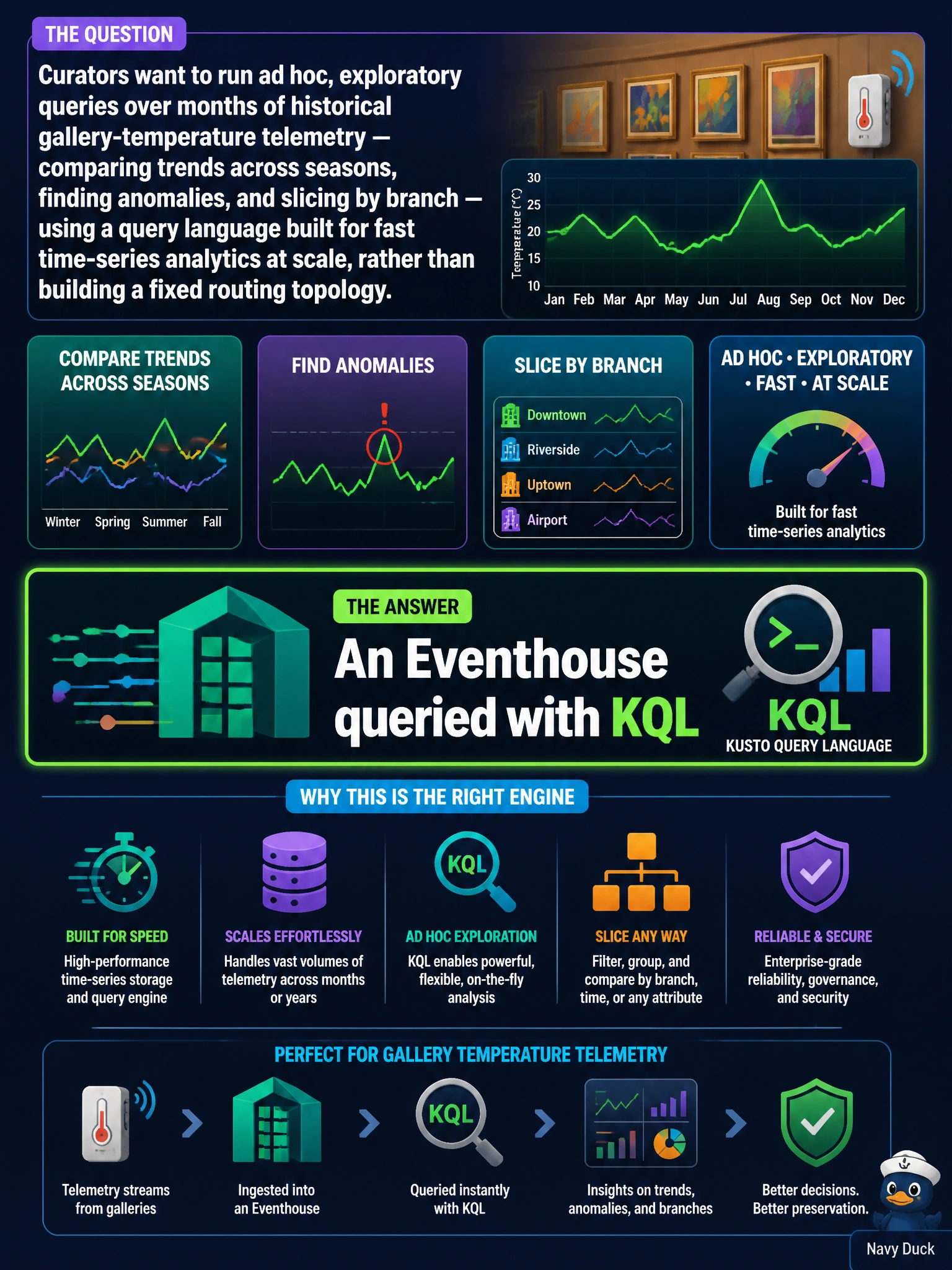
Curators want to run ad hoc, exploratory queries over months of historical gallery-temperature telemetry — comparing trends across seasons, finding anomalies, and slicing by branch — using a query language built for fast time-series analytics at scale, rather than building a fixed routing topology. Which Fabric engine is purpose-built for this kind of analysis?
Select an answer to reveal the explanation.
Short Explanation
Routing live data and exploring months of it afterward are two different jobs. An Eventhouse stores the telemetry in a time-series-optimized format and lets curators run fast, flexible KQL queries — filtering, aggregating, and slicing by season or branch — long after the data landed.
Full Explanation
An Eventhouse is Fabric's Real-Time Intelligence data store, purpose-built to hold high-volume time-series and event data and to serve fast, flexible ad hoc analytics against it through KQL. KQL's query surface — filtering, summarize, time-binning, joins across tables — is designed exactly for the kind of exploratory, multi-month trend and anomaly analysis curators want, which makes the Eventhouse the right home for this workload rather than a live-routing tool.
An Eventstream with a Filter and Manage fields topology is a live-processing pipeline for shaping and routing data as it arrives; it is not a queryable store, and it has no mechanism for curators to run ad hoc historical queries after the fact. A Dataflow Gen2 with Power Query transformations is a batch data-preparation tool aimed at reshaping and loading data into a destination, not an interactive analytics engine curators can query directly and repeatedly. A Data Activator configured with a static threshold rule only watches for a single trigger condition to fire an action or alert; it has no query interface and cannot support open-ended exploration across seasons and branches.
A caveat: an Eventhouse's analytical strengths come with a different security and cost model than a Lakehouse, so the underlying telemetry may still need to be mirrored or shortcut into other Fabric items if broader reporting tools require it. Operationally, confirm fit by running a sample seasonal-comparison KQL query directly against the Eventhouse and checking response time against the volume of historical data involved.