
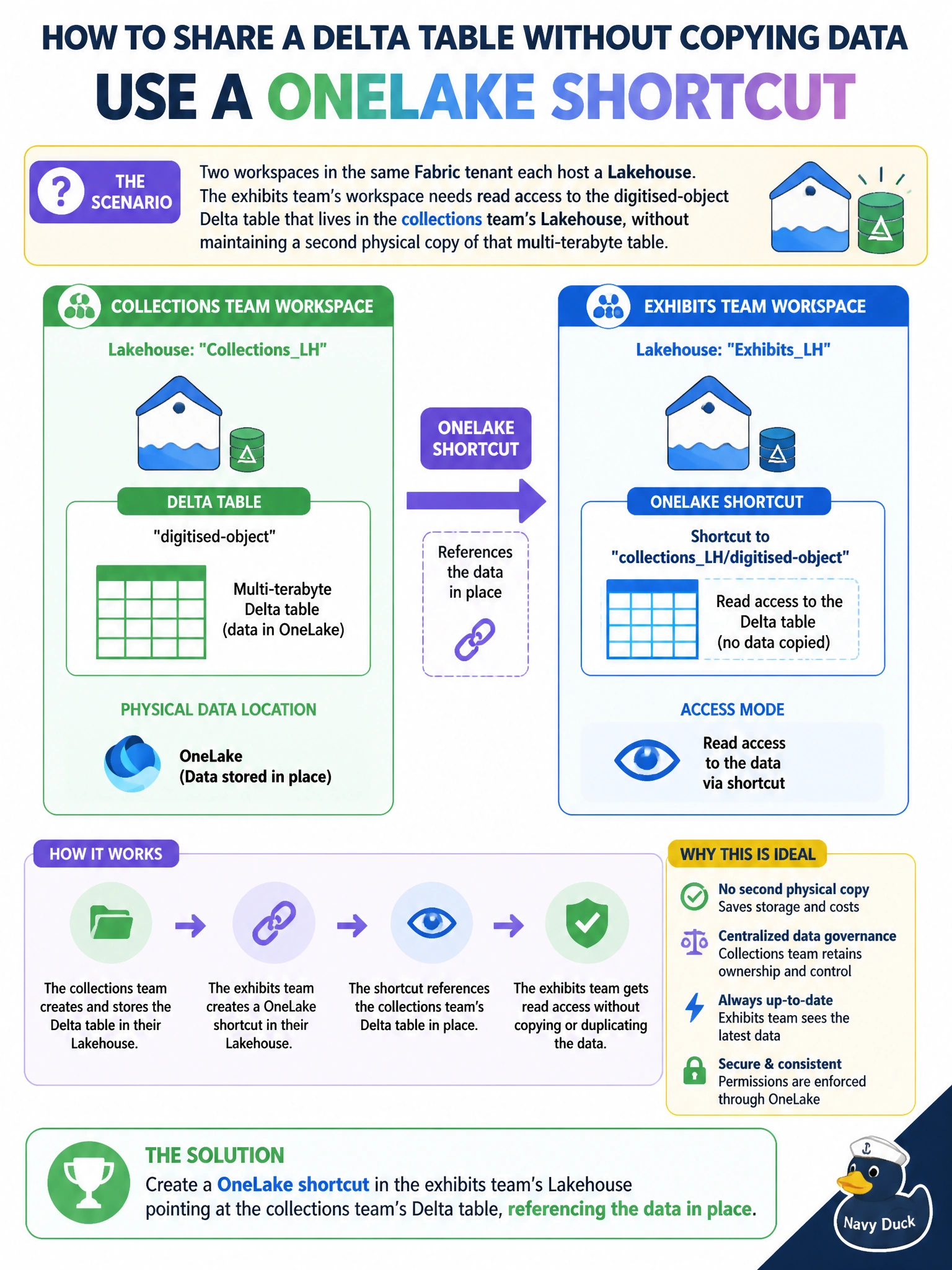
Two workspaces in the same Fabric tenant each host a Lakehouse. The exhibits team's workspace needs read access to the digitised-object Delta table that lives in the collections team's Lakehouse, without maintaining a second physical copy of that multi-terabyte table. What is the appropriate solution?
Select an answer to reveal the explanation.
Short Explanation
Think of it like two departments sharing one filing cabinet instead of each keeping a duplicate: nobody has to photocopy every page, they just get a key to the same drawer. A OneLake shortcut between the two Lakehouses is that shared key.
Full Explanation
OneLake shortcuts work across workspaces within the same tenant just as they do against external storage: the exhibits team's Lakehouse gets a reference to the collections team's Delta table, and queries against that reference read the same underlying data in place, with no second physical copy to store or keep in sync. For a multi-terabyte table, that avoids both the storage cost and the staleness risk of a duplicate. Exporting to Parquet and re-importing creates exactly the redundant copy the requirement rules out, and it also drops Delta-specific metadata like transaction history along the way. A nightly Dataflow Gen2 copy job solves a different problem — it's a valid pattern when a team genuinely needs its own independent copy, but here the requirement is explicitly “without maintaining a second physical copy,” so a scheduled copy job doesn't fit. Physically moving the table out of the collections team's workspace changes ownership and could break other consumers depending on it there, when a non-destructive reference is all that's needed. Before finalizing, confirm the exhibits team's identity has been granted read permission on the source table, since a shortcut still respects the source Lakehouse's access controls.