
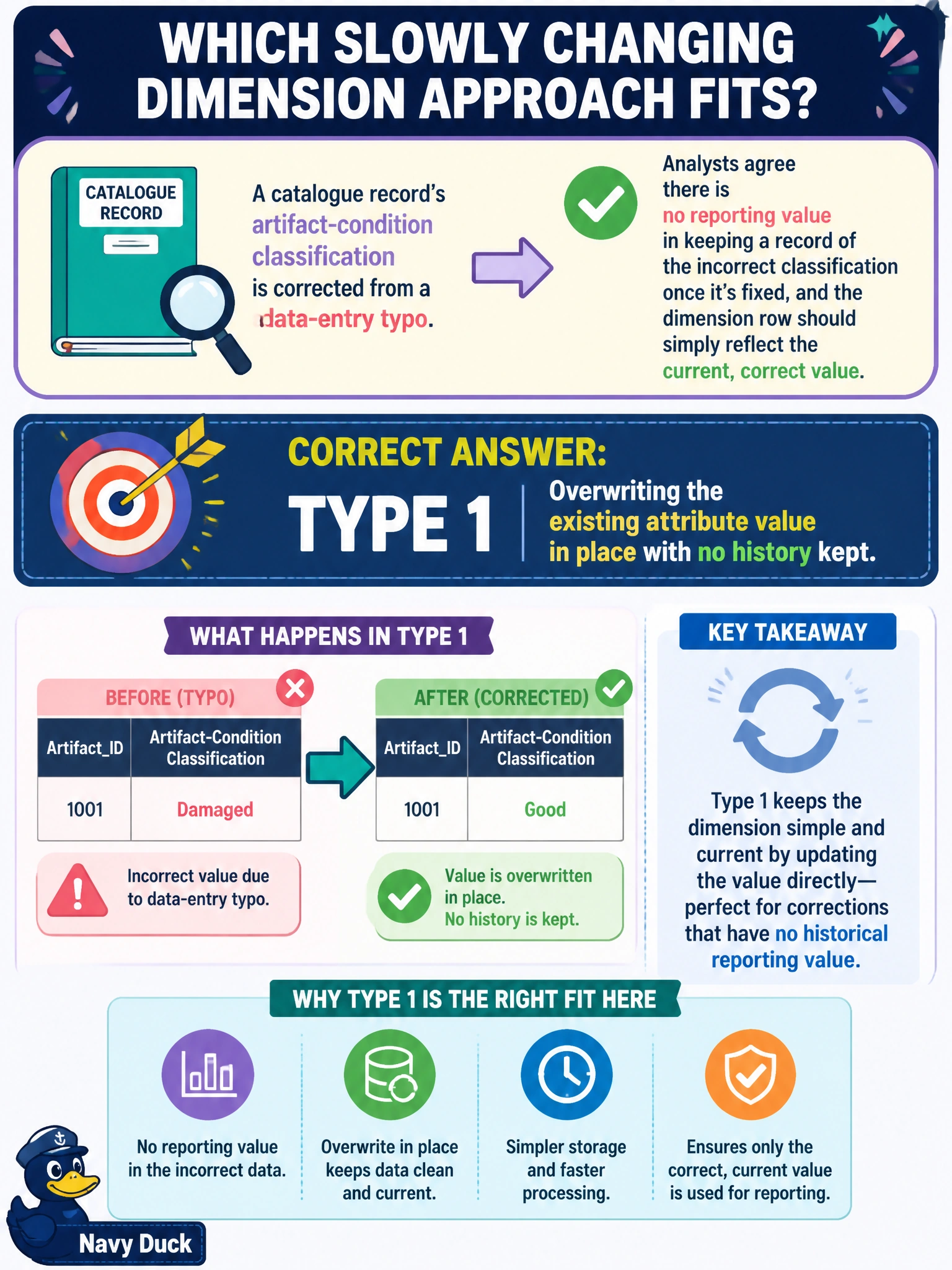
A catalogue record's artifact-condition classification is corrected from a data-entry typo. Analysts agree there is no reporting value in keeping a record of the incorrect classification once it's fixed, and the dimension row should simply reflect the current, correct value. Which slowly changing dimension approach fits this correction?
Select an answer to reveal the explanation.
Short Explanation
Some changes are just fixing a mistake, not tracking real history. A Type 1 slowly changing dimension overwrites the attribute in place, which is exactly right when the old value was simply wrong and nobody needs to keep it around.
Full Explanation
A Type 1 slowly changing dimension overwrites the existing attribute value directly, keeping no historical trace of what it used to be, which is the appropriate pattern for correcting bad data such as a data-entry typo where the old value has no analytical value once fixed. It keeps the dimension simple and the correction takes effect everywhere the dimension is used immediately. Type 2 instead preserves history by inserting a new dimension row for each meaningful change and marking prior rows inactive or expired, which is the right approach when past states genuinely matter for reporting, such as a catalogue record's classification being re-described over time for legitimate cataloguing reasons; applying Type 2 to a typo fix would incorrectly preserve a wrong value as if it were meaningful history. Type 3 keeps a limited amount of history by adding one or more 'previous value' columns alongside the current value, useful when only the immediately prior state matters, but it still implies the old value is worth retaining, which contradicts the scenario's statement that there's no reporting value in the incorrect classification. Creating an entirely new fact table for every correction is not a recognized slowly changing dimension technique and would fragment the model unnecessarily for what is a routine dimension update. Before applying Type 1 broadly, confirm the attribute in question is never used for point-in-time historical analysis, since applying Type 1 to an attribute that should have been tracked with history is a common and hard-to-reverse modeling mistake.