
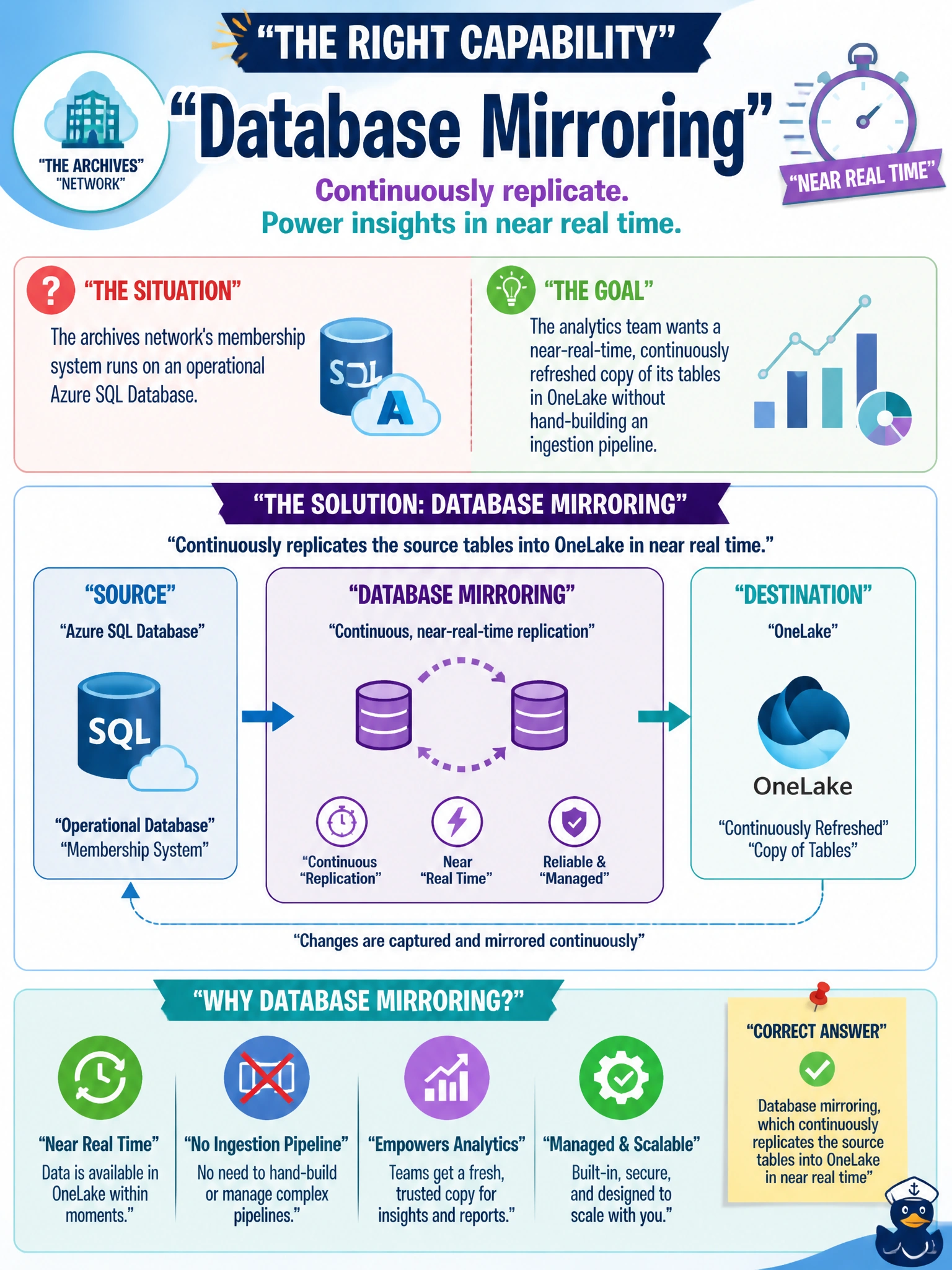
The archives network's membership system runs on an operational Azure SQL Database, and the analytics team wants a near-real-time, continuously refreshed copy of its tables in OneLake without hand-building an ingestion pipeline. Which capability is designed for this?
Select an answer to reveal the explanation.
Short Explanation
Mirroring is the always-on version of a copy: it just keeps flowing on its own. Point it at a supported operational database like Azure SQL and it continuously replicates the tables into OneLake, with no pipeline to write or schedule.
Full Explanation
Mirroring in Fabric provides continuous, low-latency replication of data from a supported operational database, such as Azure SQL Database, into OneLake in Delta format, without requiring the team to design and maintain an ETL or copy pipeline. That combination, near-real-time freshness with zero custom pipeline work, is exactly what the scenario asks for. A OneLake shortcut references data in another storage location in place, but it is aimed at file or table-based storage locations like ADLS Gen2 or another OneLake, not at querying and continuously replicating an operational transactional database's changing rows. A nightly pipeline copy activity with a full-load pattern would require building and scheduling that pipeline, which the team explicitly wants to avoid, and a nightly cadence isn't near-real-time regardless. A manual T-SQL export run on demand has no continuity at all and depends on someone remembering to run it, which fails both the automation and the freshness requirements. When evaluating mirroring for a given source, confirm the specific database type and version are on the supported list, since mirroring targets a defined set of operational and analytical sources rather than any arbitrary database.