
A pipeline's nightly schedule trigger, configured months ago to fire at 2:00 a.m., appears to have started firing at 3:00 a.m. instead ever since the clocks changed for daylight saving. No one edited the trigger. What is the most likely explanation the team should investigate first?
Select an answer to reveal the explanation.
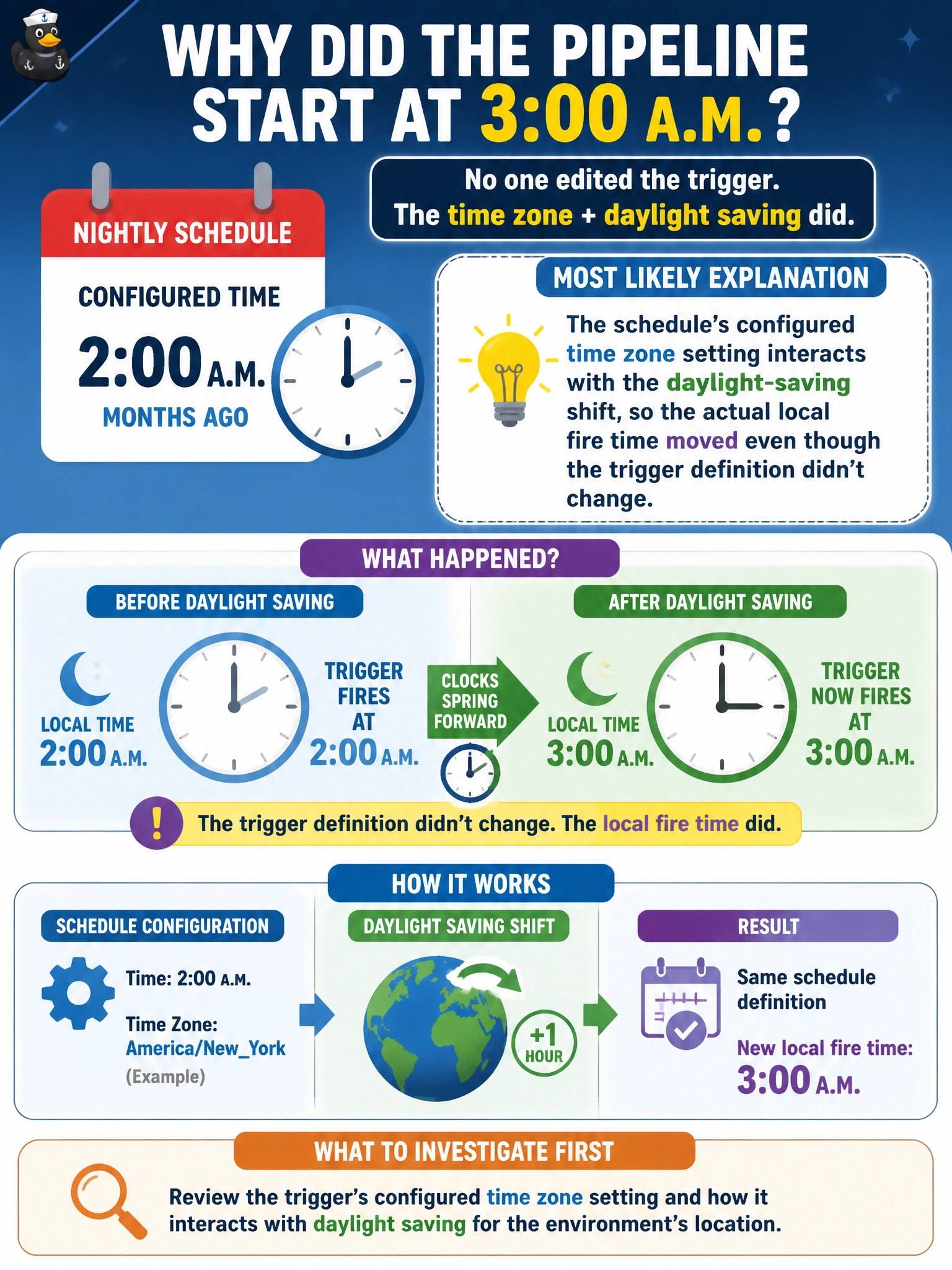
Short Explanation
Nobody touched the trigger, but the clocks moved — and that's exactly the kind of thing that quietly shifts a schedule's local fire time depending on how its time zone setting behaves around the change. Before assuming something broke, check how that schedule's time zone handles daylight saving.
Full Explanation
A schedule's fire time is computed against a configured time zone, and how that time zone setting handles a daylight-saving transition determines whether the schedule's real-world local fire time shifts along with the clocks or stays fixed against a different reference, which is the first thing worth investigating when a trigger that no one edited appears to have moved. This explains the symptom without requiring any actual configuration change, matching the fact pattern that nothing was edited. The idea that a pipeline silently rewrote its own trigger configuration isn't how the platform behaves — trigger definitions don't self-modify, and assuming so would send the investigation in the wrong direction entirely. Blaming a slower upstream dependency confuses when a trigger fires with when a run can begin: a delayed dependency pushes back the run's start or leaves it queued, but the trigger itself would still be recorded as firing at 2:00 a.m. Suggesting the Monitoring hub is simply mis-displaying times is possible in principle but is a much less likely first explanation than a documented, well-known daylight-saving interaction with time zone handling, and should be ruled out second, not assumed first. The caveat: not every time zone setting behaves identically around daylight saving, so the fix may be as simple as confirming the schedule's configured zone matches expectations rather than an unrelated one. A concrete check: compare the trigger's configured time zone against the museum network's local zone and confirm whether that zone observes daylight saving the same way the local clocks do.