
A newer data engineer on the archives team asks a colleague to explain, in plain terms, what fundamentally separates a schedule trigger from an event-based trigger in Fabric orchestration. What is the correct plain-language distinction?
Select an answer to reveal the explanation.
Short Explanation
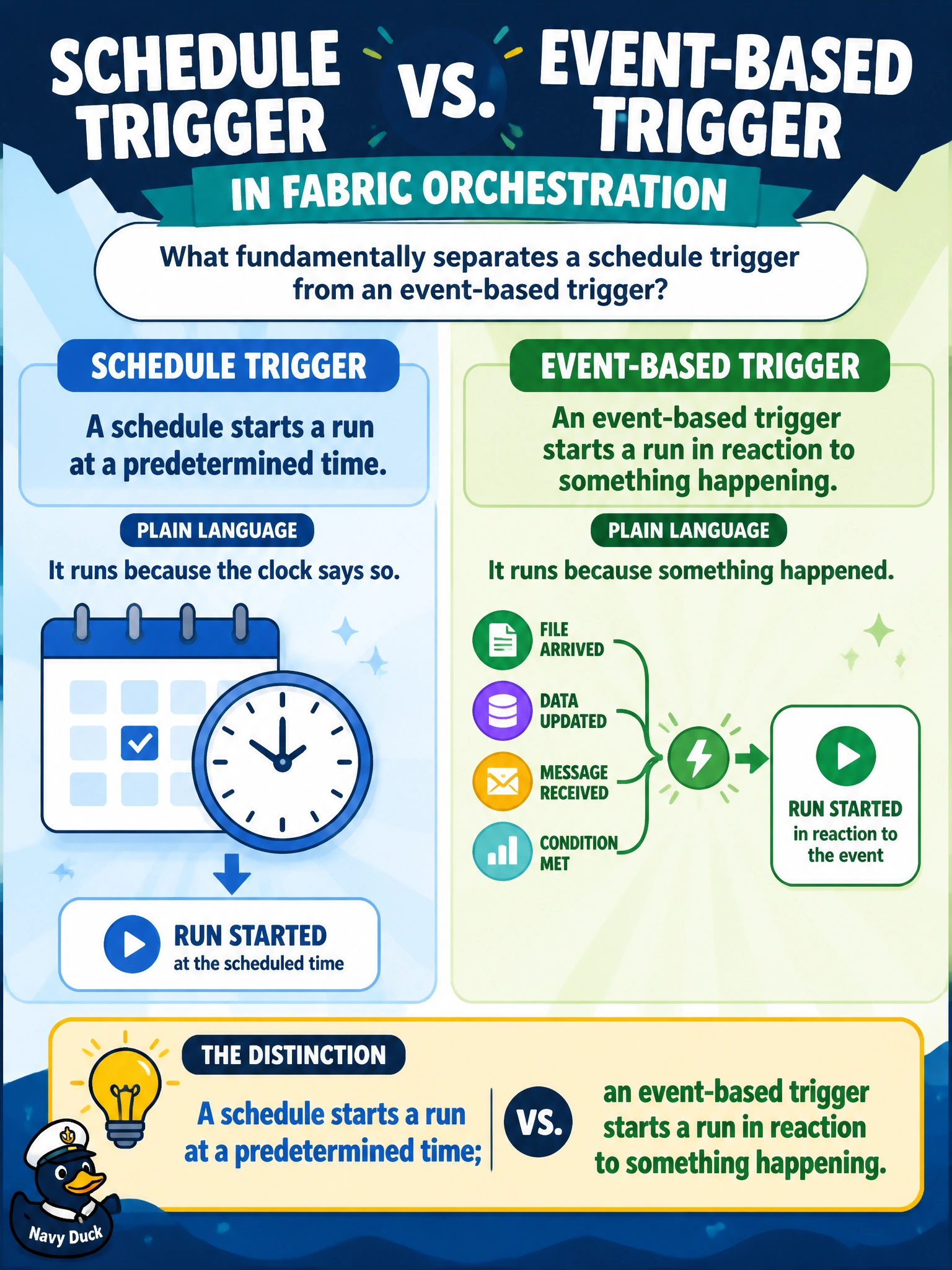
Strip away all the configuration detail and it comes down to one question: does the clock decide, or does an event decide? A schedule watches the calendar; an event-based trigger watches for something to happen. That's the whole distinction underneath everything else.
Full Explanation
The core distinction is about what causes a run to start: a schedule trigger is time-driven, firing at a recurring or fixed clock time regardless of the state of the world, while an event-based trigger is condition-driven, firing when something specific occurs, such as new data arriving. Understanding that difference is what determines which one fits a given orchestration need — clock-driven nightly batches want a schedule, unpredictable arrivals want an event trigger. The claim that schedules only work with notebooks and event triggers only work with pipelines confuses trigger type with activity type; both trigger kinds can kick off the same pipeline, and neither is restricted to a single activity type. The claim that a schedule runs only once ever is wrong on its face — recurring schedules are the norm, running nightly, hourly, or on whatever cadence is configured, not a single one-time event. Saying there's no real difference collapses two genuinely distinct orchestration concepts into one, which would leave someone unable to reason about which trigger type actually fits a scenario like an unpredictable loan return versus a predictable nightly digitisation batch. The caveat: a pipeline can have more than one trigger attached, mixing a schedule and an event trigger where both apply. A concrete check: open a pipeline's trigger settings and confirm whether it lists a recurrence pattern (schedule) or a monitored event source (event-based) as the activation mechanism.