
During the network's annual winter closure week, several branches don't open at all, and their ticketing-ingestion steps should simply be skipped for that week without disabling the entire nightly pipeline for every other branch. What orchestration approach handles this most cleanly within a single pipeline?
Select an answer to reveal the explanation.
Short Explanation
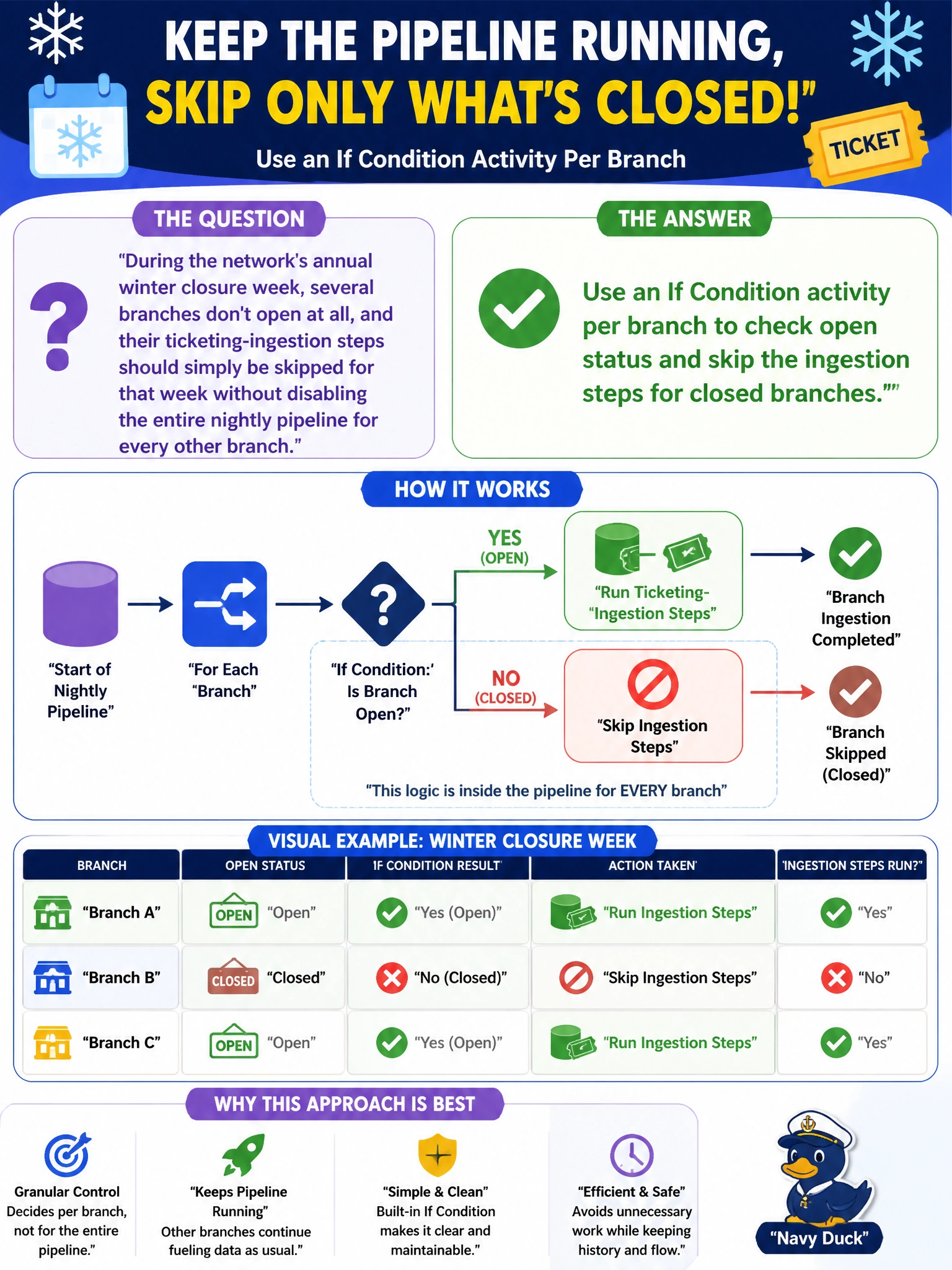
One week of closures for a few branches shouldn't mean shutting the whole pipeline down for everybody else. Put an If Condition check per branch inside the loop, and closed branches just skip their own ingestion step for the week while open branches keep running like normal.
Full Explanation
An If Condition activity evaluated per branch inside the existing loop lets each branch's own open/closed status decide whether its ingestion steps run that night, which handles the closure precisely at the granularity it actually occurs — some branches closed, others not — without touching the pipeline as a whole. Disabling the entire pipeline for the closure week stops ingestion for every branch, including the ones that remain open, which is a far blunter outcome than what's needed. Deleting closed branches from the branch list and re-adding them afterward turns a temporary, predictable closure into manual list editing twice, with real risk of forgetting the re-add step and quietly losing a branch permanently. Standing up a second, separate pipeline that only exists for one week duplicates the entire orchestration logic for a temporary situation, doubling maintenance for something a single conditional check already solves. The caveat: the open/closed status itself needs to come from a reliable source, such as a maintained branch-calendar table, rather than being hardcoded into the condition, or next year's closure dates will require an actual code change. A concrete check: run the pipeline during the closure week and confirm the Monitoring hub shows the closed branches' ingestion steps skipped, while other branches complete normally.