
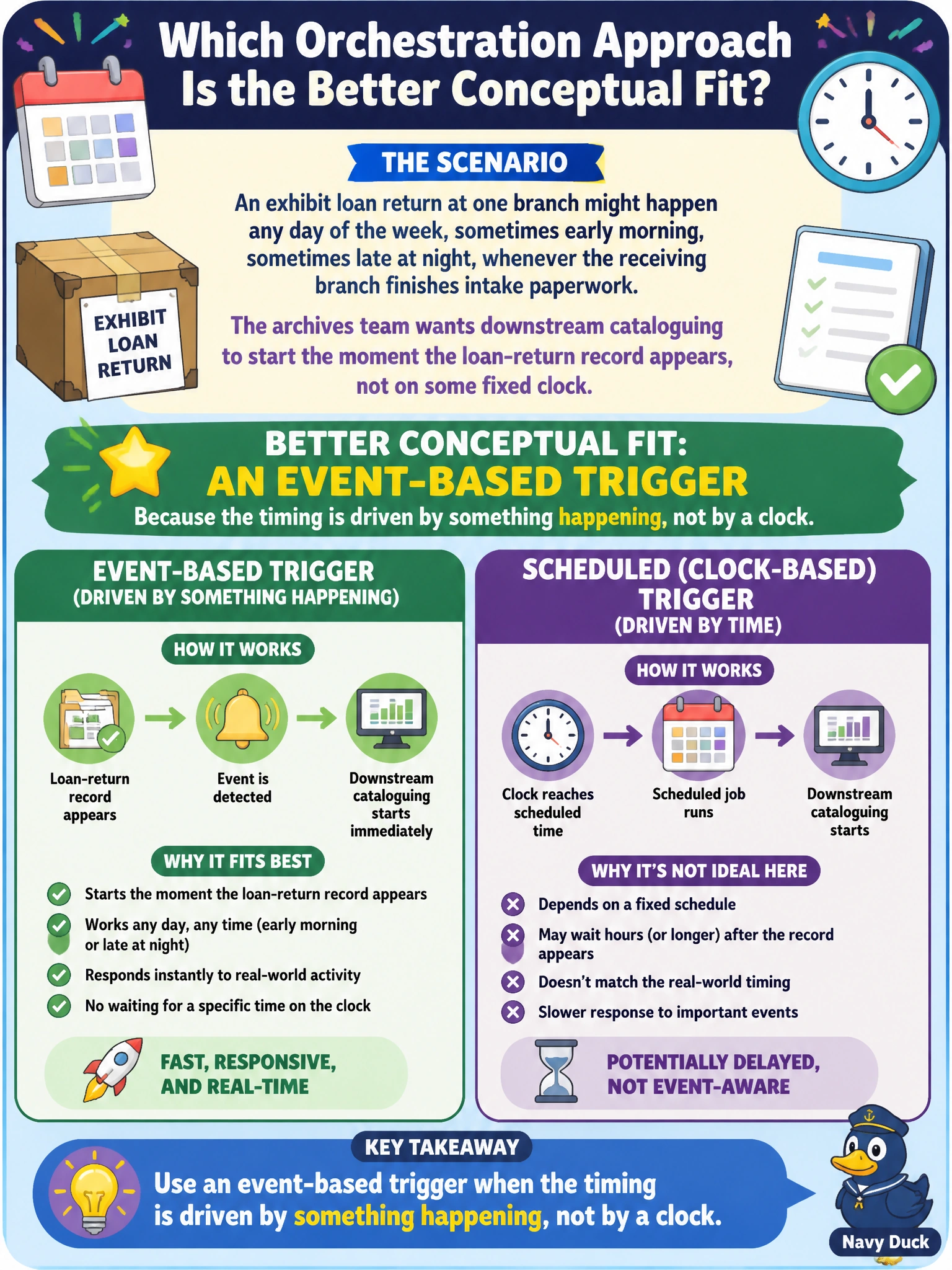
An exhibit loan return at one branch might happen any day of the week, sometimes early morning, sometimes late at night, whenever the receiving branch finishes intake paperwork. The archives team wants downstream cataloguing to start the moment the loan-return record appears, not on some fixed clock. Which orchestration approach is the better conceptual fit here?
Select an answer to reveal the explanation.
Short Explanation
Whenever the trigger for a task is 'something just happened' rather than 'it's a certain time,' that's the signature of an event-based trigger, not a schedule. A loan return finishing intake paperwork is an event, so let it drive the pipeline directly instead of waiting on a clock that has nothing to do with when the paperwork actually gets done.
Full Explanation
The defining difference between a schedule and an event-based trigger is what determines the run time: a schedule fires at a predetermined clock time regardless of what has or hasn't happened, while an event-based trigger fires in reaction to something occurring, such as a record being written. Loan returns finishing at unpredictable hours, driven by paperwork rather than a calendar, is the textbook case for an event-based trigger, since it starts cataloguing immediately rather than waiting for the next fixed slot. A fixed nightly schedule would delay same-day intake until the next scheduled run, sometimes by many hours, which contradicts the stated goal of starting the moment the record appears. A weekly schedule makes the delay dramatically worse and treats an operationally time-sensitive event as if it were low-priority batch housekeeping. Having no trigger and hoping an unrelated pipeline happens to pick up the record is not orchestration at all — it's an accidental dependency on something that was never designed to do this job, and it will eventually fail silently. The caveat: an event-based trigger still needs a well-defined signal, such as a specific write to a specific location, so it doesn't fire on unrelated activity nearby. A concrete check: create a test loan-return record and confirm the cataloguing pipeline starts within moments, not on the next calendar boundary.