
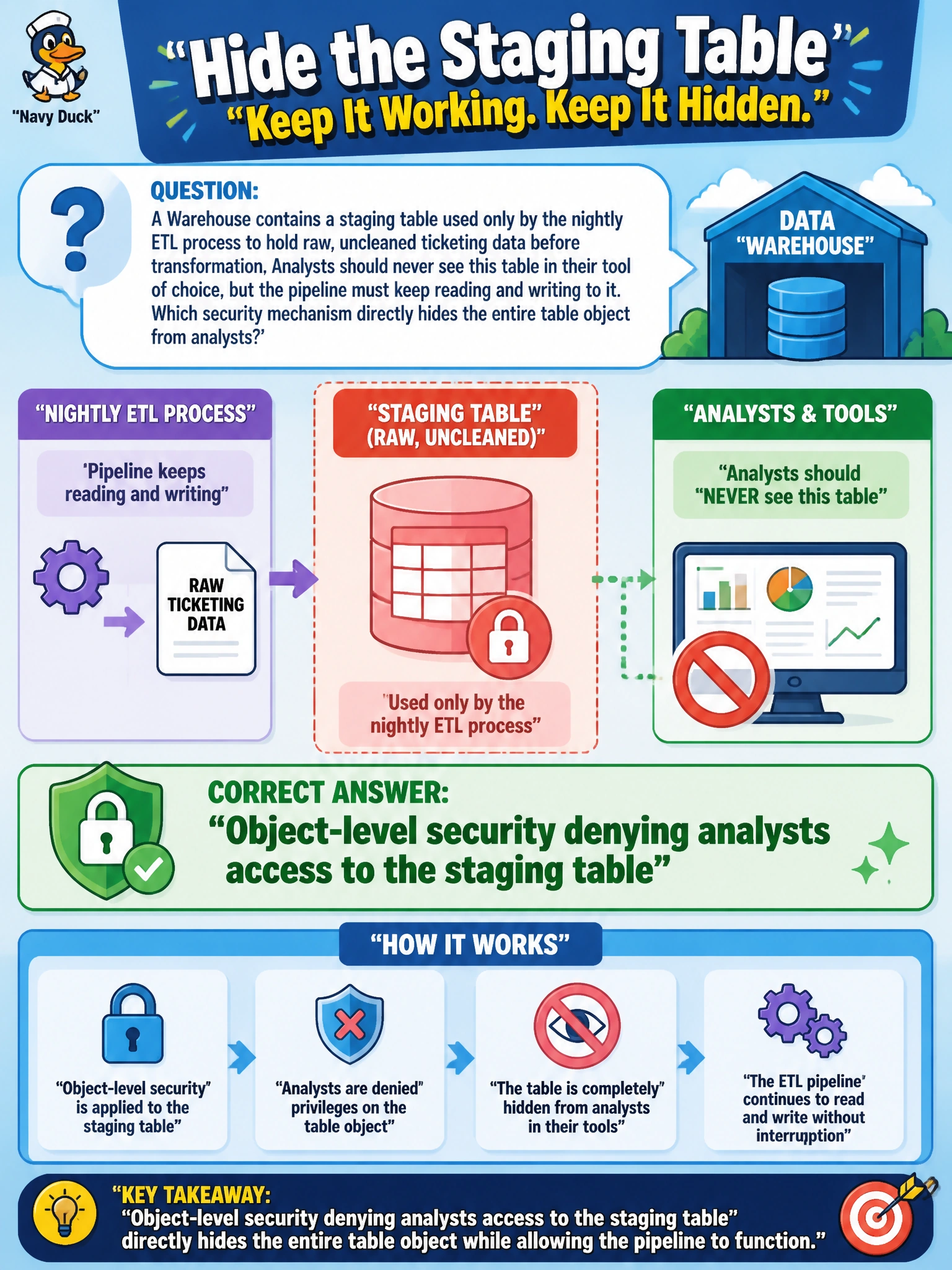
A Warehouse contains a staging table used only by the nightly ETL process to hold raw, uncleaned ticketing data before transformation. Analysts should never see this table in their tool of choice, but the pipeline must keep reading and writing to it. Which security mechanism directly hides the entire table object from analysts?
Select an answer to reveal the explanation.
Short Explanation
Object-level security is like a museum's staff-only storage room — no exhibit label, no visible door for visitors, but the loading crew still comes and goes through it every night to restock the galleries.
Full Explanation
Object-level security in a Fabric Warehouse grants or denies access at the level of the whole database object — a table, view, or stored procedure — rather than filtering its rows or masking its columns. Denying analysts access to the staging table hides it from them entirely (they can't query it and, with appropriate metadata permissions denied too, may not even see it listed), while the ETL pipeline's own service identity retains its separately granted read/write permissions and keeps operating unaffected. Row-level security would still let analysts see the table shape and any rows the predicate doesn't filter out — it doesn't hide the object itself, so it's the wrong tool when the whole table must disappear. Masking every column is a clumsy workaround that still exposes the table's existence and structure while adding overhead to every column, rather than solving the actual requirement. A OneLake role granting access to public tables only describes what analysts can see elsewhere, not a mechanism for blocking this specific staging table. To confirm, an engineer should query the Warehouse's object list as an analyst account and verify the staging table doesn't appear at all.