
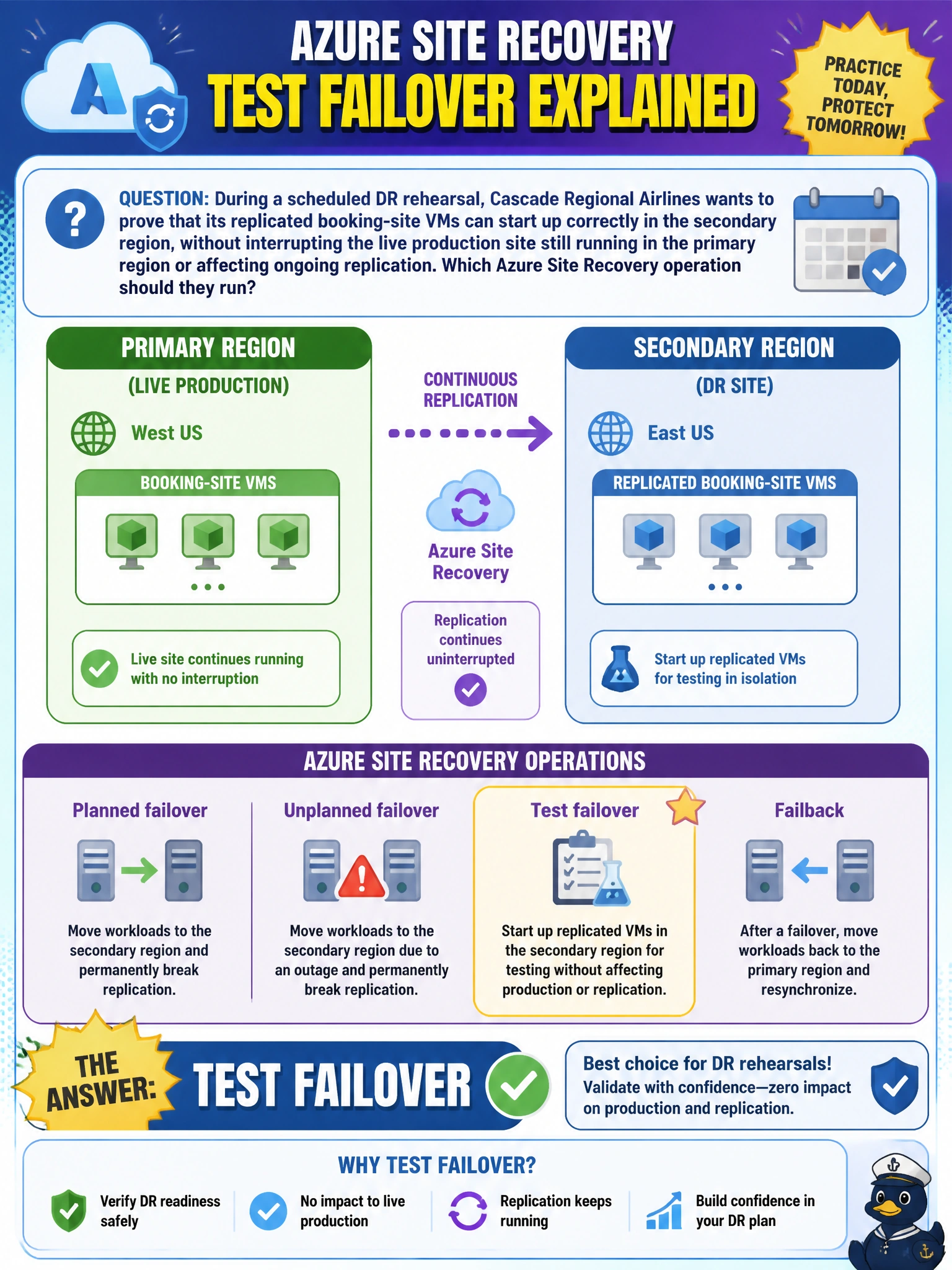
During a scheduled DR rehearsal, Cascade Regional Airlines wants to prove that its replicated booking-site VMs can start up correctly in the secondary region, without interrupting the live production site still running in the primary region or affecting ongoing replication. Which Azure Site Recovery operation should they run?
Select an answer to reveal the explanation.
Short Explanation
A test failover is a fire drill in an isolated network, not the real evacuation: it spins up the replicated VMs in a sandboxed copy of the network so the team can verify everything boots, while the real building keeps running and the sprinkler system (replication) never turns off.
Full Explanation
Test failover brings up the replicated VMs in the secondary region inside an isolated test network, which lets the team validate boot behavior, application startup, and connectivity without impacting the still-running production VMs in the primary region and without pausing or breaking ongoing replication, making it exactly the right operation for a non-disruptive DR rehearsal. A full failover is meant for an actual disaster or planned migration; it activates the replicated VMs as the live workload and disrupts or ends replication in the original direction, which is far more than a rehearsal calls for and risks a real production outage if done against the live network. Failback is the operation used after a real failover to move the workload back to the original region once it is healthy again, so it presumes a failover already happened and does not apply to a rehearsal of the initial failover step. Disabling replication stops the ongoing synchronization entirely, which would defeat the purpose of testing failover readiness and would leave the environment without disaster recovery protection until re-enabled and re-synced. After the rehearsal, the standard check is to clean up the test failover, which deletes the isolated test VMs and confirms replication health returns to normal.