
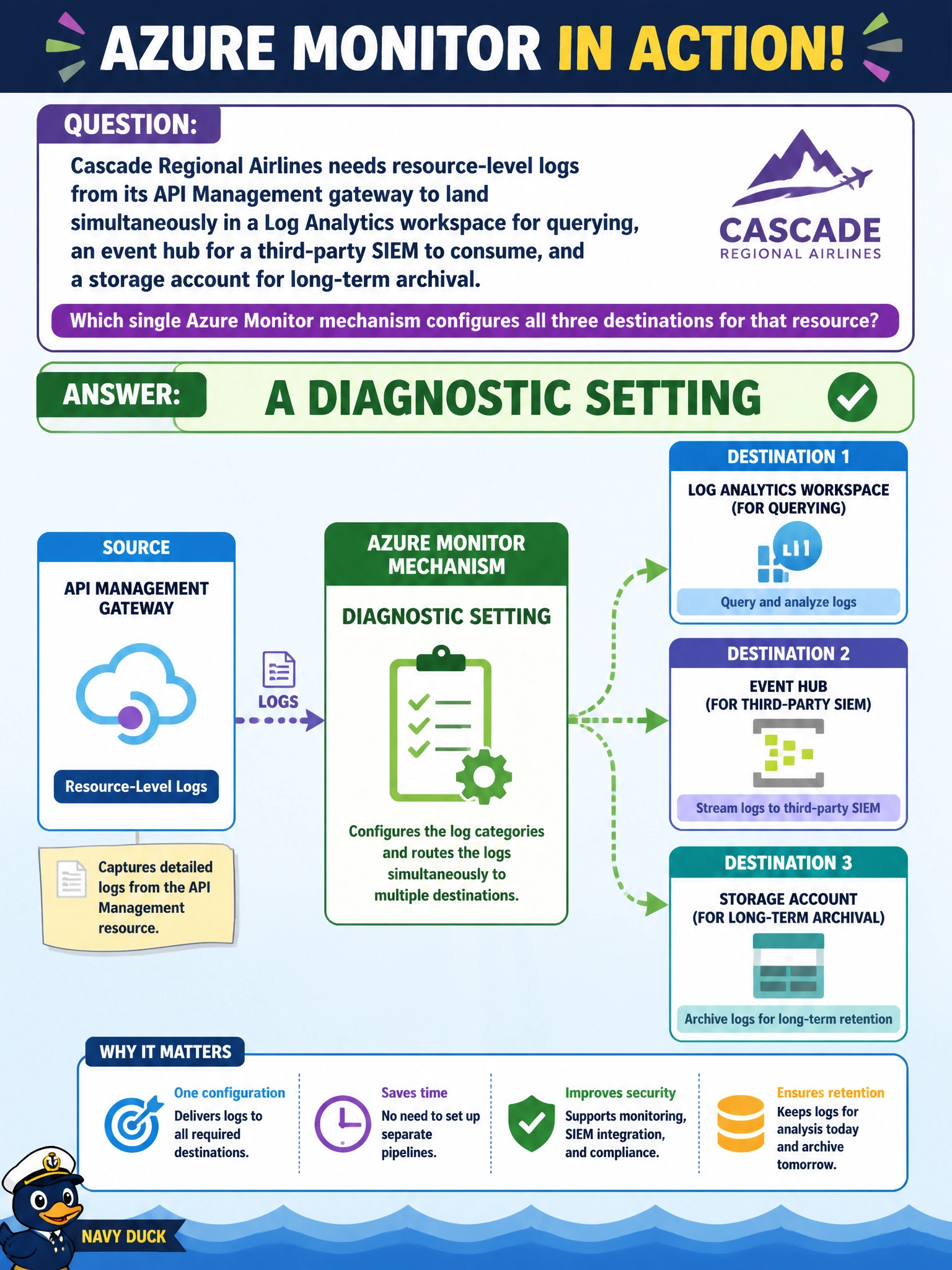
Cascade Regional Airlines needs resource-level logs from its API Management gateway to land simultaneously in a Log Analytics workspace for querying, an event hub for a third-party SIEM to consume, and a storage account for long-term archival. Which single Azure Monitor mechanism configures all three destinations for that resource?
Select an answer to reveal the explanation.
Short Explanation
A diagnostic setting is like a mail-forwarding rule that can copy the same letter to three different addresses at once: the resource's logs get sent to the workspace, the event hub, and the storage account simultaneously, without anyone manually copying data around.
Full Explanation
A diagnostic setting is configured directly on a resource, such as an API Management instance, and lets an administrator choose which log categories and metrics to export, along with up to several destinations at once, commonly a Log Analytics workspace, an event hub for streaming to external tools like a SIEM, and a storage account for cost-effective long-term retention. This makes it the single mechanism that can satisfy all three destinations from one configuration. An action group is a notification target invoked by alert rules once a condition fires; it has no capability to export raw resource logs anywhere. A recovery plan belongs to Azure Site Recovery and orchestrates the order in which virtual machines fail over during a disaster recovery event, which is unrelated to log routing. A backup policy defines schedule and retention rules for Azure Backup and likewise has nothing to do with exporting operational logs. After configuring the diagnostic setting, a practical check is to generate some gateway traffic and confirm records appear in all three destinations within the expected latency for each.