
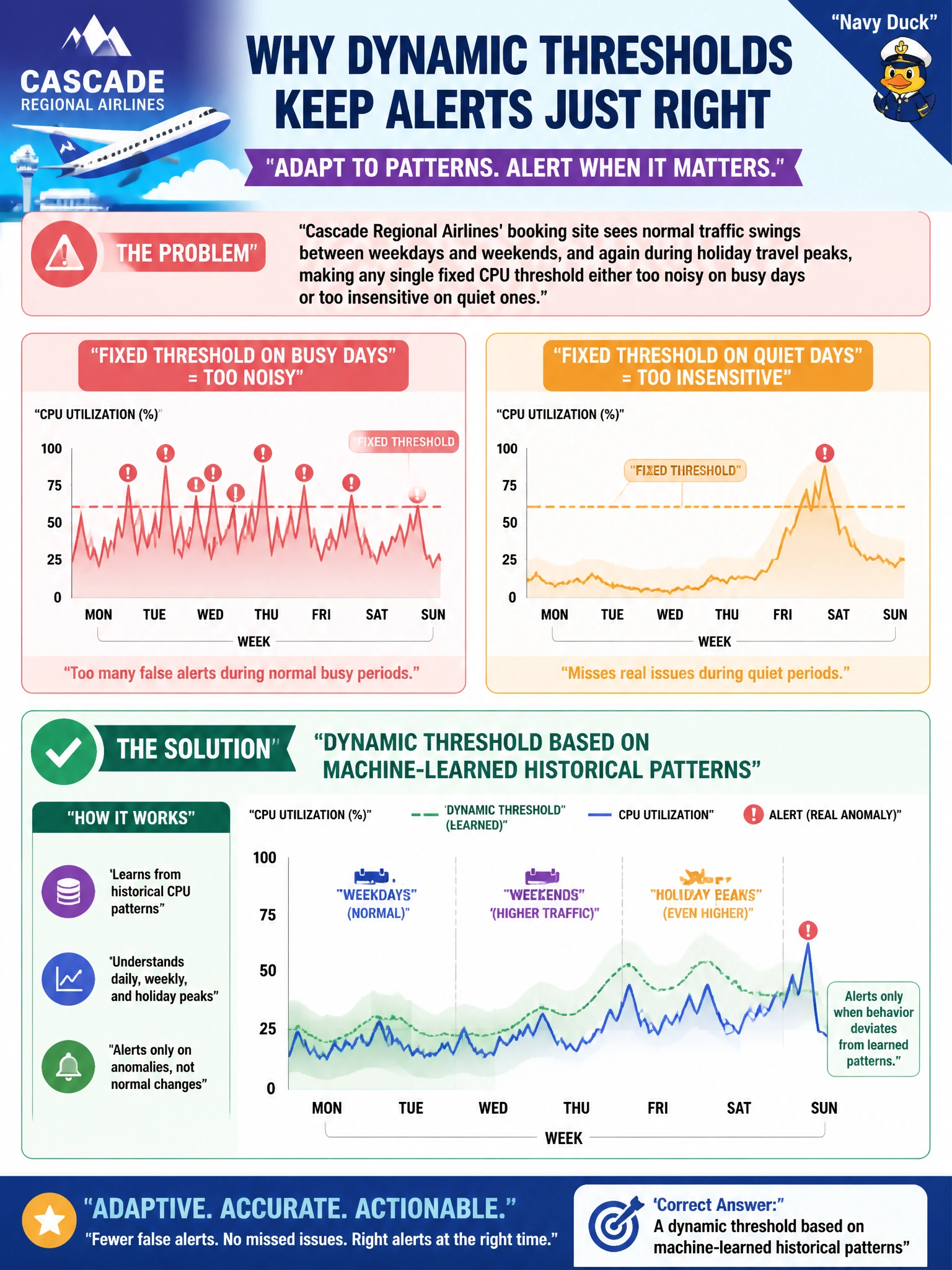
Cascade Regional Airlines' booking site sees normal traffic swings between weekdays and weekends, and again during holiday travel peaks, making any single fixed CPU threshold either too noisy on busy days or too insensitive on quiet ones. Which metric alert configuration adapts the threshold automatically to these learned patterns?
Select an answer to reveal the explanation.
Short Explanation
A dynamic threshold is like a thermostat that already knows Tuesdays run warmer than Sundays: it learns your normal ups and downs and only alerts when something is actually out of pattern for that particular day and hour.
Full Explanation
Dynamic thresholds use machine learning over the metric's historical behavior to establish an expected range that adapts to trends, seasonality, and known patterns like weekday-versus-weekend or holiday traffic, and it alerts only when the metric deviates meaningfully from that learned pattern rather than crossing one fixed number. A static threshold set to the highest observed value would essentially never fire during normal operation and would miss real problems on quieter days when a much lower CPU spike would still be abnormal. An activity log alert cannot evaluate numeric metrics at all, since it only reacts to control-plane events, so widening its time window does nothing for this problem. A scheduled query rule run once per day could theoretically compute statistics, but building and maintaining that seasonality logic by hand duplicates what dynamic thresholds already provide natively and reacts far too slowly for operational alerting. When enabling dynamic thresholds, the practical check is to review the alert's suggested threshold chart over a couple of weeks of real traffic before trusting it in production, since it needs a reasonable history to learn from.