
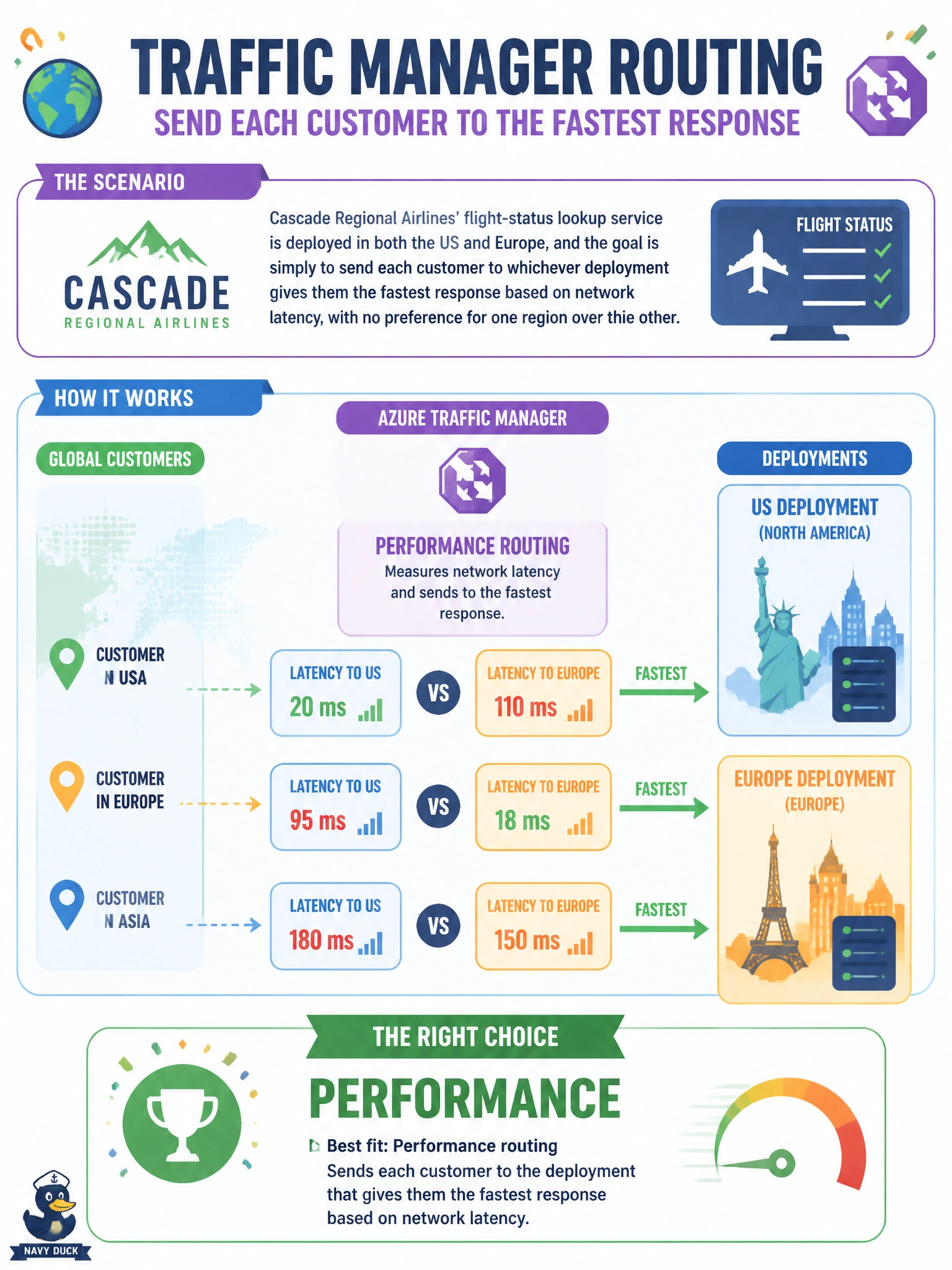
Cascade Regional Airlines' flight-status lookup service is deployed in both the US and Europe, and the goal is simply to send each customer to whichever deployment gives them the fastest response based on network latency, with no preference for one region over the other. Which Traffic Manager routing method fits this goal?
Select an answer to reveal the explanation.
Short Explanation
When you don't care which region wins, just which one is fastest for the person asking, that's a job for Performance routing. It uses Microsoft's latency measurements to send each customer to whichever endpoint will respond quickest for them.
Full Explanation
Performance routing in Traffic Manager uses an internally maintained latency table that maps the network origin of a DNS query to the Azure region with the lowest measured round-trip time, then returns the endpoint in that best-performing region — which is exactly the 'fastest response for each customer, no regional preference' requirement described. Priority routing instead enforces a strict active/passive order, always preferring one specific endpoint over others regardless of where the customer's request originates, which contradicts the goal of picking whichever region is genuinely fastest. Weighted routing distributes a fixed percentage split of traffic across endpoints regardless of the customer's location or actual latency, so it optimizes for traffic proportion, not speed. Subnet routing maps specific ranges of end-user IP addresses to specific endpoints for controlled testing or segmentation scenarios, which has nothing to do with automatically finding the lowest-latency path. The exam-relevant caveat: Performance routing decisions are based on Azure's own latency measurements between Azure regions and internet IP ranges, not a live per-request ping to the client, so results can lag real-time network conditions slightly. Operationally, confirm the method by checking the Traffic Manager profile's routing method field reads Performance and by resolving the profile's DNS name from test locations in both the US and Europe to see it return the geographically closer endpoint.