
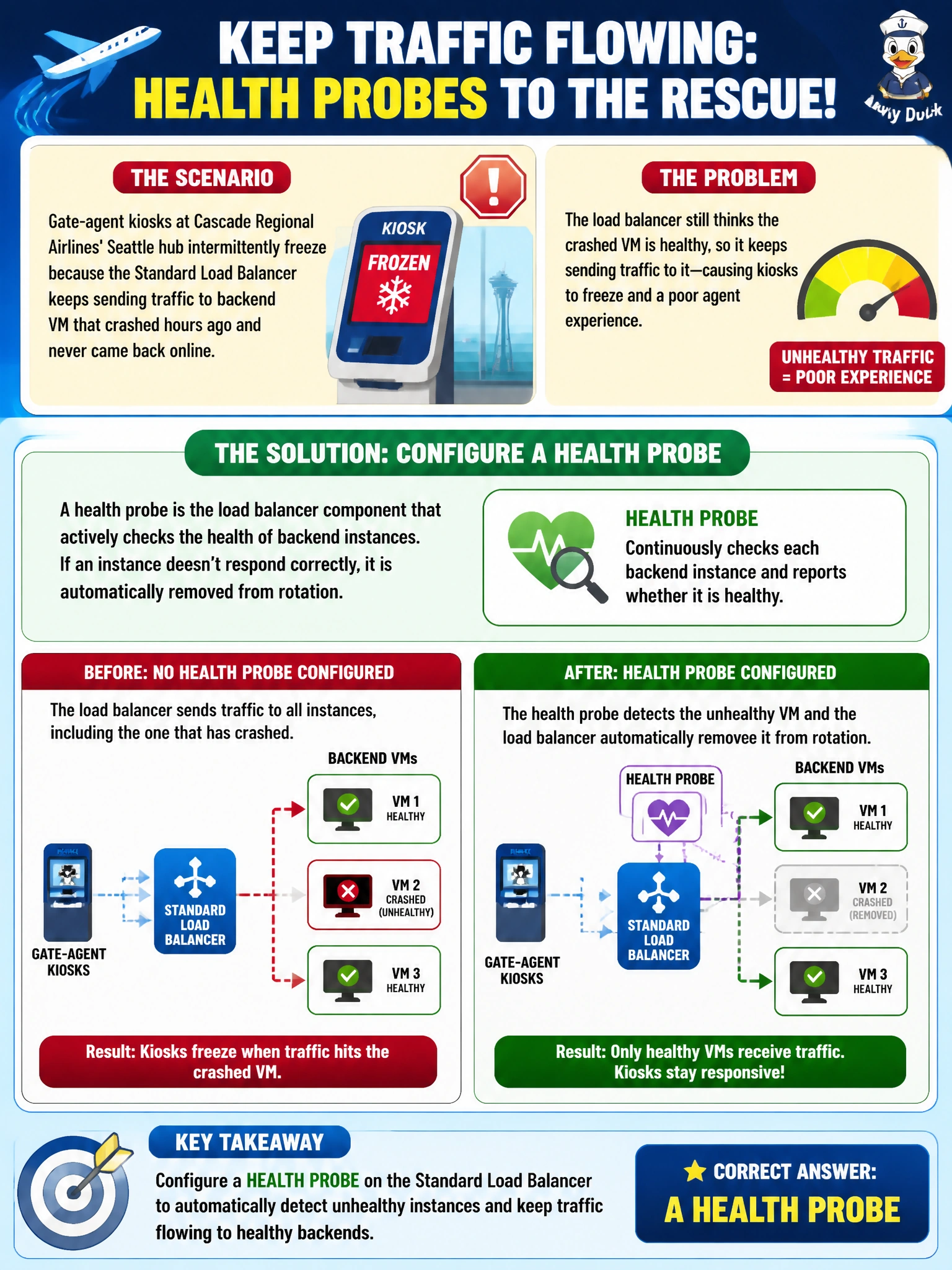
Gate-agent kiosks at Cascade Regional Airlines' Seattle hub intermittently freeze because the Standard Load Balancer keeps sending traffic to a backend VM that crashed hours ago and never came back online. Which load balancer component should the network team configure so unhealthy instances are automatically pulled out of rotation?
Select an answer to reveal the explanation.
Short Explanation
A load balancer that never checks its own backends is like a dispatcher who keeps sending calls to a phone nobody's answering. A health probe periodically knocks on each VM's door, and the moment one stops answering, it's quietly pulled out of the rotation until it recovers.
Full Explanation
A health probe sends repeated TCP, HTTP, or HTTPS checks to each instance in a backend pool on a defined interval, and any instance that fails the configured number of consecutive probes is marked unhealthy and removed from the load-balancing rotation until it starts responding correctly again. This is the mechanism that catches exactly the scenario described: a crashed VM that never recovered would keep failing probes indefinitely, so the load balancer would stop routing gate-agent traffic to it. The backend pool membership list only defines which VMs are eligible targets; it does nothing to detect whether a member is actually alive, so a crashed VM would stay listed and keep receiving traffic without a probe. An inbound NAT rule is for one-to-one management access to a single VM and plays no role in traffic distribution health. The frontend IP configuration only defines the public or internal address clients connect to; it has no awareness of backend state. An exam-relevant caveat: probe interval and unhealthy threshold determine how fast a failure is detected — a 5-second interval with a 2-failure threshold detects and reroutes around a dead instance far faster than a sparse 30-second probe. To verify, check the load balancer's health probe status in the portal or via the backend health API and confirm the crashed VM shows as unhealthy rather than unknown or healthy.