
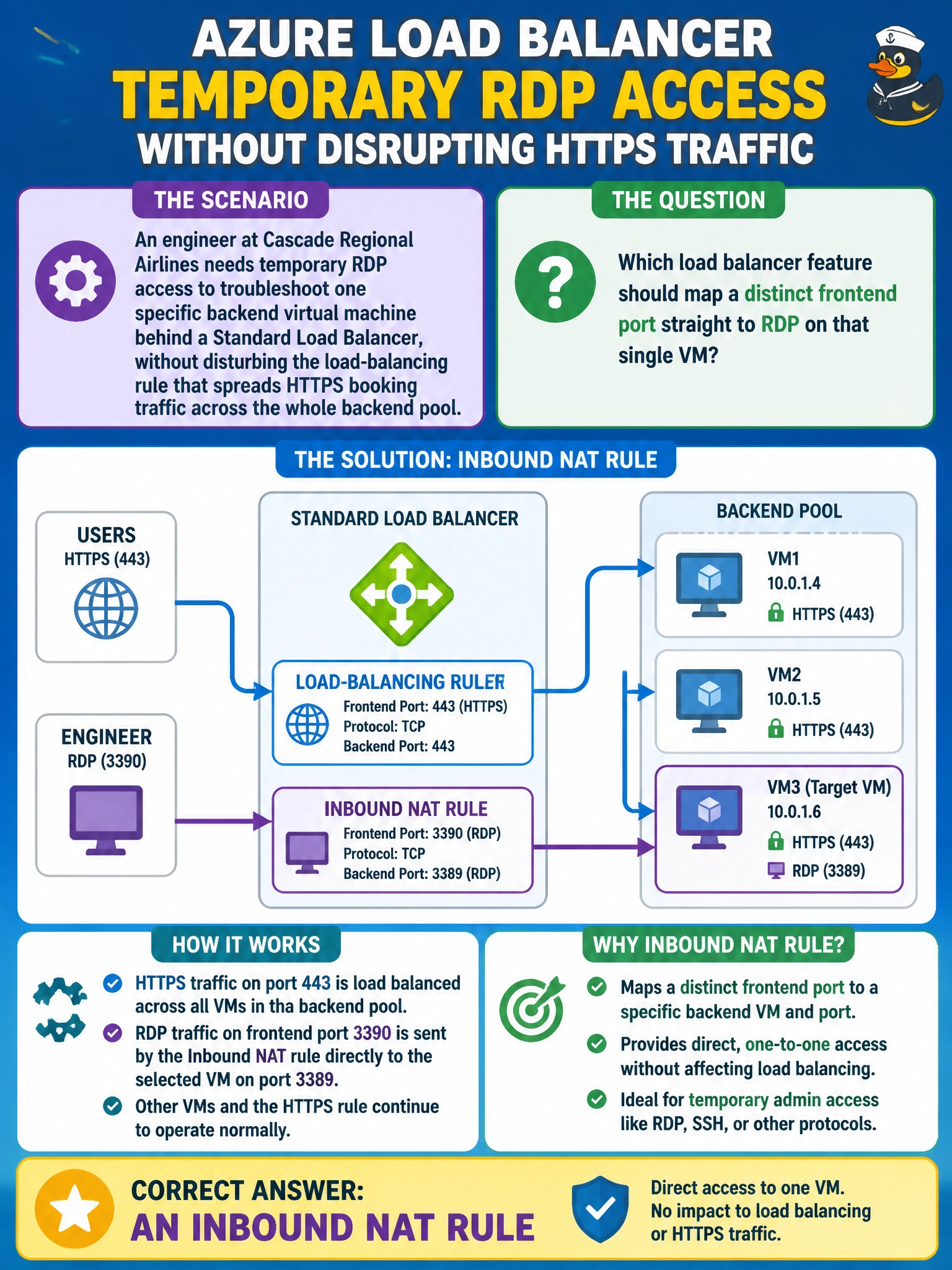
An engineer at Cascade Regional Airlines needs temporary RDP access to troubleshoot one specific backend virtual machine behind a Standard Load Balancer, without disturbing the load-balancing rule that spreads HTTPS booking traffic across the whole backend pool. Which load balancer feature should map a distinct frontend port straight to RDP on that single VM?
Select an answer to reveal the explanation.
Short Explanation
A load-balancing rule is for spreading traffic across many machines, but sometimes you just need a private line to one specific box. That's exactly what an inbound NAT rule does — it punches a dedicated port through to a single backend VM, no distribution involved.
Full Explanation
An inbound NAT rule forwards traffic that arrives on a specific frontend IP and port directly to a specific port on one backend VM, which is precisely the many-to-one mapping needed for ad hoc management access like RDP or SSH to a single instance. A load-balancing rule works the opposite way: it distributes traffic arriving on one frontend port across every healthy VM in a backend pool, which would make an RDP session land unpredictably on whichever instance the algorithm picked next. A health probe is unrelated to forwarding traffic at all — it periodically checks backend instance health so the load balancer knows which pool members should keep receiving traffic, and removing an unhealthy one from rotation is its only job. A backend pool is simply the named group of VMs or NICs that rules target; it has no routing logic of its own. The caveat worth remembering for the exam: each inbound NAT rule targets one specific backend VM, so troubleshooting several machines means several NAT rules (or the newer NAT rule bulk/pool-based option), not one shared rule. To verify this in practice, open the network interface of the target VM and confirm the load balancer's inbound NAT rules blade shows the frontend port mapped to port 3389 on that exact VM's private IP.