
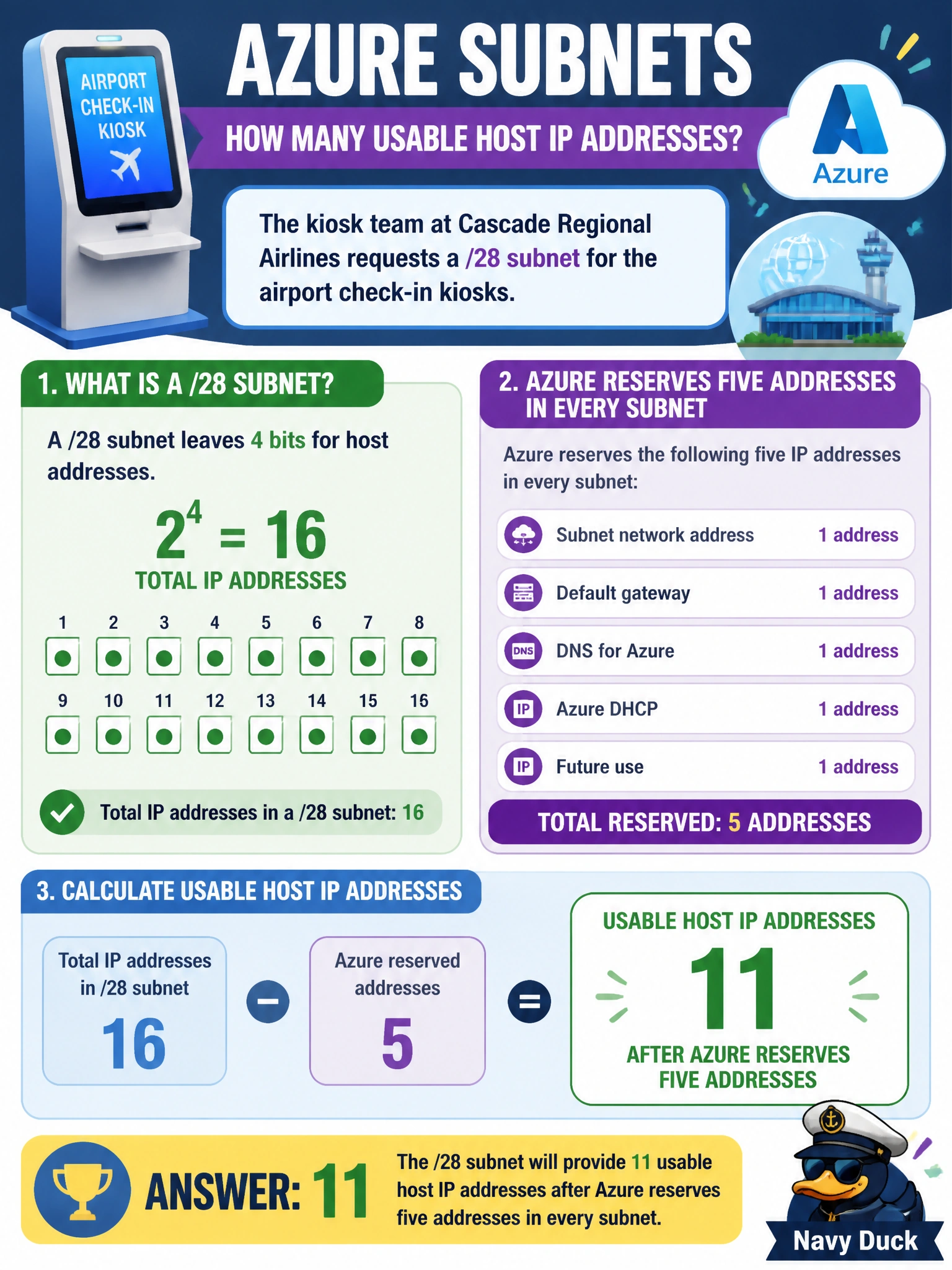
The kiosk team at Cascade Regional Airlines requests a /28 subnet for the airport check-in kiosks. How many usable host IP addresses will that subnet actually provide once Azure's reserved addresses are accounted for?
Select an answer to reveal the explanation.
Short Explanation
A /28 gives you 16 total addresses, but Azure isn't handing all of them to your VMs. It keeps five for itself in every single subnet, no matter how big or small: the network address, the broadcast address, and three more for its own internal plumbing. That leaves 11 you can actually assign.
Full Explanation
Every Azure subnet, regardless of size, reserves five IP addresses: the network address (first), the broadcast address (last), and three more used internally for Azure's DNS and management services. For a /28, which contains 16 total addresses (2^4), subtracting those five reserved addresses leaves 11 usable addresses for VM NICs and other resources. The distractor at 16 ignores reservations entirely and treats the block as if every address were assignable. The distractor at 14 applies the traditional on-premises networking rule of reserving only two addresses (network and broadcast), which does not match how Azure allocates subnets. The distractor at 13 assumes only three reserved addresses, undercounting by two. This reservation applies uniformly across every subnet size in a VNet, so a /24 loses the same five addresses a /28 does, just as a smaller fraction of the total. When sizing a subnet for a known number of hosts, an engineer should always plan for total addresses minus five, and can verify the actual usable count in the Azure portal's subnet overview, which lists ‘Available addresses’ directly.