
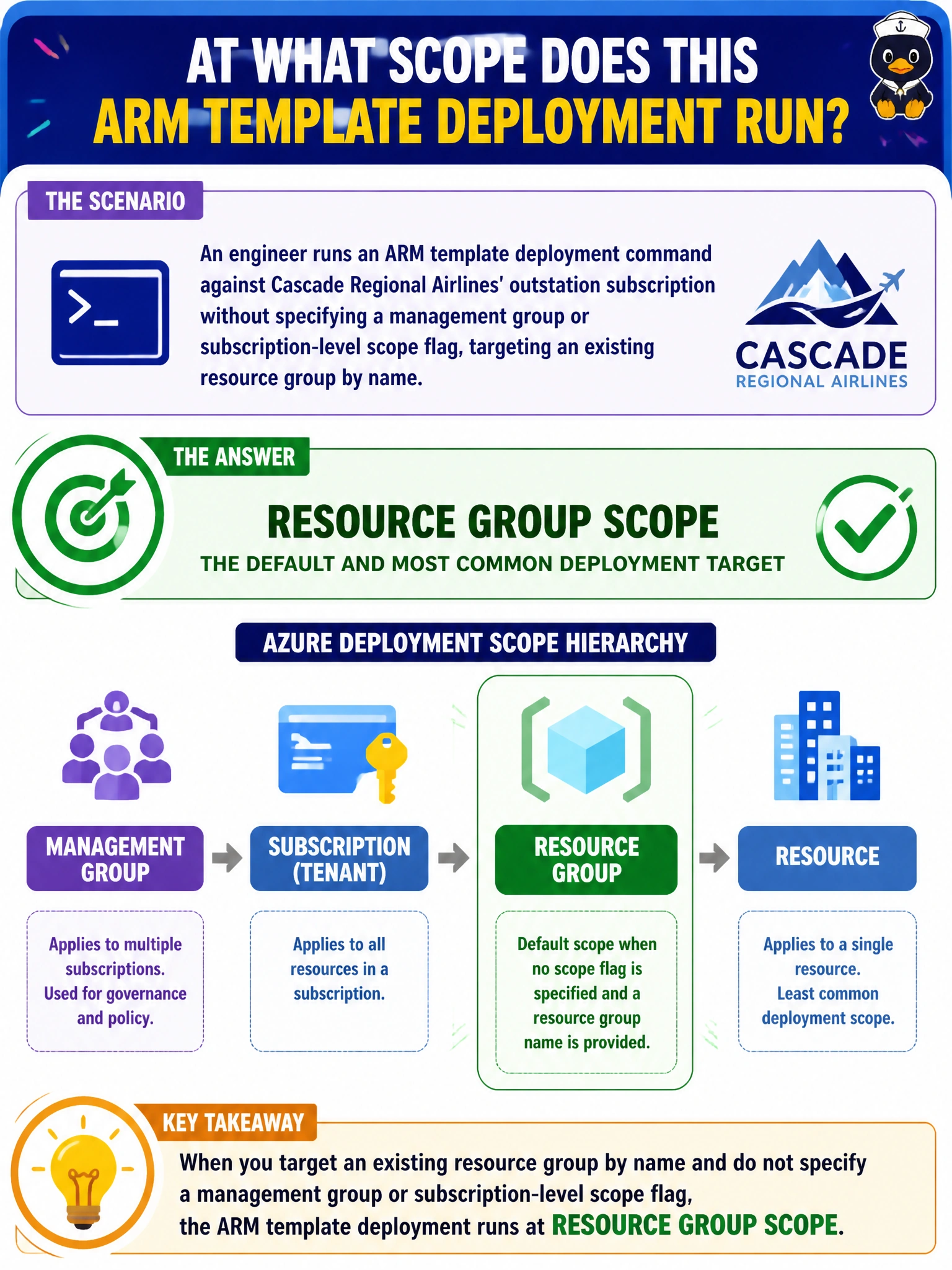
An engineer runs an ARM template deployment command against Cascade Regional Airlines' outstation subscription without specifying a management group or subscription-level scope flag, targeting an existing resource group by name. At what scope does this deployment run?
Select an answer to reveal the explanation.
Short Explanation
Resource group scope is the everyday default. Unless the engineer explicitly asks for a subscription, management group, or tenant deployment, the template lands its resources inside the resource group named on the command.
Full Explanation
Resource group scope is where the large majority of ARM and Bicep deployments target, and it is the implicit default when a deployment command names a resource group without an explicit higher-level scope flag. Resources like virtual machines, virtual networks, and storage accounts live at this scope and are what most templates declare. Tenant scope is a distinct, rarely used target reserved for deployments that must operate across the entire directory, such as certain tenant-wide policy or role assignments, and it requires an explicit tenant-scope deployment command; it is never the silent default. Management group scope is used for deployments that need to apply across multiple subscriptions, such as policy definitions inherited by every subscription under that group, and also requires being explicitly targeted. Simply belonging to a subscription does not make a resource group deployment a subscription-scope deployment; subscription scope is reserved for resources that exist at the subscription level itself, like creating the resource group. A quick check is reviewing the deployment command's target parameter, which will show the resource group name when no higher scope was requested.