
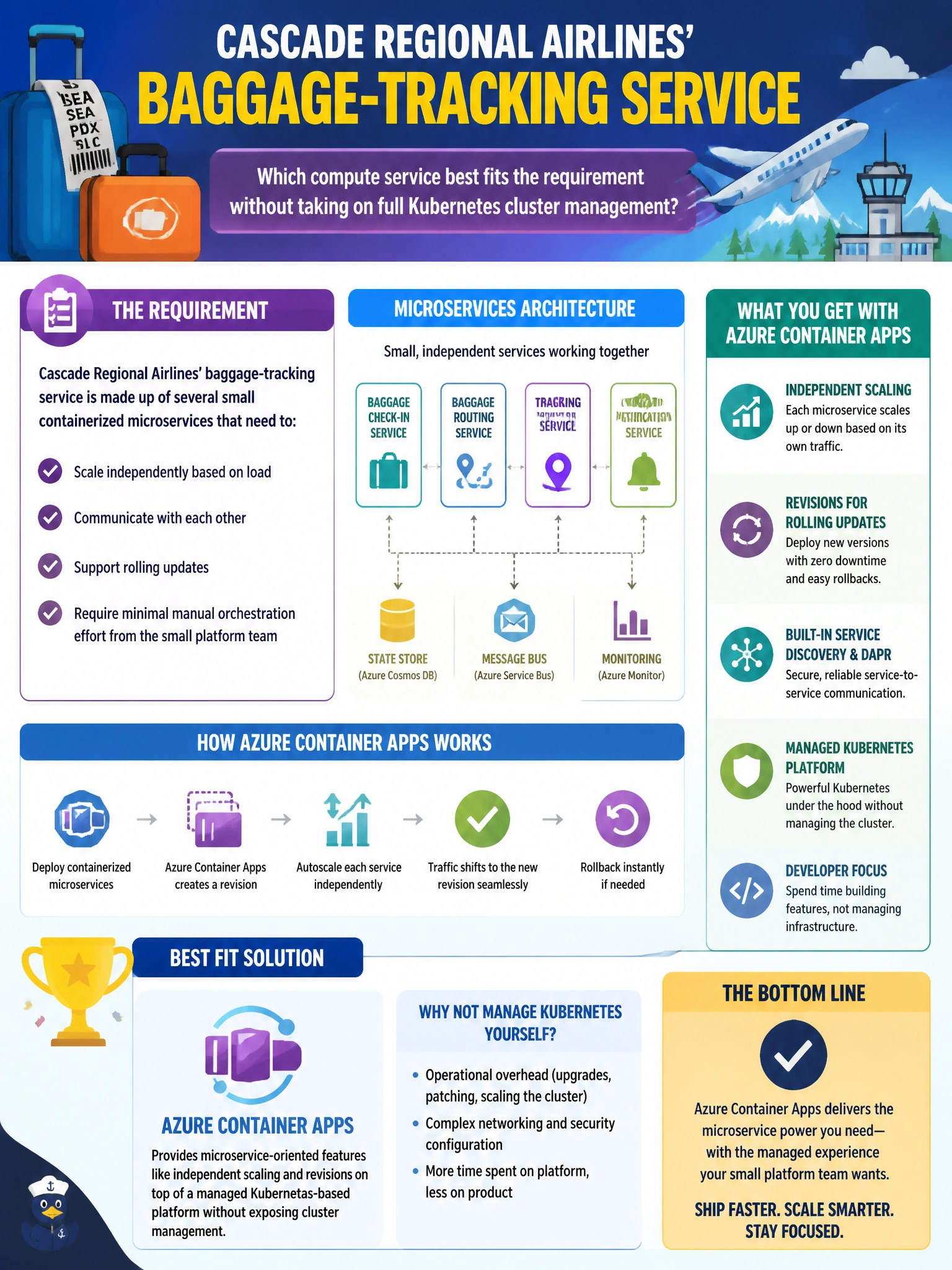
Cascade Regional Airlines' baggage-tracking service is made up of several small containerized microservices that need to scale independently based on load, communicate with each other, and support rolling updates with minimal manual orchestration effort from the small platform team. Which compute service best fits this requirement without taking on full Kubernetes cluster management?
Select an answer to reveal the explanation.
Short Explanation
You want the microservices benefits — independent scaling, revisions, service-to-service traffic — without a small team having to babysit a Kubernetes cluster. Azure Container Apps is built for exactly that middle ground: it runs on managed Kubernetes underneath but hides the cluster from you.
Full Explanation
Azure Container Apps is a serverless container platform purpose-built for microservice architectures: each container app can scale independently based on HTTP traffic or custom metrics, supports revisions for rolling updates and traffic splitting, and includes built-in service discovery and Dapr integration for service-to-service communication, all without the team ever provisioning or patching a Kubernetes cluster. A single ACI container group is not designed to host multiple independently scaling services; containers within one group scale and restart together as a unit, which does not satisfy an independent-scaling requirement across services. Azure Kubernetes Service can absolutely run communicating microservices, but it is not the only option, and choosing it here means the small platform team takes on full responsibility for cluster upgrades, node pool management, and networking configuration — overhead the requirement explicitly wants to avoid. Running all microservices as processes on scale set VMs abandons the isolation, independent scaling, and lifecycle management that containers are meant to provide, and turns deployment and scaling into manual per-VM work. As an operational check, review the number of distinct scaling triggers and revision-management needs across the microservices; if that list keeps growing toward custom scheduling or storage orchestration Container Apps doesn't cover, that is the signal to reconsider AKS with dedicated platform ownership.