
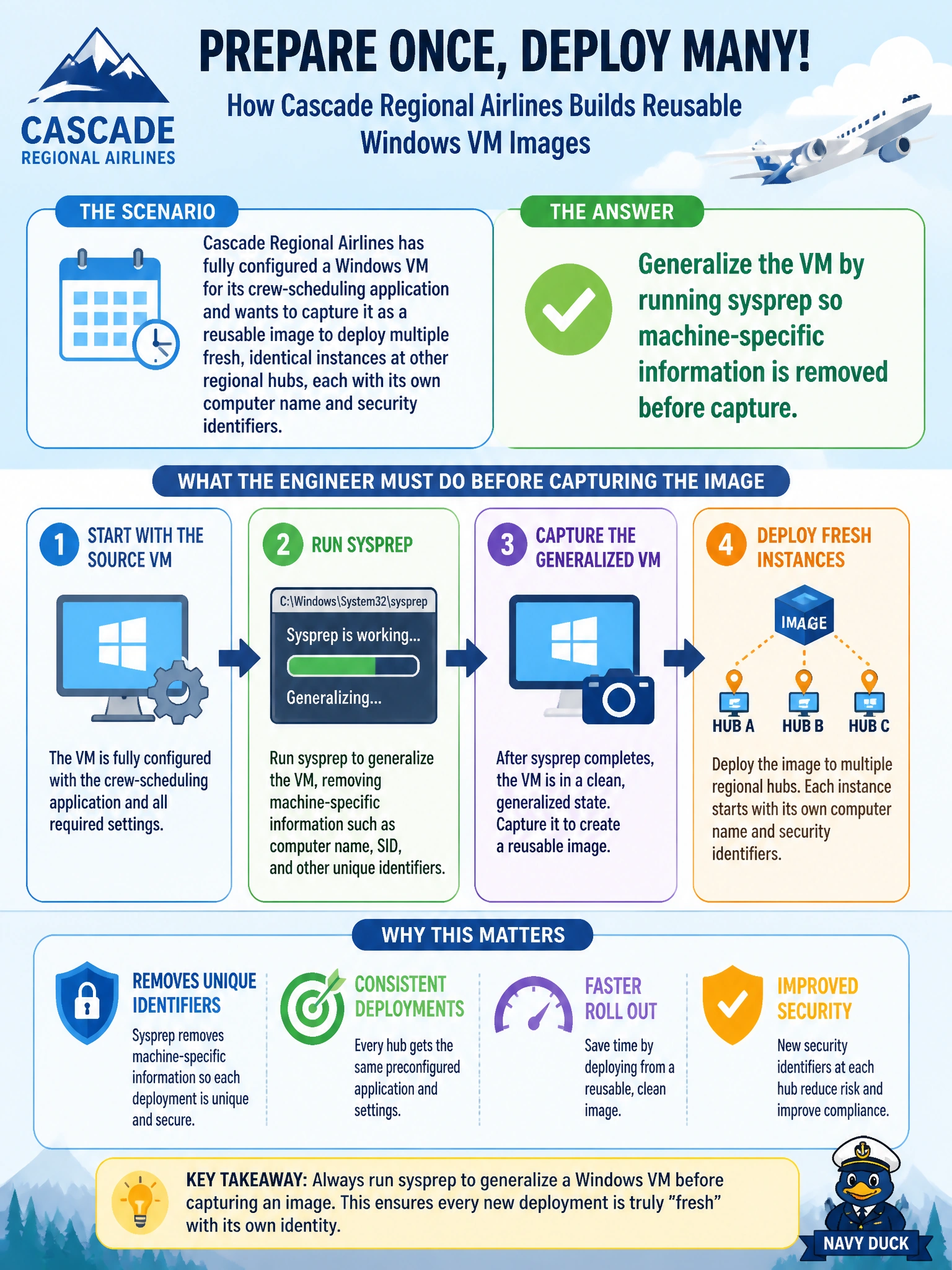
Cascade Regional Airlines has fully configured a Windows VM for its crew-scheduling application and wants to capture it as a reusable image to deploy multiple fresh, identical instances at other regional hubs, each with its own computer name and security identifiers. What must the engineer do to the source VM before capturing the image?
Select an answer to reveal the explanation.
Short Explanation
A generalized image is like a blank template that's been wiped of anyone's name and address, ready for whoever uses it next to fill in their own details. Running sysprep strips out the computer name, security identifiers, and other machine-specific settings from the source VM. Skip that step and every VM you spin up from the image thinks it's still the original machine.
Full Explanation
Generalizing a VM with sysprep removes machine-specific information — the computer name, SID, and related state — so the resulting image can be used as a clean template for deploying many new, independent VMs, each getting its own identity at first boot. This is the required prerequisite before capturing a reusable image from a VM that will spawn multiple instances, as opposed to capturing a specialized image, which preserves the original VM's identity and is meant for restoring or cloning a single specific machine, not for fleet deployment. A data-disk-only snapshot ignores the OS disk entirely, so it captures none of the configured application or OS state that makes the image worth reusing. Simply attaching an unmodified VM to an Azure Compute Gallery doesn't solve the identity problem — the gallery is a distribution and versioning mechanism for images, not a substitute for generalizing the source VM first. A custom script extension that renames the computer after each reboot treats a symptom with brittle scripting instead of addressing the actual cause, and it wouldn't touch the underlying SID conflicts either. As an operational check, confirm the source VM shows a 'Generalized' provisioning state in Azure before starting the capture, since a specialized VM can't be captured as a generalized image.