
An organization's marketing team and finance team both want to experiment with Foundry-hosted models, but each team needs its own isolated connections, quota, and deployed models without affecting the other team's resources, while still sharing centrally managed networking and security settings set by IT. How should the organization structure this in Azure AI Foundry?
Select an answer to reveal the explanation.
Short Explanation
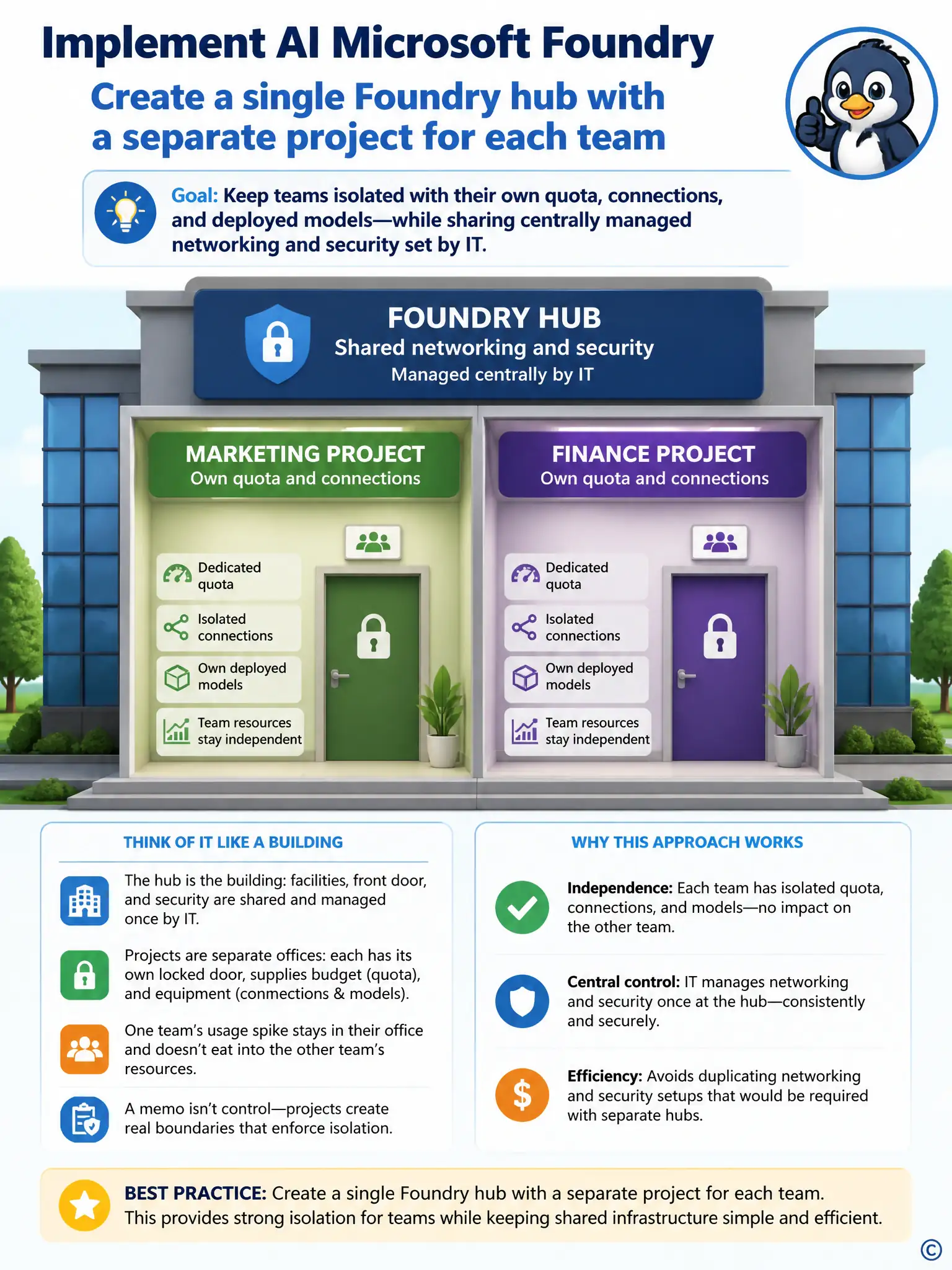
Think of the hub as the building and the projects as separate offices inside it. You give each team its own locked door, quota, connections, and deployed models, while IT still manages networking and security once. That keeps marketing and finance isolated without duplicating the shared infrastructure.
Full Explanation
The correct approach is creating a single Foundry hub with a separate project for each team. A single Foundry hub lets an organization centrally manage networking, security, and governance settings, while separate projects underneath that hub give each team, in this case marketing and finance, its own isolated connections, quota, and deployed models, without one team's usage affecting the other's. The approach of creating one Foundry project and giving both teams the same API key is incorrect because putting both teams in one project with a shared API key means they draw from the same quota and deployments, so heavy usage by one team can throttle or interfere with the other, which is exactly the isolation the organization wants to avoid. The approach of creating two entirely separate Azure subscriptions with no shared configuration is incorrect because entirely separate subscriptions with no shared configuration would force IT to duplicate networking and security setup for each team rather than manage it centrally, which contradicts the requirement to keep those settings shared and centrally controlled. The approach of creating one Foundry project and relying on system message instructions to keep each team's usage separate is incorrect because system message instructions only shape how a model responds within a conversation; they have no ability to separate quota, connections, or deployed resources between teams. Since the requirement is isolated resources per team alongside shared centrally managed infrastructure, a hub-and-project structure is the mechanism designed for that exact split.