
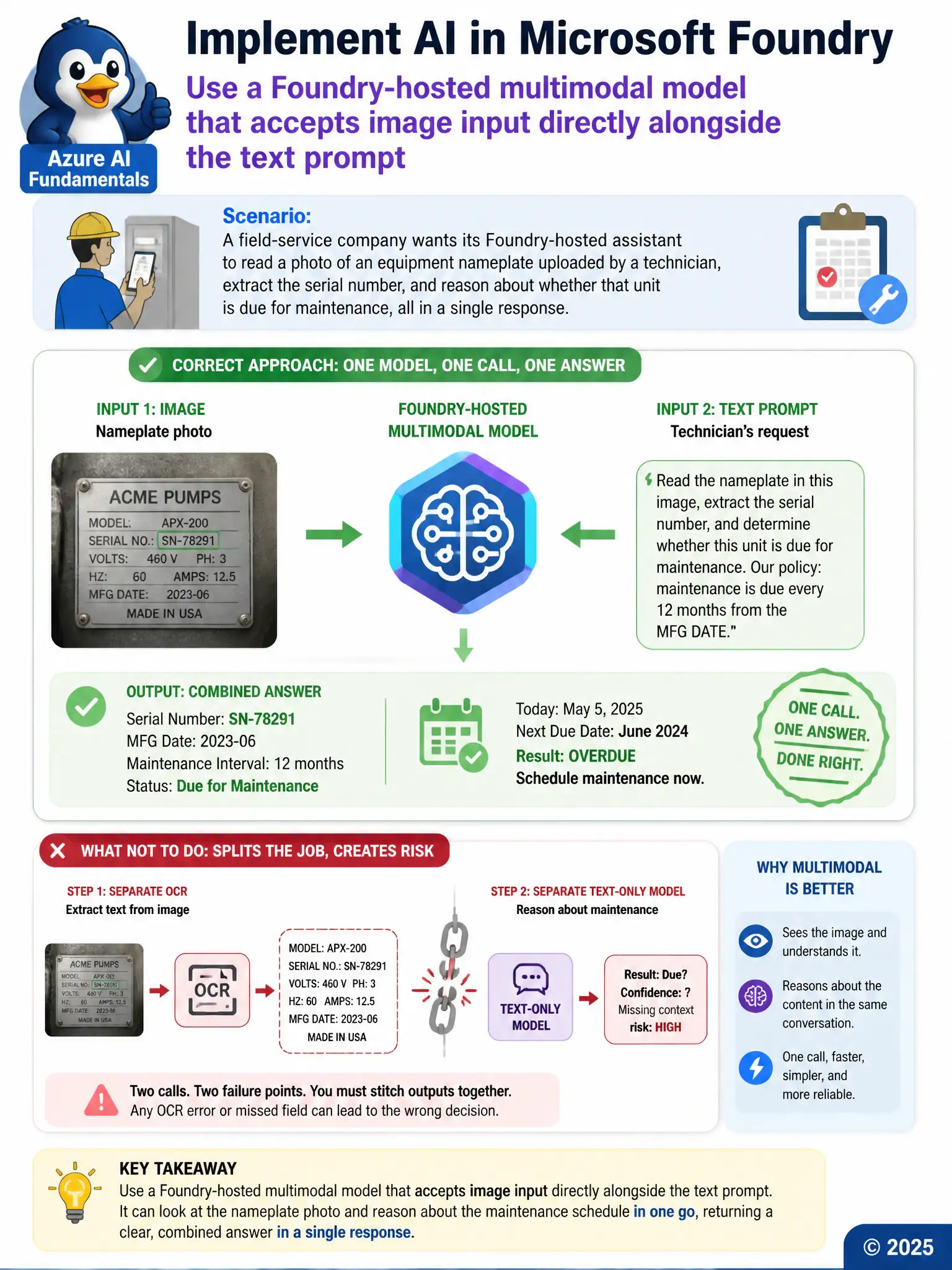
A field-service company wants its Foundry-hosted assistant to read a photo of an equipment nameplate uploaded by a technician, extract the serial number, and reason about whether that unit is due for maintenance, all in a single response. Which approach best fits this need?
Select an answer to reveal the explanation.
Short Explanation
You need a Foundry-hosted multimodal model that can look at the nameplate photo and reason about maintenance in the same response. A text-only model can't see the image, and splitting the job into separate OCR and reasoning steps just makes it more fragile. Cropping helps, but it doesn't replace a model that can actually read the photo.
Full Explanation
The correct approach is to use a Foundry-hosted multimodal model that accepts image input directly alongside the text prompt. That lets the assistant read the serial number from the nameplate photo and reason about whether the unit is due for maintenance in one call, which matches exactly what the scenario requires. The text-only approach with the image's file path pasted into the prompt is incorrect because a text-only model cannot interpret pixel data from a file path string; a path is just text and gives the model no visual information to read. The separate OCR approach is incorrect because manually running a separate OCR step and stitching its output into a second, unrelated text-only request adds unnecessary integration complexity and a second point of failure when a single multimodal call already handles both extraction and reasoning together. The tight-cropping approach is incorrect because cropping alone does not guarantee accurate extraction; image quality, lighting, and angle also affect legibility, and cropping is a helpful practice, not a substitute for using a model actually capable of reading images.