
A travel-planning assistant built with Foundry Agent Service needs to book a flight by calling the company's internal reservation system in real time and returning a confirmation number to the traveler. The team wants the agent to reliably invoke that API with the correct structured parameters rather than guessing from free text. What should they configure?
Select an answer to reveal the explanation.
Short Explanation
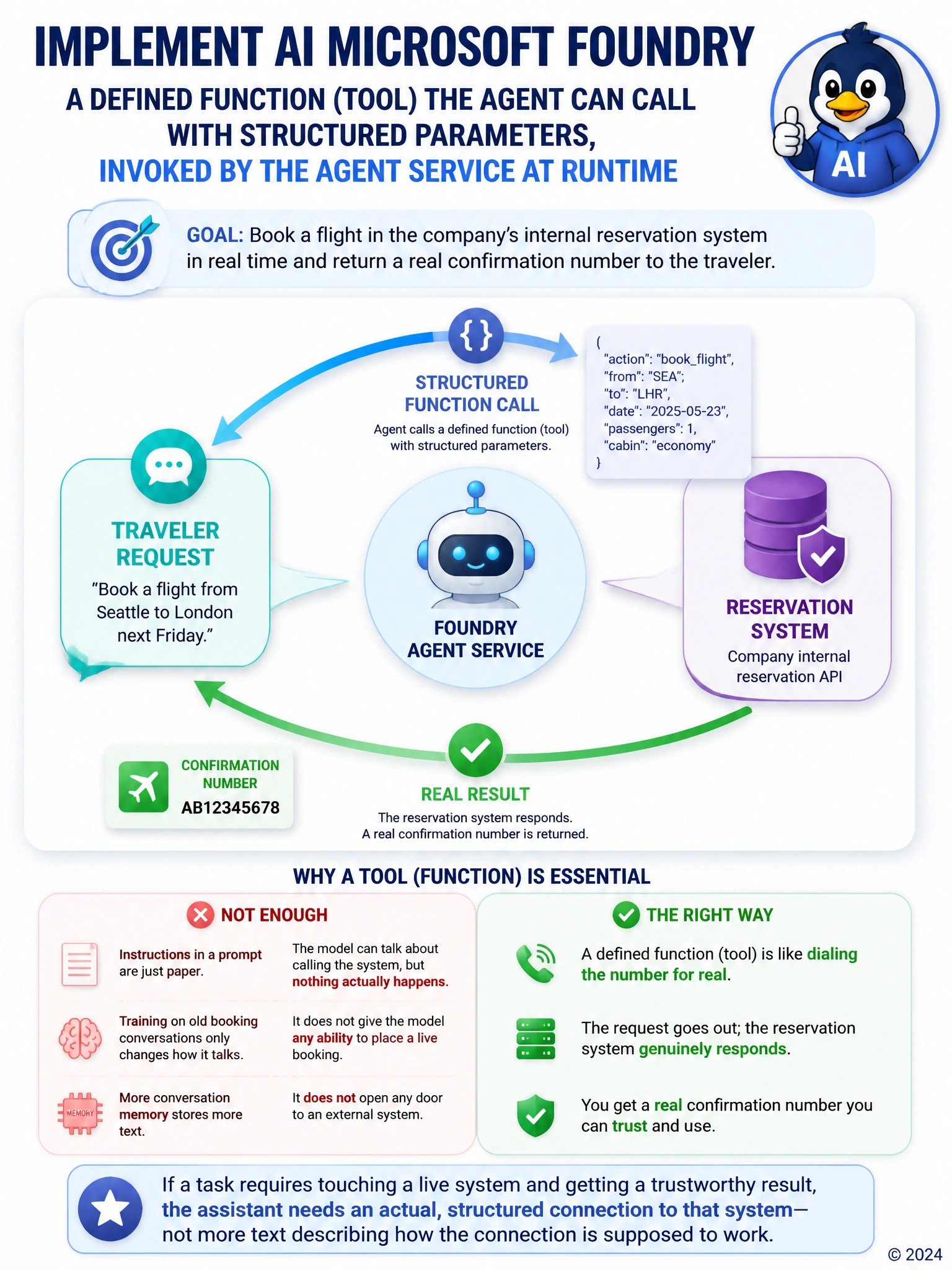
Imagine giving someone a phone number written on paper versus actually dialing it for them. Handing instructions in a prompt is like the paper: the model can talk about calling the reservation system, but nothing actually happens, and any confirmation number it gives back is something it made up to sound plausible. Defining a proper function or tool is like dialing the number yourself, so the request genuinely goes out, the reservation system genuinely responds, and the number that comes back is real. Training the model on old booking conversations only changes how it talks about bookings, not whether it can place one, and giving it a bigger memory for the conversation does not open any door to an external system either. If a task requires touching a live system and getting a trustworthy result, the assistant needs an actual, structured connection to that system, not more text describing how the connection is supposed to work.
Full Explanation
The correct answer is D. Defining a function, or tool, with a structured parameter schema lets the agent service actually invoke the reservation API at runtime with validated arguments and return the real result, such as a genuine confirmation number, back into the conversation. This is the mechanism built for connecting an agent to a live external system. Option A is incorrect because pasting API documentation into the system message only gives the model text to reason about; it cannot make the model actually call the endpoint, and any confirmation number it produces would be fabricated rather than real. Option B is incorrect because fine-tuning changes the model's conversational style and phrasing based on past transcripts, but it does not grant the model runtime access to call an external system. Option C is incorrect because a larger context window lets the model retain more conversation history, which has no bearing on whether it can execute a real API call and return an authentic result.