
A media company is choosing which model to use for a new Foundry-hosted summarization feature. Several candidate models in the model catalog could plausibly work, and the team wants to compare their quality, cost per token, and expected latency before committing engineering time to build against any single one. What should they do first?
Select an answer to reveal the explanation.
Short Explanation
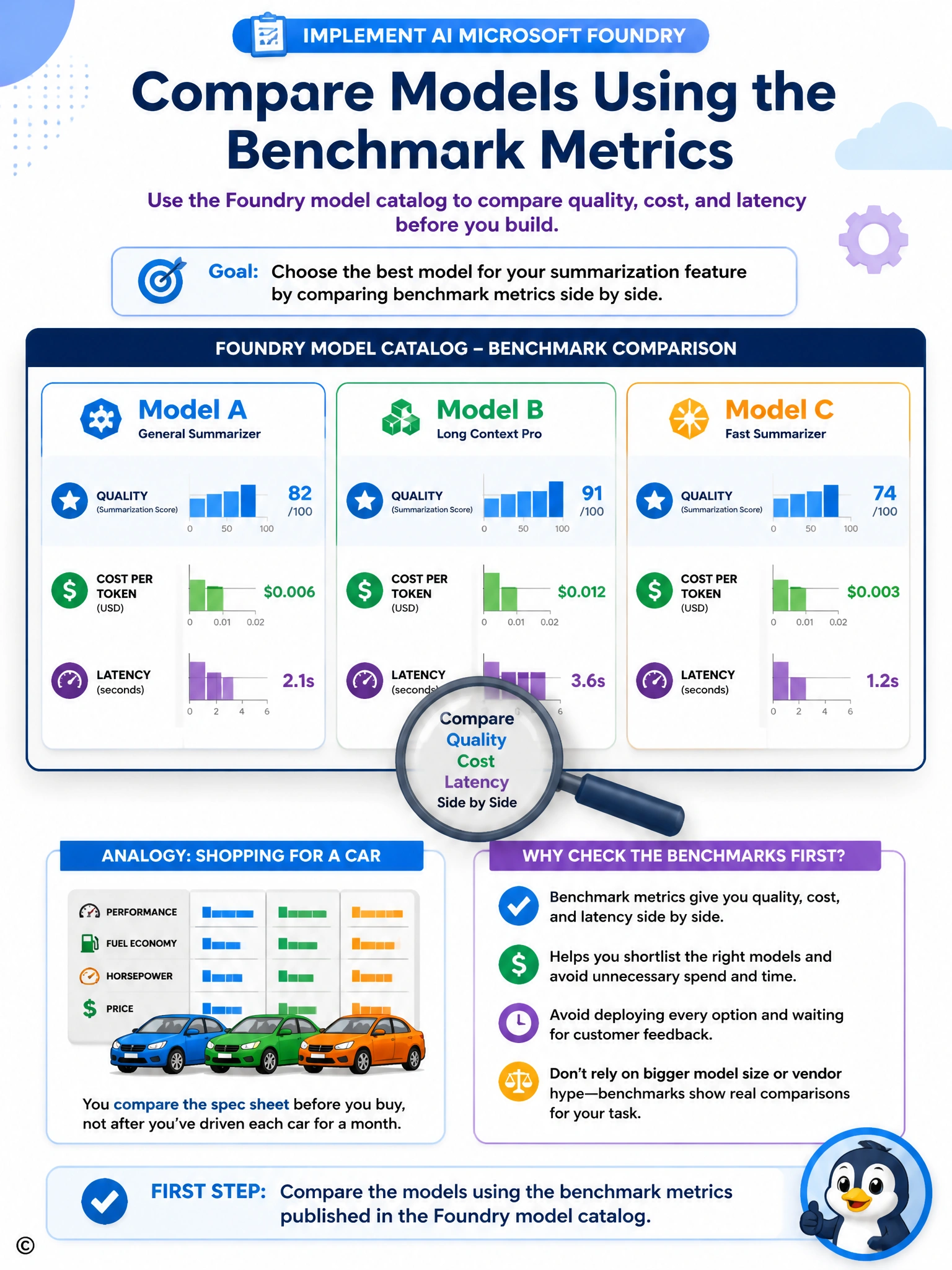
When you are shopping for a car, you do not buy five cars and drive each one for a month to figure out which is best. You look at the spec sheet, fuel economy, horsepower, price, all lined up so you can compare apples to apples before signing anything. The model catalog's benchmark data works the same way, giving quality, cost, and latency numbers for each candidate side by side so the team can shortlist before writing a single line of integration code. Deploying every option straight to production and watching what customers say is the slow, expensive version of test-driving five cars for a month each. Bigger parameter counts sound impressive but do not reliably translate into better summaries, cheaper calls, or faster responses for this specific task. And trusting a vendor's own description of how good their model is skips the comparison entirely, since that description was never designed to be a fair measurement against the alternatives.
Full Explanation
The correct answer is C. Azure AI Foundry's model catalog publishes benchmark data such as quality scores, cost per token, and latency for many models side by side, letting the team compare candidates before writing any integration code or spending on production traffic. This directly answers the stated need to evaluate options up front. Option A is incorrect because deploying every candidate to production and waiting on customer feedback is slow, expensive, and risks exposing real customers to a poorly suited model for weeks before a decision is made. Option B is incorrect because parameter count alone does not reliably predict summarization quality, cost, or latency; smaller models are frequently competitive or superior on specific tasks. Option D is incorrect because vendor marketing descriptions are not independently verified and can overstate capability, whereas the catalog's benchmark data comes from consistent, comparable evaluation runs the team can inspect directly.