
A retail company deploys a small text-classification model in Azure AI Foundry to tag support emails by topic. Traffic is sporadic, sometimes zero calls for hours and sometimes a short burst during a sale. The team wants to minimize cost without committing to reserved capacity they might not use. Which deployment approach best fits this pattern?
Select an answer to reveal the explanation.
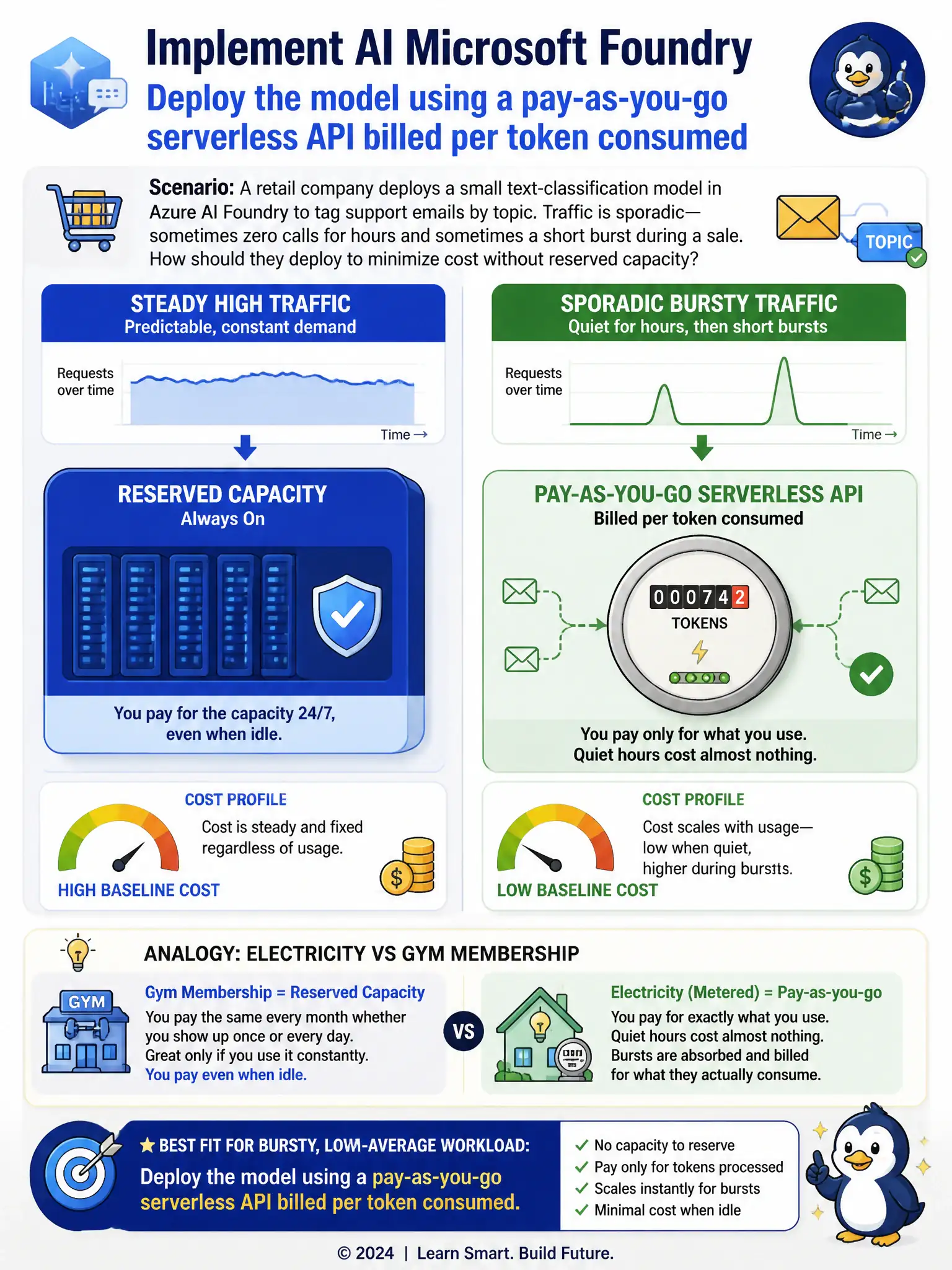
Short Explanation
Think of this like paying for electricity instead of a gym membership. Since your traffic is quiet for hours and then bursts, pay per token so idle time costs almost nothing. Reserving capacity or managing your own cluster just pays for unused baseline capacity.
Full Explanation
The deployment approach that best fits this pattern is the pay-as-you-go serverless API billed per token consumed. It charges only for tokens actually processed, which matches sporadic, unpredictable traffic where the workload sits idle for long stretches and spikes briefly. There is no upfront capacity commitment, so the company pays close to nothing during quiet periods and scales automatically during the sale-day burst. Deploying to a provisioned throughput unit with reserved capacity is incorrect because it reserves fixed capacity that is billed whether or not it is used, which is wasteful for a workload that is mostly idle rather than steady and high-volume. Fine-tuning the model on retail-specific data before deploying it is incorrect because fine-tuning changes what the model has learned, not how it is billed or scaled, and would not address the cost concern raised in the scenario. Deploying to a dedicated Azure Kubernetes Service cluster the team manages is incorrect because standing up and operating that cluster adds infrastructure management overhead and a baseline compute cost that runs regardless of traffic, which is the opposite of what a sporadic workload needs.