
A software company based in Germany is building a Foundry-hosted assistant for a client whose contract requires that all data processed by the AI service, including model inference, remain within the European Union at all times. Which action best satisfies this requirement when setting up the Foundry deployment?
Select an answer to reveal the explanation.
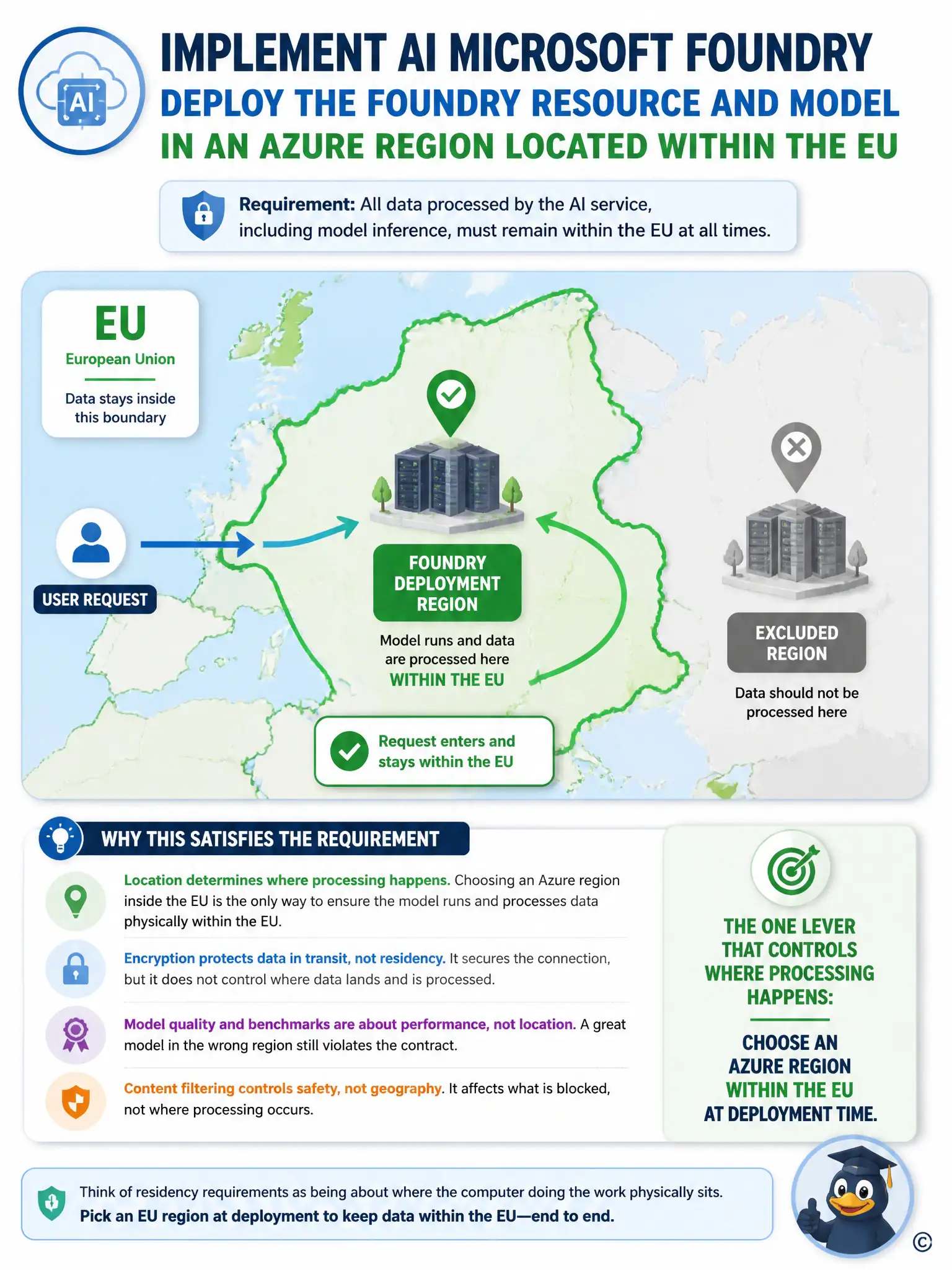
Short Explanation
Think of residency requirements as being about where the computer doing the work physically sits, not about how safe or fast the connection to it is. If a contract says data has to stay inside the EU the whole time, you deploy the Foundry resource and model in an EU Azure region because that’s what determines where the model actually runs and processes the request. Encryption, benchmark scores, and content filtering don’t change where processing happens.
Full Explanation
The correct choice is deploying the Foundry resource and model in an Azure region located within the EU. Data residency is determined by where the Azure resource and its associated model deployment physically run, so creating the Foundry resource in an Azure region located within the EU ensures inference and data processing occur inside the required geographic boundary. The encryption option is incorrect because encrypting data in transit with TLS protects the data from interception while it moves between systems, but it does not control which physical region processes that data; the request could still be encrypted and sent to a non-EU region, violating the contract. The benchmark option is incorrect because benchmark performance is unrelated to geography; picking the top-scoring model says nothing about where that model's deployment is hosted, and a high-performing model in the wrong region still fails the residency requirement. The content-filtering option is incorrect because content filtering severity governs what kind of harmful content is blocked or flagged in requests and responses, a content-safety concern, not a data-location concern, and adjusting it has no effect on where processing happens. Meeting a residency requirement is fundamentally a deployment and infrastructure decision, made by choosing the region for the resource itself, not a setting applied after the fact.