
A team's Foundry-hosted customer support assistant handles conversations that sometimes run to 40 or more back-and-forth turns. Testers notice that in very long conversations, the assistant starts giving generic answers and stops referencing details the customer mentioned near the start of the chat, even though those details are still relevant. What is the most likely cause of this behavior?
Select an answer to reveal the explanation.
Short Explanation
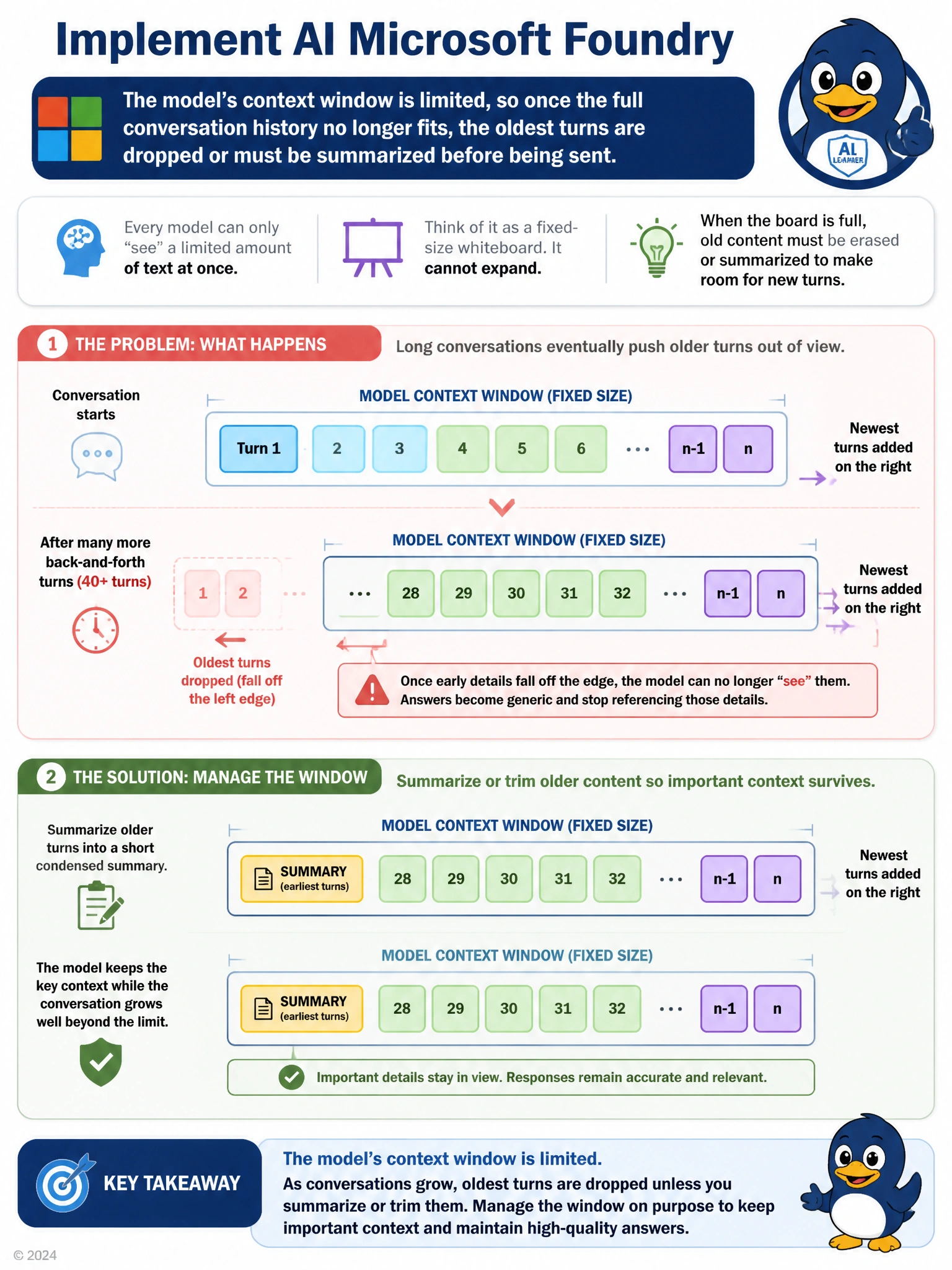
Every model can only 'see' a limited amount of text at once, kind of like a whiteboard of a fixed size. As the conversation keeps growing, new turns get written on, and eventually the oldest lines have to get erased or condensed to make room, because the whiteboard cannot expand. That is exactly what testers are seeing: once the conversation passes a certain length, the earliest details fall off the edge and the assistant can no longer 'see' them, so its answers turn generic. It has nothing to do with a developer setting an arbitrary chat-length rule, and it is not the system message's fault either, since that piece stays put the whole time regardless of how long the chat runs. It is also not a filtering issue quietly deleting sensitive messages. The real fix is to manage that whiteboard on purpose: periodically compress older turns into a short summary, or trim the parts that matter least, so the important context survives even as the conversation keeps growing past what the model can hold in one pass.
Full Explanation
The correct answer is B. Every model has a fixed context window measured in tokens, and once a conversation's full history exceeds that window, the application (or the platform) must drop or summarize earlier turns to fit the remaining ones in, which is why early details stop influencing later answers. Option A is incorrect because nothing in the scenario suggests a developer intentionally capped conversation length; the described symptom, gradual loss of early detail as the chat grows, is the signature of a token-budget limit, not an arbitrary cutoff rule. Option C is incorrect because the system message is a small, separate piece of the prompt that stays present regardless of conversation length; its being static does not explain why turn-specific customer details disappear as the chat grows longer. Option D is incorrect because content filtering evaluates messages for policy violations and blocks or flags them; it does not selectively erase early conversation history based on topic sensitivity, and there is no indication the missing details were sensitive. The fix is to manage context proactively, for example by summarizing older turns into a condensed running summary or trimming least-relevant history, rather than assuming the platform will preserve everything indefinitely.