
A team built a Foundry-hosted assistant that converts free-text customer requests into one of a small set of fixed command codes for a downstream system. Given the same input, the downstream system requires the exact same code every time, with no creative variation between runs. Which adjustment to the model's generation settings addresses this?
Select an answer to reveal the explanation.
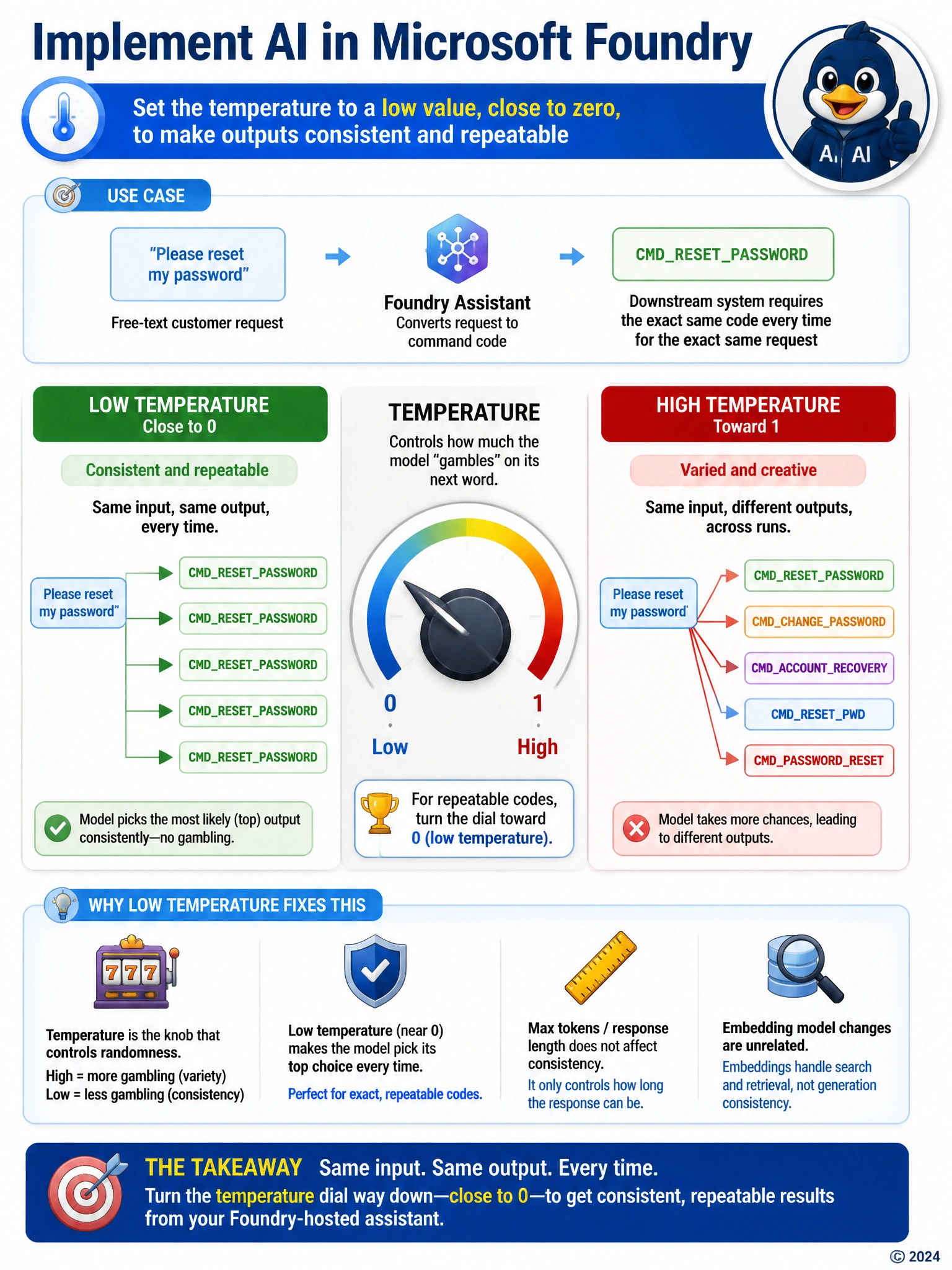
Short Explanation
There is a knob that controls how much the model likes to gamble on its next word instead of just picking the safest, most likely one - that is temperature. Turned up, you get variety, which is great for brainstorming taglines but terrible when a downstream system expects the exact same code back every single time for the exact same request. Turned down toward zero, the model stops taking chances and just picks its top choice consistently, which is exactly the repeatable behavior this use case needs. Cranking randomness up higher only makes the problem worse. Letting responses run longer does not touch consistency at all, since the issue was never about length. And swapping out the embedding model is solving an unrelated problem - that piece handles search and retrieval, not how the generation model decides what word to say next. When the requirement is same input, same output, every time, turning the randomness knob way down is the direct fix.
Full Explanation
The correct answer is A. Temperature controls how much randomness the model introduces when choosing its next output tokens; setting it to a low value near zero makes the model consistently favor its highest-probability output, which produces the same command code for the same input run after run, exactly what the downstream system requires. Option B is incorrect because raising temperature and top_p increases randomness and variety in the output, which moves the assistant away from repeatable behavior and toward the opposite of what a fixed-code use case needs. Option C is incorrect because the max token limit controls how long a response is allowed to be, not how deterministic the model's word choices are; a longer allowed response does nothing to make a short command code consistent between runs. Option D is incorrect because embedding models are used for representing text as vectors for retrieval or search tasks, not for controlling the generation behavior of the chat model producing the command codes, so changing the embedding model has no effect on output determinism. Because this task calls for stable, repeatable, low-variation output rather than creative variety, tuning temperature toward zero is the setting that directly targets the requirement.