
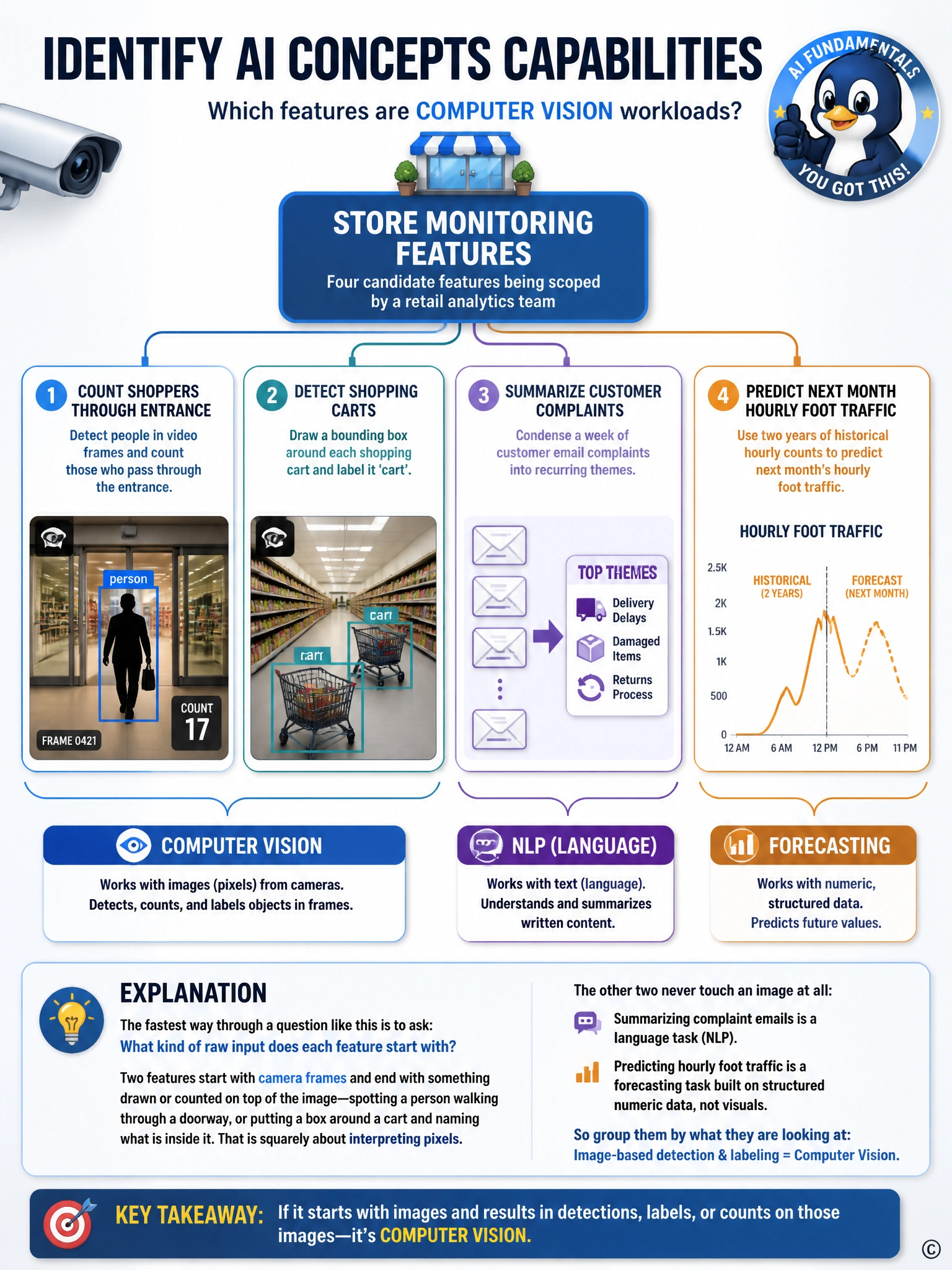
A retail analytics team is scoping four candidate features for a new store-monitoring system: counting how many shoppers pass through the front entrance by detecting people in video frames, drawing a bounding box around each shopping cart in a camera frame and labeling it 'cart', condensing a week of customer email complaints into a short list of recurring themes, and predicting next month's hourly foot traffic from two years of historical hourly counts. (Select TWO.) Which two features are computer vision workloads?
Select all correct answers, then click Submit.
Short Explanation
The fastest way through a question like this is to ask what kind of raw input each feature actually starts with. Two of these features start with camera frames and end with something drawn or counted on top of the image, spotting a person walking through a doorway, or putting a box around a cart and naming what is inside it. That is squarely about interpreting pixels. The other two never touch an image at all: one is chewing through written complaint emails to find common threads, which is a language task, and the other is looking at a long column of past hourly numbers to guess a future number, which is a forecasting task built on structured data, not visuals. So group them by what they are looking at, image-based detection and labeling goes together, and text summarization and numeric prediction each belong to their own separate categories.
Full Explanation
The correct answers are B and C. Detecting people in a video frame to count entrances, and drawing a bounding box around each cart and labeling it, both involve locating and identifying objects within images, which is the core of a computer vision workload. Option D is incorrect because condensing a body of written complaints into recurring themes is a natural language processing task, since it operates on text rather than pixels. Option A is incorrect because predicting a future numeric value, hourly foot traffic, from a historical time series is a forecasting task built on structured, sequential data rather than image input. The distinguishing factor across all four features is the type of data being processed and the kind of insight being produced: the two correct options both take raw video frames and locate or classify visual elements within them, while the two incorrect options work on text and time-series numbers respectively, placing them in different AI workload categories entirely.