
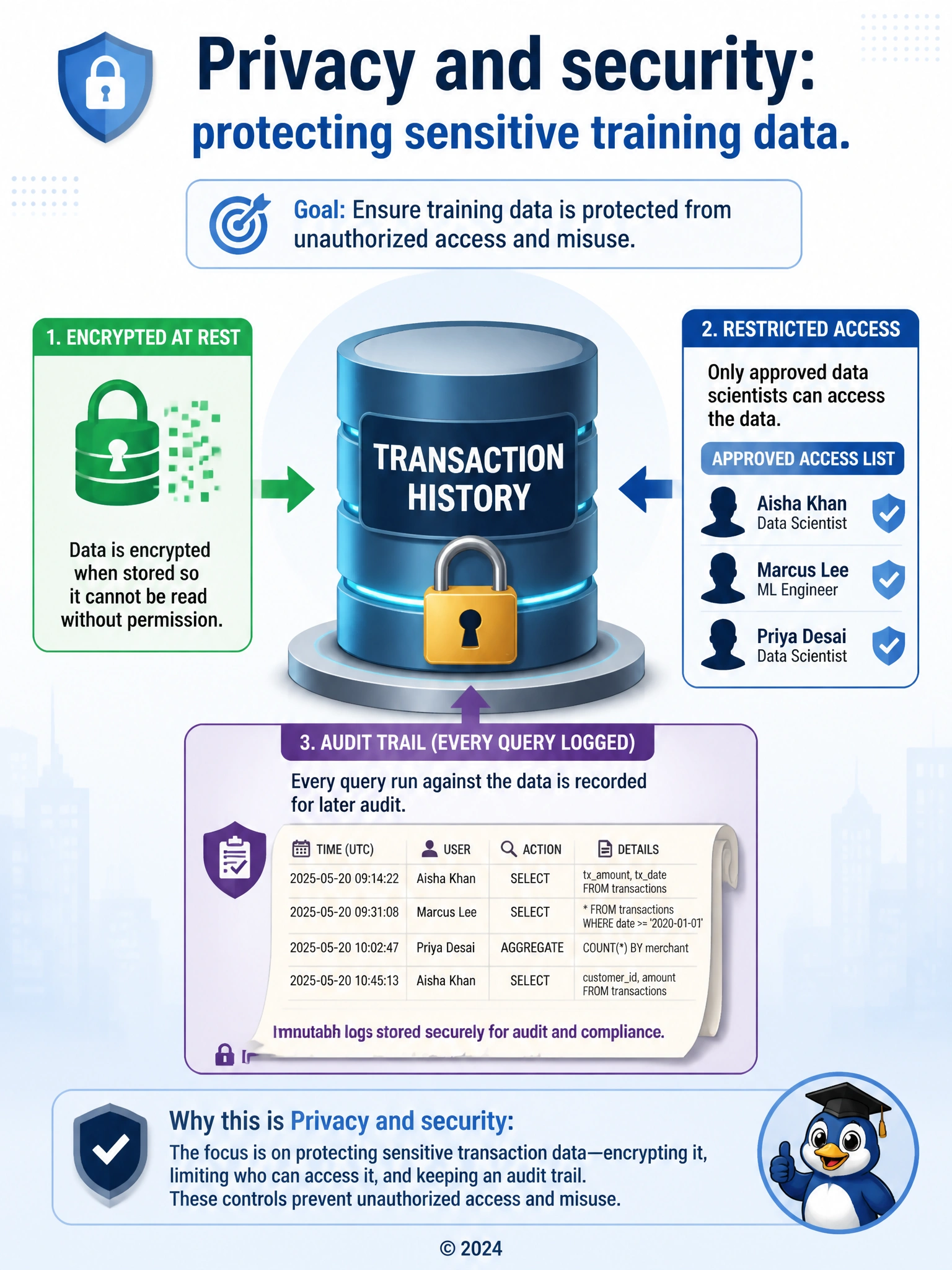
A regional bank's fraud detection team trains a model on years of customer transaction history. Before any engineer can query the training data, the security team requires the data set to be encrypted at rest, restricts access to a named list of approved data scientists, and logs every query run against the data for later audit. Which Responsible AI principle is the security team primarily enforcing?
Select an answer to reveal the explanation.
Short Explanation
Look at what the security team is actually locking down: the data itself, who can touch it, and a paper trail of every time someone does. Encryption at rest, a short named list of approved people, and an audit log are all classic data-protection controls, not something about explaining decisions to customers or about who is accountable when the model misbehaves. Those are real concerns too, but they show up as different features: a plain-language explanation of a denied transaction would be about openness, and a named committee that owns the model's outcomes would be about answerability. Here, nothing is being explained and no oversight body is mentioned, the entire scenario is about restricting and tracking access to sensitive transaction records. That laser focus on protecting the data from unauthorized eyes is what points to this particular responsible AI principle.
Full Explanation
The correct answer is C. Encrypting the transaction data at rest, limiting who can query it, and logging every access for audit are all controls aimed at keeping sensitive customer financial data safe from unauthorized access and misuse, which is the definition of the privacy and security principle. Option A is incorrect because transparency is about disclosing how the fraud model reaches its decisions to the people affected by them, not about controlling who can access the underlying data set. Option B is incorrect because accountability concerns having identifiable people or a governance body answerable for the model's behavior and outcomes, whereas the measures described here are technical access controls over data, not an oversight structure. Option D is incorrect because reliability and safety addresses the model performing consistently and predictably in production, which is a separate concern from protecting the data used to train it. The scenario describes encryption, restricted access, and audit logging, all of which map directly to safeguarding sensitive information rather than any of the other three principles.