
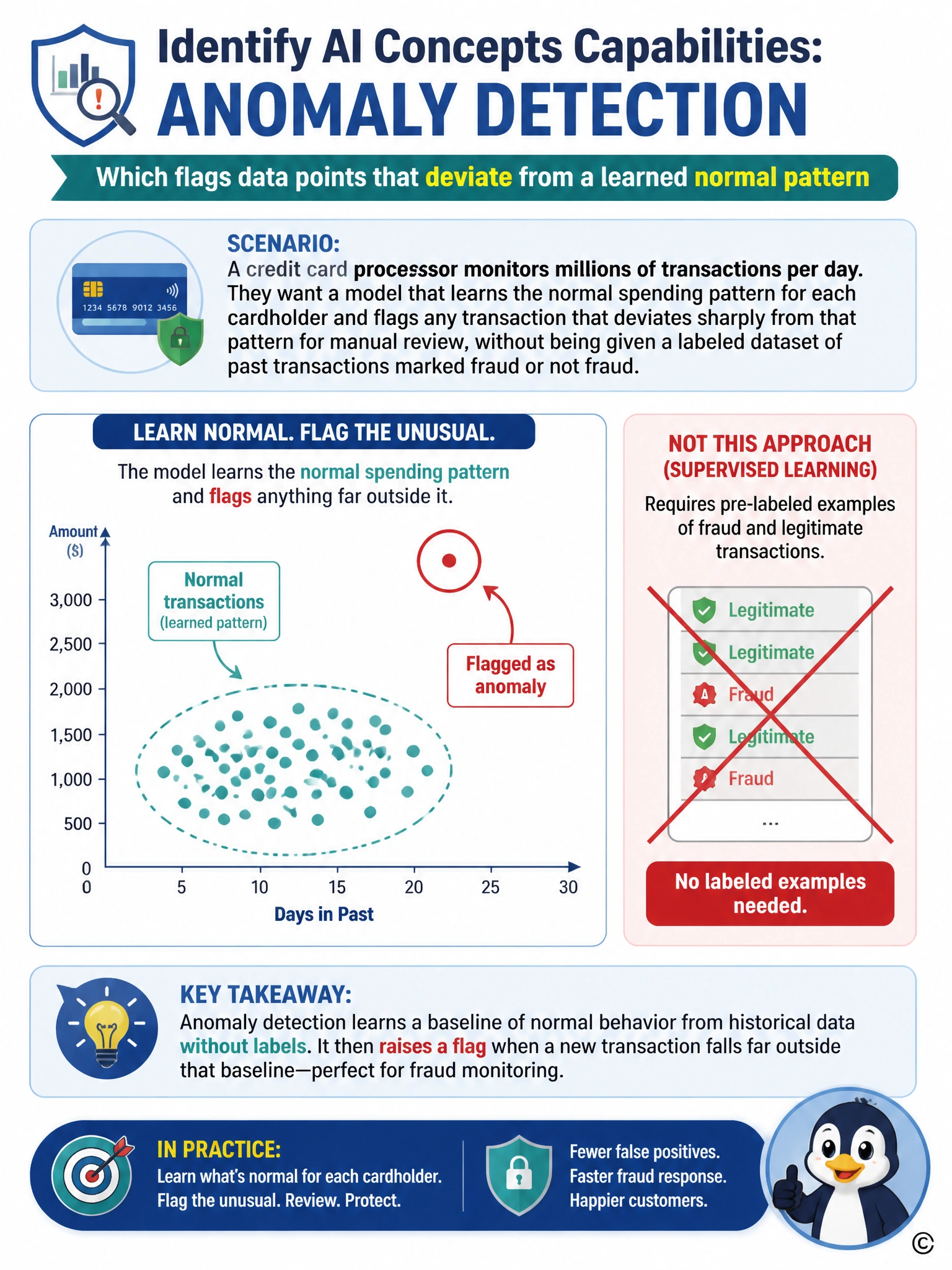
A credit card processor monitors millions of transactions per day and wants a model that learns the normal spending pattern for each cardholder and flags any transaction that deviates sharply from that pattern for manual review, without being given a labeled dataset of past transactions marked fraud or not fraud. Which AI capability fits this requirement?
Select an answer to reveal the explanation.
Short Explanation
Notice the key constraint buried in the scenario: there is no stockpile of transactions already marked as fraud or legitimate to learn from. That single detail rules out an approach that needs labeled examples of the exact thing you're trying to catch, because you simply don't have any. What you do have is a history of normal behavior for each cardholder, and the goal is to catch anything that breaks sharply from that pattern. That's a fundamentally different task from sorting transactions into predefined buckets, from grouping similar-looking transactions together, or from estimating a numeric value like a likely purchase size. The approach that fits is one built to learn a baseline of normal and then raise a flag whenever something falls far outside it, which is exactly the shape of the fraud-monitoring problem described here.
Full Explanation
The correct answer is C. Anomaly detection learns what a cardholder's normal transaction pattern looks like and then measures how far each new transaction departs from that baseline, flagging outliers for review, which matches the processor's requirement to work without a labeled fraud dataset. Option A is incorrect because classification requires a training set of transactions already labeled fraud or not fraud, which the processor explicitly does not have; without those labels a classifier cannot be trained to draw that boundary. Option B is incorrect because clustering groups similar transactions into segments, which is useful for discovering natural groupings like spending categories, but it does not, on its own, flag any particular transaction as unusual relative to an individual's history. Option D is incorrect because regression predicts a continuous number, such as an expected purchase amount, but producing a predicted amount is not the same as deciding whether an actual transaction is suspicious. Anomaly detection is the capability purpose-built for spotting deviations from an established baseline without prior fraud labels.