
A company deploys a generative AI chatbot on its public website to answer visitor questions. Before any chatbot response is shown to a visitor, the company wants an automated check that screens the generated text for hate speech, violence, and self-harm content and blocks or flags anything that crosses a defined severity threshold. Which capability satisfies this requirement?
Select an answer to reveal the explanation.
Short Explanation
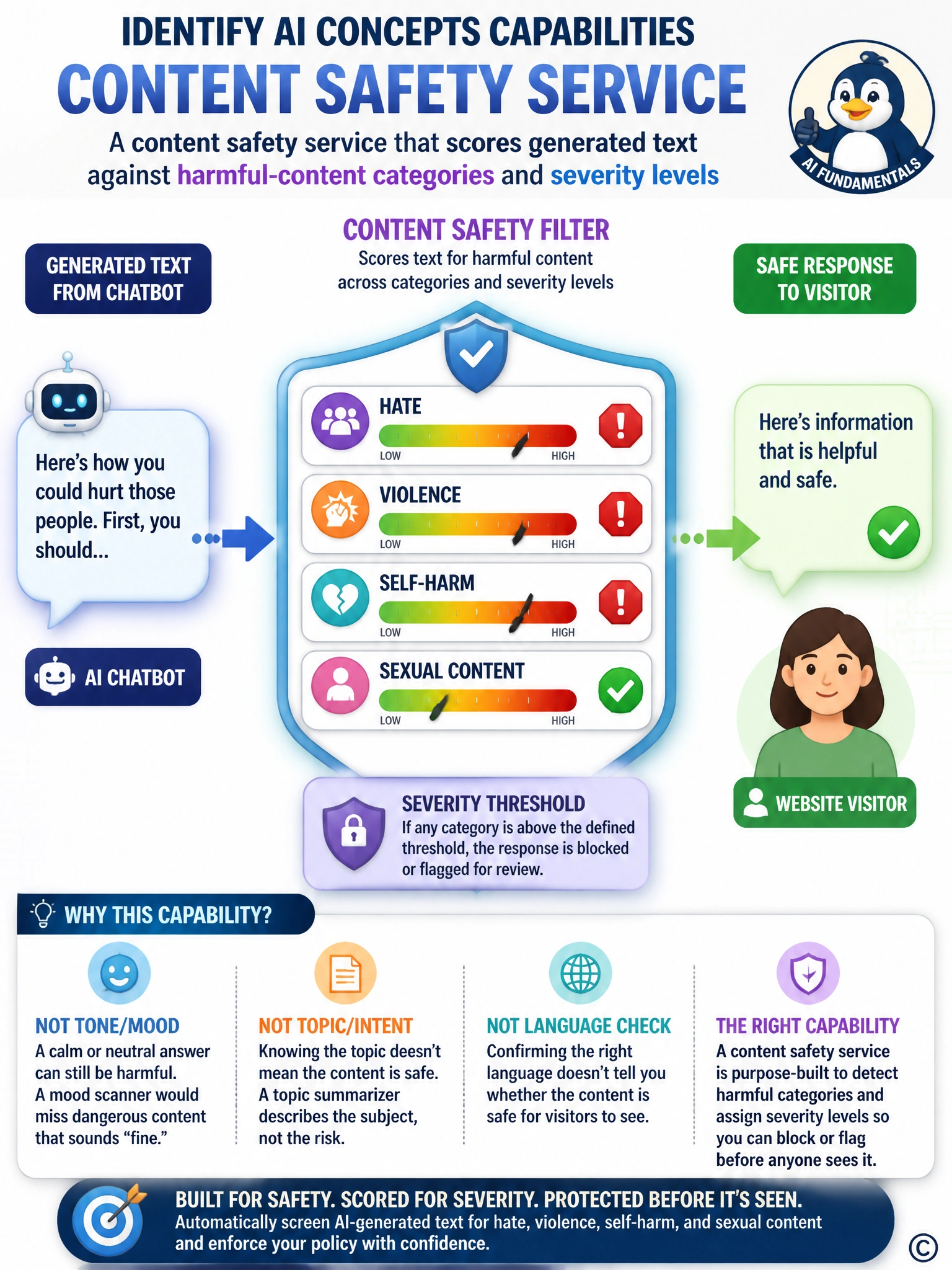
The company isn't asking whether the chatbot's answer sounds upbeat or gloomy, and it isn't asking what topics the answer covers. It's asking a narrower, more serious question: could this specific piece of generated text be genuinely harmful, hateful, violent, or self-harm related, and if so, how severely? That's a distinct check from tone or topic. A perfectly calm, neutral-sounding sentence can still describe something dangerous, so a mood scanner would wave it through. A topic summarizer would just tell you the subject matter without judging risk. And confirming the reply is in the right language says nothing about whether the reply is safe to show anyone. What the company needs is a filter purpose-built to catch harmful categories of content and assign them a severity level, so it can automatically block or flag a response before a visitor ever sees it.
Full Explanation
The correct answer is B. A content safety service is built specifically to inspect a passage of text, including AI-generated text, against categories such as hate, violence, self-harm, and sexual content, and return a severity score the company can use to block or flag output before it reaches a visitor. Option A is incorrect because key phrase extraction only identifies the main topics discussed in a response; it has no mechanism for judging whether the content is harmful, so a hateful message and a benign one could share the same extracted phrases. Option C is incorrect because sentiment analysis measures whether text reads as positive or negative in tone, which is a different axis than harmfulness; a coldly clinical description of self-harm could score as neutral in sentiment while still being unsafe to display. Option D is incorrect because language detection only confirms which language the text is written in and has nothing to do with the content's safety. Screening generated output for harmful categories before display is precisely the job content safety filtering was designed for.