
A team has drafted two different system message variants for a Foundry-hosted support assistant and wants to decide which one to ship, backed by evidence rather than opinion. What should they do before choosing?
Select an answer to reveal the explanation.
Short Explanation
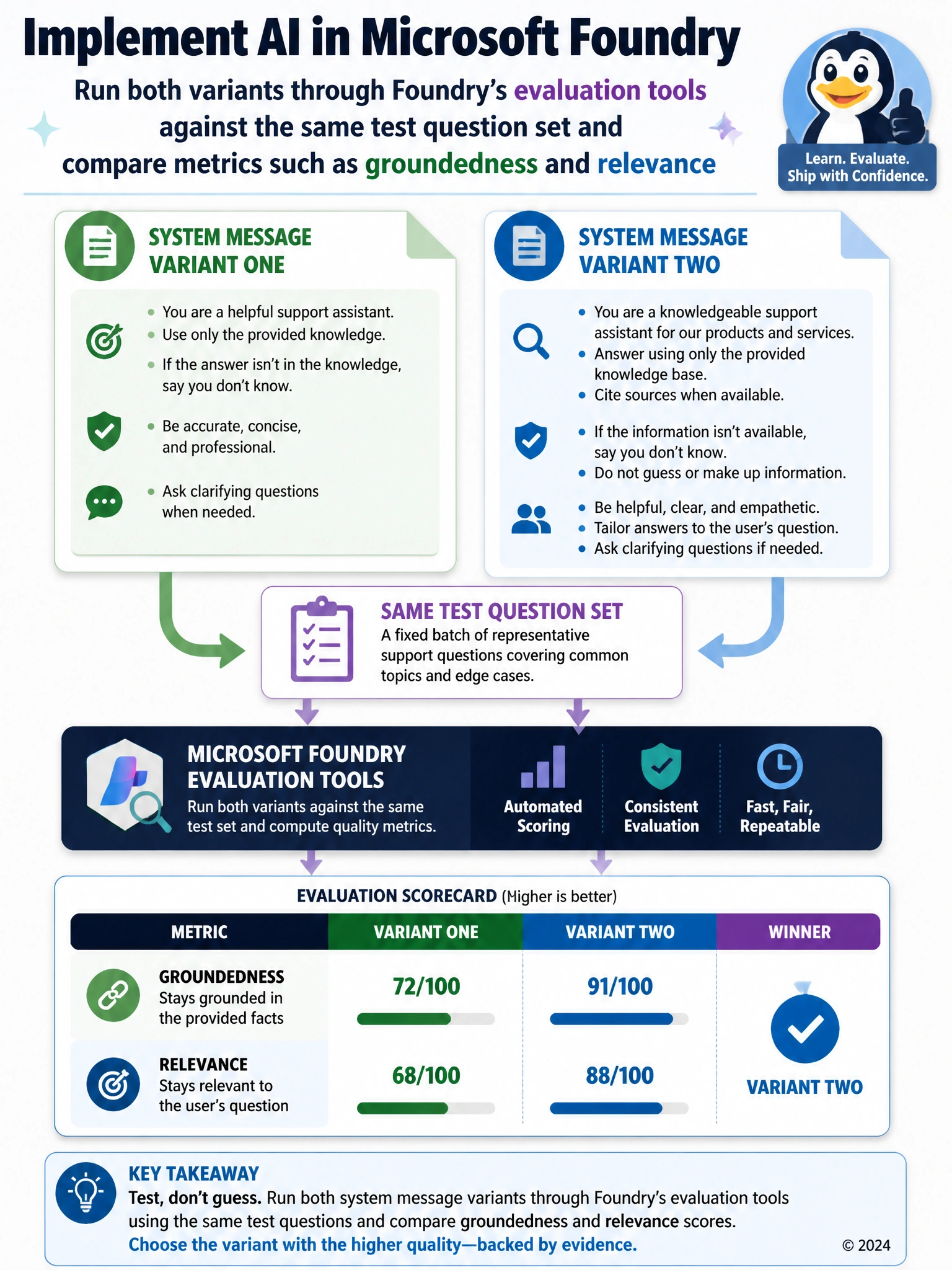
When two people have each written a different set of instructions for the assistant and nobody can agree which is better, the fix is not to guess, it is to actually test them, running the same batch of questions through both and comparing how each one scores on things like staying grounded in the facts and staying relevant to what was asked. Just releasing both versions to everyone and watching for angry messages is not really a fair test, since it is slow, messy, and does not isolate which prompt caused which reaction. Picking the one written by whoever has been at the company longest tells you nothing about the actual quality of the writing. And assuming the shorter version must be better just because it is shorter ignores that the important instructions might be the ones that got left out.
Full Explanation
The correct answer is B. Running both system message variants through Foundry's evaluation tools against the same set of test questions produces comparable metrics such as groundedness and relevance, giving the team objective evidence about which variant actually performs better before either one reaches real users. Option A is incorrect because shipping both variants to everyone at once and watching for complaints exposes every user to whichever variant they happen to get with no controlled comparison, and complaint volume is a noisy, delayed signal rather than a direct quality measurement. Option C is incorrect because choosing based on the author's seniority says nothing about how well the prompt actually performs; a more experienced engineer can still write a weaker system message than a less experienced one. Option D is incorrect because prompt length by itself does not determine quality; a shorter system message can omit necessary grounding instructions just as easily as a longer one can include useful detail, so length is not a reliable stand-in for measured performance.